
Zui-Ki-Tei facts for kids


Zui-Ki-Tei (瑞暉 亭) is a special Japanese tea house in Stockholm, Sweden. Its name means "The House of the Promising Light" or "Home of the Auspicious Light." You can find it in the park outside the Museum of Ethnography.
This tea house was first built in Japan. Then, it was carefully taken apart, shipped to Sweden, and put back together in the park in 1990. It's a public building, which means anyone can visit the park and see the house from the outside, even though it's officially closed during winter.
Zui-Ki-Tei is actually the second tea house of its kind for the Museum of Ethnography. The first one, also named Zui-Ki-Tei, was built in 1935 but sadly burned down in 1969.
Contents
What is Zui-Ki-Tei?
Design and Rooms
Zui-Ki-Tei was designed by a famous architect named Masao Nakamura. He thought about the beautiful park, the museum's plans, and the history of the first tea house when he designed it. A master builder named Hayashi Seibai helped construct it.
The house has two main tea rooms where tea ceremonies happen. It also has a special area for preparing tea, a room for the host to enter, and a storage room. The two tea rooms are different sizes:
- The small tea room (called koma) is cozy and fits about three and three-quarter tatami mats. Tatami are traditional Japanese floor mats.
- The large tea room (called hiroma) is bigger and fits six tatami mats.
These rooms are also built in different Japanese architectural styles, making them unique.
The Tea Garden
Around Zui-Ki-Tei, there's a special Japanese garden called a roji. This garden is split into two parts: an inner garden and an outer garden. The inner garden has many traditional features:
- A waiting bench (koshikake) for guests.
- Two stone washbasins (tsukubai) where people can purify themselves.
- A stone lantern (tōrō) for light.
- Stepping stones (tobi ishi) to guide visitors.
A bamboo fence and gate separate the two parts of the garden.
History of Zui-Ki-Tei
The First Tea House (1935-1969)

The idea for a Japanese tea house in Sweden came from a Swedish artist named Ida Trotzig in the early 1930s. She shared her idea with the Museum of Ethnography. The museum director, Gerhard Lindblom, contacted a Japanese group to see how they could get a traditional tea house.
At first, they thought about getting a used tea house. But then, a Japanese businessman and politician named Ginjirō Fujiwara became very interested in the project. He loved the tea ceremony and Sweden. So, he decided to donate a new tea house along with a company called James Lundgren & Co.
The first Zui-Ki-Tei was built in Tokyo. It was designed by a tea master named Tsuge Sõkei. On March 20, 1935, a special ceremony was held in Tokyo. Prince Chichibu, who was the emperor's brother, inspected the building. He gave it the name Zui-Ki-Tei.
The name has a special meaning:
- Zui means "bringing promise" and also represents Sweden.
- Ki means "radiant light" and symbolizes Japan, the "Land of the Rising Sun."
- Tei means "hut" or "small house."
So, the name "The House of the Promising Light" also shows the friendship between Japan and Sweden.
After the ceremony, the tea house was taken apart and shipped to Sweden. It was put back together and officially opened on October 8, 1935. Sweden's crown prince, who later became King Gustav VI Adolf, was there for the opening.
The Fire and Rebuilding
Sadly, on October 1, 1969, the first Zui-Ki-Tei burned down. No one knows for sure what caused the fire, but it might have been an arsonist. Even though a museum employee quickly discovered the fire, it was too late to save the building. Only the outer shell remained, which was later removed.
However, some parts of the old tea house survived! The old waiting bench (koshikake) from 1935 is still in the park behind the museum. Some of the old stone washbasins (tsukubai) and stepping stones (tobi ishi) are also still there. Other items, like the stone lanterns (tōrōs), are kept safe in the museum's storage.
After the fire, the museum wanted to build a new tea house, but it took many years. In the 1980s, a group was formed to make this happen. It included Ida Trotzig's granddaughters and a special person named Taro Gadelius. Taro Gadelius had worked with the first tea house project. He suggested that some Japanese paper companies, where Ginjirō Fujiwara used to be president, might help.
In March 1989, Taro Gadelius announced that several Japanese companies had decided to donate a new tea house! Other companies would pay for shipping and building the garden. Professor Masao Nakamura was chosen to design the new Zui-Ki-Tei. The Japanese donors said the new tea house was a sign of friendship between Japan and Sweden and a tribute to Mr. Fujiwara.
Just like the first one, the new tea house was built in Japan first. A ceremony was held on November 4, 1989, with Japanese royalty like Prince Hitachi and princess Hitachi, and princess Chichibu. Then, it was shipped to Sweden and officially opened again on May 28, 1990, with Princess Christina of Sweden attending.
How Zui-Ki-Tei is Used Today
You can visit Zui-Ki-Tei in person all year round, but the inside is officially closed during winter. In the summer, the museum often holds public and private tea ceremony demonstrations in the large tea room (hiroma). A group called "Chado Urasenke Tankokai Sweden Association" helps with these events. They also offer guided tours of the tea house during this time.
You can also explore Zui-Ki-Tei online anytime using Google Arts and Culture.
There's a special tea ceremony event held every year on the last Sunday of August. It's called Gadelius Day, and it remembers Ida Trotzig, Ginjirō Fujiwara, and Taro Gadelius for their important roles in bringing the tea house to Sweden. This event is usually private.
Impact of Zui-Ki-Tei
The new Zui-Ki-Tei, built in 1990, led to the creation of the "Chado Urasenke Tankokai Sweden Association." This group, led by tea master Eiko Duke Soei, aims to share the Japanese tea ceremony with people in Sweden. They do this by offering lectures, courses, and demonstrations.
Images for kids
-
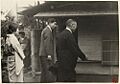
Ginjirō Fujiwara, Prince Chichibu and Princess Chichibu during the inauguration of Zui-Ki-Tei in Tokyo, March 20, 1935.
-
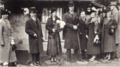
Inauguration of Zui-Ki-Tei in Sweden, October 8, 1935. From the left: Ida Trotzig, the Japanese minister Shiratori, crown princess and later queen Louise, crown prince and later king Gustav VI Adolf, Douglas Lundgren, consul Lundgren and Mrs Lundgren.
-
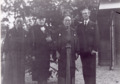
Stockholm 1939. From the left: Fukukita Yasunosuke, Ida Trotzig, Ginjirō Fujiwara and Gerhard Lindblom. Parts of Zui-Ki-Tei can be seen in the background, to the right.
-
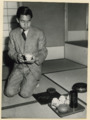
Crown prince of Japan, later Emperor Emeritus, drinking tea in Zui-Ki-Tei August 18, 1953. The photo was taken in the waiting hall (machiai) of the old Zui-Ki-Tei
-
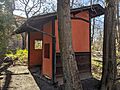
The old waiting arbor (koshikake) from 1935 that survived the fire in 1969. It can still be viewed in the park behind the Museum of Ethnography, Stockholm.
-

Zui-Ki-Tei, photo probably taken in 1995.
-
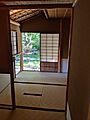
Zui-Ki-Tei 2019. View of the koma. The nijiriguchi and shoji doors are open, showing the roji and tōrō. The tokonoma is not visible.
-
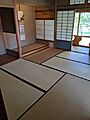
Zui-Ki-Tei 2019 interior. View of the hiroma, tokonoma included. A corridor (engawa) clad in tatami surround the hiroma.


