
Advent calendar facts for kids
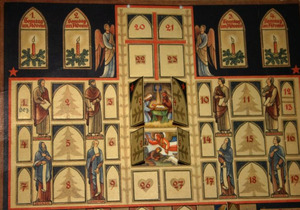
An Advent calendar is a special calendar used to count down the days until Christmas. The word comes from the German Adventskalender. It helps people celebrate the season of Advent, which is the time leading up to Christmas.
Many Advent calendars start on December 1st. However, some begin on the First Sunday of Advent, which can be any day between November 27th and December 3rd. This tradition began with German Lutherans in the 1800s and 1900s. Over time, it became popular with many other Christian groups around the world.
Contents
What is an Advent Calendar Like?
.jpg)
Advent calendars come in many fun designs. Some show classic scenes like the manger scene or Saint Nicholas. Others might feature sports, technology, or other exciting themes. You can find them as simple paper cards with small flaps. There are also fabric calendars with pockets or wooden boxes with tiny drawers for gifts.
Most Advent calendars are large cards with small "doors" or "windows." There is one door for each day in December, usually leading up to Christmas Eve (December 24th) or Christmas Day (December 25th). You open one door each day, starting on December 1st or the First Sunday of Advent.
Behind each door, you might find a picture, a short poem, or a part of a story, like the Christmas story. Many calendars also hide a small treat, such as a toy or a piece of chocolate. Some calendars even have a Bible verse or a Christian prayer to read each day.
Some towns in Europe have very special Advent calendars. They decorate windows on buildings, turning them into a huge "living" Advent calendar. A new window is lit up or revealed each day!
A Look Back: The History of Advent Calendars
Early Beginnings
The idea for Advent calendars started in Germany in the 1800s. Families would often make chalk marks on a door or light candles to count down the days to Christmas. Later, people started hanging up religious pictures, one for each day.
Becoming Popular Worldwide
After World War II, Advent calendars became very popular again. A German publisher named Richard Sellmer played a big part in this. In 1945, he got permission to print these calendars. He quickly started selling them internationally, even designing some in English and Swedish.
A big moment happened in 1953. The magazine Newsweek showed a picture of President Eisenhower's grandson with an Advent calendar. This made demand for them skyrocket, especially in the United States. Sellmer even created special calendars for the US market, like one showing the White House!
Between 1946 and 1998, Sellmer's company made over 230 different Advent calendars. Around 2010, they offered about 100 different designs each year. These calendars often showed different traditions from around the world. For example, calendars for Switzerland might not include Saint Nicholas.
Different Designs and Traditions
Over time, the calendars with small doors became the most common. A Protestant priest is thought to have created the idea of hiding biblical pictures behind 24 doors. This 24-door design, starting on December 1st, became widely accepted after 1945.
Some special calendars, like The Secret of Christmas by Paula Jordan, even counted days until January 6th. This holiday celebrates the arrival of the Three Kings. Since 2017, an organization called Andere Zeiten has offered a children's Advent calendar that also goes until January 6th. It includes stories, experiments, and games.
In the 1950s, Advent calendars became very affordable and popular. Many designs showed charming, snow-covered towns. The largest door, usually for December 24th, often revealed a beautiful nativity scene.
Advent Calendars on TV! (The Nordic Tradition)
In countries like Denmark, Finland, Iceland, Norway, and Sweden, there's a special tradition. They have a Julekalender (which means "Christmas calendar") as a TV or radio show! These shows start on December 1st and end on Christmas Eve, December 24th.
The very first radio show of this kind aired in Sweden in 1957. The first TV version also came from Sweden in 1960. Denmark started its own julekalender in 1962. Now, this fun tradition has spread to all the other Nordic countries.
Some of these shows are made just for kids, while others are for the whole family to enjoy. There are even some for adults! A classic example that many children and adults in Norway love is the 1979 TV show Jul i Skomakergata.
Image gallery
-
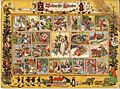
Advent calendar from Im Lande des Christkinds. The doors contain Christmas poems. Images, from a cut-out sheet, were pasted over them.
-
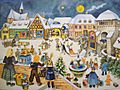
A 1946 Advent calendar by Marianne Schneegans
-
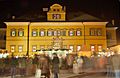
The 24 windows of the front of Hellbrunn Palace in Salzburg, Austria, used as an Advent calendar during the town's Christmas market
-
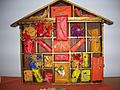
A home-made Advent calendar featuring presents
-
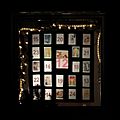
An Advent calendar consisting of images that have dates on the inverse side
-
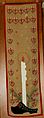
A Norwegian Advent calendar
-
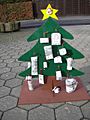
A home-made Advent calendar made from wood in the shape of a Christmas tree
-
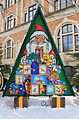
Advent Calendar at the City Hall in Stollberg, Saxony
-
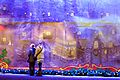
Two girls try to open the first door of an Advent calendar at the Kaiser Wilhelm Memorial Church in Berlin.
-
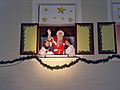
"Living" Advent calendar
-
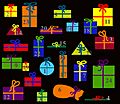
Advent calendar with presents as flaps, randomly arranged
-
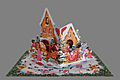
Stand-up Advent calendar by Carlsen Verlag, 1959
-
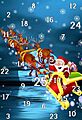
An Advent calendar featuring Santa Claus riding his sleigh


.jpg)


.jpg)


See also
 In Spanish: Calendario de Adviento para niños
- Advent candle
- Advent daily devotional
- Advent wreath
- Christingle
- Lenten calendar
