
Epiphany (holiday) facts for kids
Quick facts for kids Epiphany |
|
|---|---|

The Adoration of the Magi by Edward Burne-Jones (1894)
|
|
| Also called | Baptism of Jesus, Three Kings Day, Denha, Little Christmas, Theophany, Timkat, Reyes, Uphalimass, Eid al-Ghitas, Eid al-Qiddas |
| Observed by | Christians, Alawites |
| Type | Church service, winter swimming, chalking the door, house blessings, star singing |
| Significance |
|
| Date |
|
| Frequency | Annual |
| Related to |
|
Epiphany (pronounced ə-PIF-ə-nee) is a special Christian holiday. It celebrates several important moments when Jesus was "revealed" to the world. In many places, it's also known as Three Kings' Day.
This holiday remembers the Wise Men's visit to baby Jesus. It also celebrates Jesus' baptism and his first miracle at the Wedding at Cana.
Western Christians mainly focus on the Wise Men's visit. This shows Jesus's first appearance to people who were not Jewish. Eastern Christians, however, mostly celebrate Jesus's baptism in the Jordan River. They see this as Jesus being revealed as the Son of God.
The traditional date for Epiphany is January 6. Some churches that follow the Julian calendar observe it on January 19. This is because of the difference between the Julian and Gregorian calendars. Many people take down their Christmas decorations on January 5, the night before Epiphany.
Contents
What Does "Epiphany" Mean?
The word Epiphany comes from an old Greek word, epipháneia. This word means "manifestation" or "appearance." It's like when something important is shown or revealed.
In ancient times, this word was used for things like the sunrise or when a god appeared to people. In the Bible, it describes God showing himself to people.
Other names for this holiday in Greek mean "Theophany" (God shining forth) or "The Day of the Lights." In Egypt, it's called Eid al-Ghitas.
A Look Back: The History of Epiphany
How the Celebration Began
Epiphany likely started in the eastern part of the Roman Empire. It was a day to honor Jesus's baptism. Around the year 200, a writer named Clement of Alexandria mentioned people celebrating Jesus's baptism on January 6 or 10.
At first, some Christians celebrated Jesus's birth and baptism on the same day. This was because they believed Jesus was 30 years old when he was baptized. Over time, the celebration grew to include other events from Jesus's early life. These included the Wise Men's visit and the miracle at the wedding in Cana.
.jpg)


In the Western Church, the celebration of Jesus's birth (Christmas) moved to December 25. Epiphany on January 6 then focused more on the Wise Men's visit. This event showed Jesus to the wider world, not just the Jewish people.
Epiphany Traditions Around the World
Epiphany is celebrated in many different ways by Christians everywhere. While Western churches often focus on the Wise Men, Eastern churches highlight Jesus's baptism. But the main idea is always the same: Jesus being revealed to the world.
Catholic Church Customs

In the Catholic Church, Epiphany is observed on January 6 or the Sunday between January 2 and 8. Many places in the United States celebrate it on the Sunday.
A special custom in some parts of Europe is the blessing of Epiphany water, frankincense, gold, and chalk. Priests use the chalk to write the initials of the three Wise Men (Caspar, Melchior, and Balthasar) above church and home doors. These letters can also mean "Christ bless this house" in Latin.
Protestant Church Celebrations
Many Protestant churches, like Lutheran, Anglican, and Methodist congregations, celebrate Epiphany. They might observe it on January 6 or the following Sunday.
For many, Epiphany marks the end of the Twelve Days of Christmas. Some traditions, like in the Church of England, see the Christmas season lasting until February 2, which is Candlemas.
Eastern Orthodox Church Traditions
.jpg)


Eastern churches call Epiphany "Theophany," meaning "God shining forth." It's one of their most important holidays. They celebrate it on January 6 (or January 19 for churches using the Julian calendar).
The main focus is on Jesus's baptism in the Jordan River. This event is seen as a moment when all three parts of the Trinity (God the Father, God the Son, and God the Holy Spirit) were revealed.
Blessing of Waters
A very important tradition is the Great Blessing of Waters. This often happens twice: once inside the church on the eve of the feast, and again on Epiphany day at a nearby body of water like a river or lake.
During the outdoor ceremony, a priest throws a cross into the water. People, often young men, then dive into the cold water to retrieve it. The person who finds the cross is believed to receive good luck and blessings for the year.
The blessed water, called "Theophany Water" or "holy water," is taken home by families. They use it to bless themselves, their homes, and sometimes even drink it.
House Blessings
Priests also visit homes to bless them with the newly blessed Theophany Water. They perform a short prayer service and sprinkle holy water throughout the house. This is believed to bring protection and blessings.
Oriental Orthodox Celebrations

In the Ethiopian Orthodox Church, Epiphany is called Timkat. It's celebrated on January 19 (or January 20 in some years). This festival involves blessing water and solemn processions with sacred items. People are sprinkled with or go into the blessed water.
Among Syriac Christians, the feast is called denho, meaning "up-going" or "rising light." In the Armenian Apostolic Church, January 6 celebrates both the Nativity (birth) and Theophany (revelation) of Christ.
Music for Epiphany
Classical Music
Many famous composers have written music for Epiphany. Johann Sebastian Bach composed two cantatas for this feast. These were often performed during church services.
Part VI of his Christmas Oratorio was also meant for Epiphany. Felix Mendelssohn's oratorio Christus includes parts about the Wise Men.
Carols and Hymns
Two well-known Christmas carols are connected to Epiphany. "As with gladness, men of old" was written in 1860. "We Three Kings of Orient Are" was created for a holiday pageant in 1857.
Another popular hymn is "Songs of thankfulness and praise." These songs help people celebrate the meaning of Epiphany.
National and Local Customs
Epiphany is celebrated with many different customs around the world. In some places, Christmas decorations are taken down on Epiphany. In others, they stay up until February 2.
Argentina, Paraguay, and Uruguay
In these countries, Epiphany is called "Día de Reyes" (The Day of Kings). Children leave their shoes by the door on the night of January 5. They also leave grass and water for the Wise Men's camels. In the morning, they find gifts left by the "Reyes." A special ring-shaped cake, "Rosca de Reyes," is eaten.
Bulgaria

In Bulgaria, Epiphany is called Bogoyavlenie ("Manifestation of God") or Yordanovden ("Day of Jordan"). A priest throws a wooden cross into the water. Young men race to retrieve it. Finding the cross is considered an honor and brings good health. In Kalofer, a traditional dance is performed in the icy Tundzha river before the cross is thrown.
Benelux and German-speaking Europe


In Belgium, Luxembourg, parts of the Netherlands, and Germany, children dress as the Wise Men. They go from house to house singing songs and collecting donations for good causes. They also perform a house blessing by marking the year and "K+M+B" (for the Wise Men's names or "Christ bless this house") above doorways with chalk. A "Three Kings cake" is often eaten, with a hidden bean or trinket. Whoever finds it becomes king or queen for the day.
England
The night before Epiphany, January 5, is known as Twelfth Night. This was a traditional time for plays and celebrations. The Yule log was kept burning until this day. A traditional dish was Twelfth Cake, a rich fruitcake. Finding a hidden item in the cake would crown someone king or queen for the day.
Ethiopia and Eritrea

In the Ethiopian Orthodox Church and Eritrean Orthodox Church, Epiphany is called Timkat. It is celebrated on January 19 (or January 20 in some years). This feast includes blessing water and solemn processions with sacred items.
Francophone Europe
In France and Belgium, people share a "galette des Rois" (king cake). This is a round, flat cake often filled with almond paste. In the south, a crown-shaped brioche called "gâteau des Rois" is eaten. Both cakes hide a small charm. The youngest person cuts the cake, and whoever finds the charm becomes "king" or "queen" and wears a paper crown.
Greece and Cyprus

In Greece and Cyprus, the feast is called Theophany or Phōta ("Lights"). Customs revolve around the Great Blessing of Waters. A cross is thrown into the water, and men compete to retrieve it for good luck. This tradition is believed to cleanse the seas and protect against mischief. Priests also visit homes to sprinkle them with holy water.
Italy


In Italian folklore, the Befana is an old woman who delivers gifts to children on Epiphany Eve (January 5). She is like Santa Claus or the Wise Men. Legend says she missed her chance to bring a gift to baby Jesus. Now, she brings gifts to other children. She is often shown riding a broomstick and entering homes through the chimney. She brings sweets to good children and "coal" (black sugar candy) to those who misbehaved.
Poland
.jpg)
In Poland, Epiphany, or Trzech Króli (Three Kings), is celebrated with large parades. People dress as the Wise Men, and carols are sung. Children might dress in colors representing Europe, Asia, and Africa. Families take chalk, a gold ring, incense, and amber to church to be blessed. They then write "K+M+B+" and the year above their doors for protection. A Three Kings cake with a hidden coin or almond is also served.
Russia

In Russia, Epiphany is celebrated on January 19 (January 6 in the Julian calendar). It marks Jesus's baptism. The Russian Orthodox Church performs the Great Blessing of Waters. Traditionally, people go to a nearby lake or river. Holes are cut in the ice, often shaped like a cross, for the blessing.
Many Russians believe that on this day, water becomes holy. Some people even bathe in the freezing water, dipping themselves three times to honor the Holy Trinity. This is seen as a way to wash away sins and experience spiritual renewal. Holy water is also taken home to bless families and homes.
Spain

In Spain, Epiphany is called El Día de los Reyes Magos. Children polish their shoes and leave them out on the night of January 5, hoping the Wise Men will leave presents. If children misbehaved, they might find coal (black sugar candy). Many towns have colorful parades with the Reyes Magos on horses, camels, or carriages. They throw sweets and toys to the crowds. A special cake called Roscón is also eaten.
United States

In Louisiana, Epiphany starts the Carnival season. People bake King Cakes, which are round, sweet cakes with a hidden doll or bean. Whoever finds it must provide the next king cake. The city of Tarpon Springs, Florida, is famous for its Greek Orthodox Epiphany celebration. A wooden cross is thrown into Spring Bayou, and boys dive in to retrieve it. The one who finds it is said to be blessed for a year.
Images for kids
-
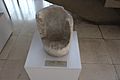
Holy (Epiphany) water vessel from 15th–16th centuries. It is found on Hisar near the town of Leskovac, Serbia. Photographed in National museum of Leskovac.
-
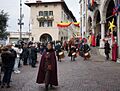
Epiphany celebration in Gemona del Friuli, Italy.
-
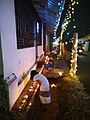
Diyas (lights) are used to celebrate Epiphany in some Kerala Christian households.
-
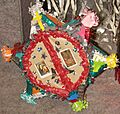
The picture depicts a Christmas-star, the main part of an old Hungarian Christmas-tradition called csillagozás (star-play). It is usually performed by a child who is younger than 10 years. The play itself is a string of Christmas carols that tells the story of Jesus' birth. In the end of the performance the child asks the Lord's blessings for the house and ones who're living in it and wishes them merry Christmas. In return the child usually gets some sweets or money.
-
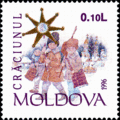
Star boys. Postage stamp depicting traditional Christmas and Epiphany star singing in Moldova.
-
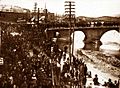
Epiphany procession in the capital of North Macedonia Skopje near Stone Bridge on the Vardar river in the early 1920s.
-
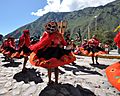
Feast of Día de Reyes in Peru.


_(Ollantaytambo)_(4578168158).jpg)
See also
 In Spanish: Epifanía para niños
