
Air quality index facts for kids

An Air Quality Index (often called AQI) is a simple way to understand how clean or polluted the air is right now, or how it might be in the near future. When air pollution goes up, the AQI number also goes up. This means there are more risks for people's health.
Many countries have their own ways of measuring air quality. These systems are based on their national air quality rules. Some common air pollutants that are measured include ozone (at ground level), tiny particulates, sulfur dioxide, carbon monoxide, and nitrogen dioxide.
Certain groups of people are more easily affected by poor air quality. These include children, older people, and anyone with breathing or heart problems. When the AQI is high, governments usually suggest that people do less physical activity outdoors. Sometimes, they even advise people to stay inside.
Contents
Understanding Air Quality
What is the Air Quality Index (AQI)?
The AQI helps us know how much pollution is in the air. It uses information from special air monitors or computer models. These tools measure how much of a pollutant is in the air over a certain time. Scientists use studies to understand how different levels of air pollution affect our health.
Each pollutant has its own way of being measured and converted into an AQI number. AQI values are usually put into groups. Each group has a name, a color, and advice for public health.
How Air Pollution Affects Us
The AQI can rise when more pollution is released into the air. This can happen during busy traffic times or when there's a forest fire nearby. Sometimes, air pollution can get trapped in an area. This happens when the air is still, often due to certain weather conditions like low winds. When air pollution stays in one place, it can lead to high levels of pollutants and hazy skies.

What Happens When Air Quality is Poor?
When the AQI is expected to be high because of tiny particles in the air, health organizations might:
- Advise sensitive groups to avoid hard outdoor activities. Sensitive groups include older people, children, and those with breathing or heart problems.
- Announce an "action day." This encourages people to help reduce air pollution. For example, they might suggest using public transportation instead of driving.
- Suggest wearing masks outdoors or using air purifiers indoors. This helps stop tiny particles from getting into people's lungs.
If the air quality becomes very bad, like during a serious air pollution event, the AQI can show that people might get very sick quickly. In such cases, agencies might use emergency plans. These plans allow them to ask big polluters, like factories, to stop or reduce their emissions until the air gets better.
Not all air pollutants have an AQI. However, many countries track common pollutants. These include ground-level ozone, tiny particles, sulfur dioxide, carbon monoxide, and nitrogen dioxide. They then calculate an AQI for these pollutants.
Each country's AQI system shows how that country decided on its air quality rules. There is now a website where governments worldwide can share their real-time air data. This data is shown using a common AQI definition.
Air Quality Around the World
Many countries have their own systems to measure and report air quality. While the details might differ, they all aim to inform people about air pollution and protect their health.
Air Quality in Australia
In Australia, each state and territory checks air quality. They publish data based on national standards. They use a simple scale where an AQI of 100 means the maximum safe level for a pollutant.
Australia uses six AQI levels, each with health advice:
| AQI | Category | Health advice |
|---|---|---|
| 0–33 | Very Good | Enjoy activities |
| 34–66 | Good | Enjoy activities |
| 67–99 | Fair | People who are very sensitive to air pollution should plan hard outdoor activities for when the air quality is better. |
| 100–149 | Poor | Sensitive groups: Reduce or reschedule hard outdoor activities. |
| 150–200 | Very Poor | Sensitive groups: Avoid hard outdoor activities. Everyone: Reduce or reschedule hard outdoor activities. |
| 200+ | Hazardous | Sensitive groups: Avoid all outdoor physical activities. Everyone: Significantly reduce outdoor physical activities. |
Air Quality in Canada
Canada uses the Air Quality Health Index (AQHI). This tool helps people understand how air quality affects their health. It helps them decide if they should change their outdoor activities when pollution levels are high. The AQHI also suggests ways to reduce our impact on the environment. It gives special advice to people sensitive to air pollution.
The AQHI uses a number from 1 to 10+ to show the health risk. Sometimes, if pollution is very high, the number can go above 10. The AQHI gives current air quality and forecasts for today, tonight, and tomorrow.
| Health risk | Air quality health index | Health messages | |
|---|---|---|---|
| At risk population | General population | ||
| Low Risk | 1–3 | Enjoy your usual outdoor activities. | Ideal air quality for outdoor activities. |
| Moderate Risk | 4–6 | Consider reducing or rescheduling hard activities outdoors if you feel symptoms. | No need to change your usual outdoor activities unless you feel symptoms like coughing or a sore throat. |
| High Risk | 7–10 | Reduce or reschedule hard activities outdoors. Children and older people should also take it easy. | Consider reducing or rescheduling hard activities outdoors if you feel symptoms like coughing or a sore throat. |
| Very High Risk | Above 10 | Avoid hard activities outdoors. Children and older people should also avoid outdoor physical effort. | Reduce or reschedule hard activities outdoors, especially if you feel symptoms like coughing or a sore throat. |
Air Quality in China
Hong Kong's Air Quality Health Index
On December 30, 2013, Hong Kong started using a new system called the Air Quality Health Index. This index, reported by the Environmental Protection Department, uses a scale from 1 to 10+. It looks at four air pollutants: ozone, nitrogen dioxide, sulfur dioxide, and tiny particles (PM10 and PM2.5). The AQHI groups air quality into five health risk categories with advice.
| Health Risk | AQHI |
|---|---|
| Low | 1 |
| 2 | |
| 3 | |
| Moderate | 4 |
| 5 | |
| 6 | |
| High | 7 |
| Very High | 8 |
| 9 | |
| 10 | |
| Serious | 10+ |
Mainland China's AQI System
China's Ministry of Environmental Protection (MEP) measures air pollution. Since January 1, 2013, the MEP has monitored daily pollution in 163 major cities. The AQI is based on six air pollutants: sulfur dioxide (SO2), nitrogen dioxide (NO2), tiny particles (PM10 and PM2.5), carbon monoxide (CO), and ozone (O3).
The final AQI value is the highest score from these six pollutants. An AQI of 300 does not mean twice the pollution of an AQI at 150. It also doesn't mean the air is twice as harmful.
| AQI | Air Pollution Level | Air Pollution Category |
Health Implications | Recommended Precautions |
|---|---|---|---|---|
| 0–50 | Level 1 | Excellent | No health effects. | Everyone can continue outdoor activities normally. |
| 51–100 | Level 2 | Good | A few very sensitive people might feel slight effects. | Only very few sensitive people should reduce outdoor activities. |
| 101–150 | Level 3 | Lightly Polluted | Healthy people might feel slight irritation. Sensitive people will be more affected. | Children, older people, and those with breathing or heart diseases should reduce long and hard outdoor exercises. |
| 151–200 | Level 4 | Moderately Polluted | Sensitive people will feel more serious effects. Healthy people's hearts and breathing might be affected. | Children, older people, and those with breathing or heart diseases should avoid long and hard outdoor exercises. Everyone else should moderately reduce outdoor activities. |
| 201–300 | Level 5 | Heavily Polluted | Healthy people will often show symptoms. People with breathing or heart diseases will be seriously affected. | Children, older people, and those with heart or lung diseases should stay indoors and avoid outdoor activities. Everyone else should reduce outdoor activities. |
| 301–500 | Level 6 | Severely Polluted | Healthy people will feel less able to do activities and might show strong symptoms. Other sicknesses might start in healthy people. Older people and those with diseases should stay indoors and avoid exercise. Healthy people should avoid outdoor activities. | Children, older people, and the sick should stay indoors and avoid physical effort. Everyone else should avoid outdoor activities. |
Air Quality in Europe
The Common Air Quality Index (CAQI) has been used in Europe since 2006. In November 2017, the European Environment Agency introduced the European Air Quality Index (EAQI). They encouraged its use to inform the public about air quality.
The Common Air Quality Index (CAQI)
The CAQI was created to be easy for everyone to understand. Its main goal is to draw attention to city air pollution and its main cause (traffic). It also helps people reduce their exposure to pollution. The CAQI does not focus on the combined effects of different pollutants on health.
The CAQI is a number from 0 to 100. A low number means good air quality, and a high number means poor air quality. It has hourly and daily versions. It also has separate versions for areas near roads ("roadside" or "traffic" index) and areas away from roads ("background" index). The CAQI is the highest value among the pollutants measured.
| Qualitative name | Index or sub-index | Health Advice |
|---|---|---|
| Very low | 0–25 | Air quality is excellent. Enjoy all outdoor activities. |
| Low | 25–50 | Air quality is good. Enjoy all outdoor activities. |
| Medium | 50–75 | Air quality is moderate. Sensitive people should be aware. |
| High | 75–100 | Air quality is poor. Sensitive people should reduce outdoor activities. |
| Very high | >100 | Air quality is very poor. Everyone should reduce outdoor activities. |
Air Quality in India

The National Air Quality Index (NAQI) was launched in New Delhi on September 17, 2014. This was part of the Swachh Bharat Abhiyan (Clean India Mission).
The Central Pollution Control Board and State Pollution Control Boards run a National Air Monitoring Programme. They have over 342 monitoring stations in 240 cities. An expert group, including doctors and air quality specialists, helped create the NAQI system in 2014. The old system measured three things, but the new one measures eight pollutants. These include PM10, PM2.5, NO2, SO2, CO, O3, NH3, and Pb.
The NAQI has six categories: Good, Satisfactory, Moderate, Poor, Severe, and Hazardous. The worst sub-index from any pollutant shows the overall NAQI.
| AQI | Remark | Colour Code | Possible Health Effects |
|---|---|---|---|
| 0–50 | Good | Minimal effect | |
| 51–100 | Satisfactory | Minor breathing discomfort for sensitive people | |
| 101–200 | Moderate | Breathing discomfort for people with lung, asthma, and heart diseases | |
| 201–300 | Poor | Breathing discomfort for most people after long exposure | |
| 301–400 | Severe | Respiratory illness after long exposure | |
| 401–500 | Hazardous | Affects healthy people and seriously affects those with existing diseases |
Air Quality in the United States

The United States Environmental Protection Agency (EPA) created an Air Quality Index to report air quality. An AQI value above 300 means hazardous air quality, while below 50 means good air quality. This AQI has six categories, showing increasing levels of health concern.
| AQI | Category | Color | Health implications | What should people do |
|---|---|---|---|---|
| 0–50 | Good | Green | Air quality is good, with little or no risk. | It's a great day to be active outside. |
| 51–100 | Moderate | Yellow | Air quality is acceptable. A very small number of sensitive people might have moderate health concerns. | Unusually sensitive people: Think about reducing long or hard exercise. Watch for symptoms like coughing or shortness of breath.
Everyone else: It's a good day to be active outside. |
| 101–150 | Unhealthy for Sensitive Groups | Orange | Sensitive groups might feel health effects. Most people will likely not be affected. | Sensitive groups: Reduce long or hard exercise. It's okay to be active outside, but take more breaks and do less intense activities. Watch for symptoms. |
| 151–200 | Unhealthy | Red | Everyone might start to feel health effects. Sensitive groups might feel more serious effects. | Sensitive groups: Avoid long or hard exercise. Move activities indoors or reschedule.
Everyone else: Reduce long or hard exercise. Take more breaks during all outdoor activities. |
| 201–300 | Very Unhealthy | Health alert: everyone might feel more serious health effects. | Sensitive groups: Avoid all physical activity outdoors. Move activities indoors or reschedule.
Everyone else: Avoid long or hard exercise. Consider moving activities indoors or rescheduling. |
|
| 301–500 | Hazardous | Health warnings for emergency conditions. The whole population is more likely to be affected. | Everyone: Avoid all physical activity outdoors.
Sensitive groups: Stay indoors and keep activity levels low. |
How the US AQI Works
The US AQI is based on five main pollutants. These are ground-level ozone, particulate matter, carbon monoxide, sulfur dioxide, and nitrogen dioxide. The EPA sets national standards for these pollutants to protect public health. An AQI value of 100 usually matches the safe level for a pollutant. The EPA regularly checks and updates these standards.
If several pollutants are measured in one place, the highest AQI value is reported for that location. For example, if ozone and particulate matter both have an AQI, the higher one is used.
Keeping Track of US Air Quality
You can find real-time air quality data and forecasts on the EPA's AirNow website. This information is color-coded using the AQI. Other groups also provide monitoring for sensitive people, like those with asthma, children, and older adults. Historical air data, including AQI charts and maps, are on the EPA's AirData website. There's even a free email service for New York residents, AirNYC. It sends notifications about AQI changes for chosen locations. A detailed map with current AQI levels and a two-day forecast is also available on the Aerostate website.
In recent years, many affordable air quality sensors have become popular. These are used by citizen scientists and have created large networks across the US and worldwide. The EPA has developed a way to correct data from some of these sensors. This makes their data similar to official regulatory data for calculating the AQI. This corrected sensor data now appears alongside official data on the EPA's national fire map.
A Look Back: The History of AQI in the US
The AQI first appeared in 1968. The National Air Pollution Control Administration started a project to create an air quality index. They wanted to use it in major cities. The goal was to make the public aware of air pollution. This would also encourage local officials to control pollution sources and improve air quality.
The first AQI used standard pollutant levels to create individual pollutant scores. These scores were then combined to form a single total air quality index. This system could use data from air monitors or computer models. Even though there were challenges, like not enough data and different rules in different places, publishing city rankings helped achieve the goal. It led to better indices and their regular use in the future.
Images for kids
-
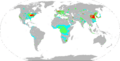
A global air quality map

