
Akashi Kaikyo Bridge facts for kids
Quick facts for kids Akashi Kaikyo Bridge明石海峡大橋 |
|
|---|---|

Akashi Kaikyo Bridge from the air, December 2005
|
|
| Coordinates | 34°36′58″N 135°01′14″E / 34.6162°N 135.0205°E |
| Carries | Six lanes of the  Kobe-Awaji-Naruto Expressway and four emergency lanes Kobe-Awaji-Naruto Expressway and four emergency lanes |
| Crosses | Akashi Strait |
| Locale | Awaji Island and Kobe |
| Other name(s) | Pearl Bridge |
| Maintained by | Honshu-Shikoku Bridge Expressway Company Limited (JB Honshi Kōsoku) |
| Characteristics | |
| Design | Suspension bridge |
| Total length | 3,911 metres (12,831 ft) |
| Width | 35.5 metres (116 ft) |
| Height | 282.8 metres (928 ft) (pylons) |
| Longest span | 1,991 metres (6,532 ft) |
| Clearance below | 65 metres (213 ft) |
| History | |
| Designer | Satoshi Kashima |
| Construction begin | 1988 |
| Construction end | 1998 |
| Opened | April 5, 1998 |
| Statistics | |
| Toll | ¥2,300 |
The Akashi Kaikyo Bridge (pronounced Ah-kah-shee Kai-kyoh), also known as the Pearl Bridge, is an amazing suspension bridge in Japan. It connects the city of Kobe on Honshu island with Awaji Island. This giant bridge is part of the Kobe-Awaji-Naruto Expressway. It crosses the Akashi Strait, a busy and sometimes stormy waterway.
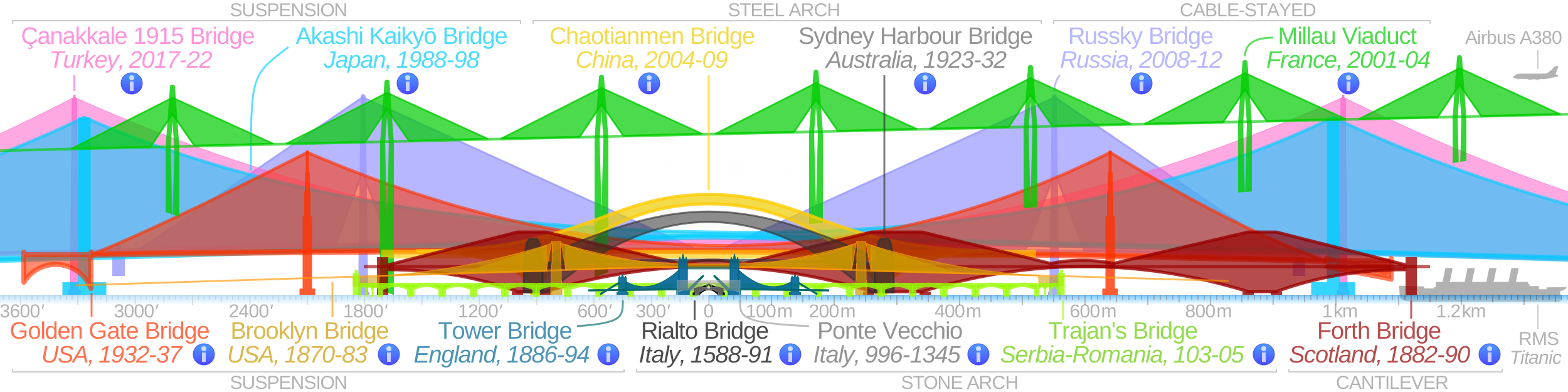
The bridge was finished in 1998. At that time, it had the longest central span of any suspension bridge in the world, stretching 1,991 metres (6,532 ft). As of May 2026, it is the second-longest, after the 1915 Çanakkale Bridge in Turkey. The Akashi Kaikyo Bridge is a very important part of the Honshū–Shikoku Bridge Project, which created three main routes across the Seto Inland Sea.
Contents
History of the Akashi Kaikyo Bridge
Why the Bridge Was Needed
Before the Akashi Kaikyo Bridge was built, people traveled across the Akashi Strait by ferry. This strait is known for strong winds, heavy rain, and storms. Sadly, there were serious accidents involving ferries in bad weather. These events showed how dangerous ferry travel could be and highlighted the urgent need for a safer way to cross the strait. This led the Japanese government to plan for a bridge. The Akashi Kaikyo Bridge forms part of the Kobe-Awaji-Naruto Expressway. It is a key link in the system connecting the islands of Honshu and Shikoku.
Planning and Design
Engineers and experts began studying how to build a bridge across the strait in the late 1950s. They realized it would be a huge challenge because of the strong currents and deep water. In 1970, a special group called the Honshu–Shikoku Bridge Authority was created. They did many tests, even underwater, to figure out the best way to build the bridge's foundations. A plan for a bridge was approved in 1973, but construction had to wait because of tough economic times.
Building the Bridge

Work on the Akashi Kaikyo Bridge finally began in April 1988. The original idea was for a bridge that could carry both trains and cars. However, the final plan was for a road-only bridge with six lanes for traffic. More than 100 companies worked together on this massive project.
In January 1995, a big earthquake, called the Great Hanshin Earthquake, hit the area. Even though the earthquake was very strong, the bridge's parts that were already built were not badly damaged. This showed how well the bridge was designed to resist earthquakes! Construction finished on time in September 1996. The bridge officially opened on April 5, 1998. Japan's then-Crown Prince Naruhito and Crown Princess Masako attended the opening ceremony. It was one of Japan's biggest projects of the 20th century.
How the Bridge is Built
Underwater Foundations
.jpg)
The bridge stands on four main parts: two huge piers under the water and two anchorages on land. The piers are like giant feet that hold up the main towers. The anchorages are heavy blocks on each side of the strait that hold the ends of the main cables. These parts are built to be incredibly strong. The piers, for example, are placed in areas with very strong ocean currents. Special layers of rock and other materials were added around them to stop the currents from eroding the ground.
Above-Water Structure

The Akashi Kaikyo Bridge has three main sections, called spans. The middle section is the longest, at 1,991 m (6,532 ft). The two side sections are each 960 m (3,150 ft) long. The total length of the bridge is 3,911 m (12,831 ft) (about 2.4 miles)!
When the Great Hanshin Earthquake happened in 1995, it actually moved the bridge's towers slightly. This meant the central span became 1 m (3.3 ft) longer than planned! The bridge was designed to be super strong. It can handle winds up to 286 kilometres per hour (178 mph) and very powerful earthquakes (up to magnitude 8.5). It also has special devices called tuned mass dampers. These are like giant shock absorbers that help the bridge stay steady during strong winds or tremors.
The two main towers reach 282.8 m (928 ft) into the sky. Because of changes in temperature, the bridge can actually expand or shrink by up to 2 m (6.6 ft) in a single day! The huge steel cables that hold up the bridge contain enough wire to wrap around the Earth almost eight times! Each cable is 112 centimetres (44 in) (about 44 inches) thick and made of 36,830 strands of wire.
The Akashi Kaikyo Bridge looks amazing at night. It has 1,737 lights! These lights are on the main cables, towers, and other parts. They use red, green, and blue lights that can be mixed by computers to create many different colors. There are 28 different lighting patterns used for special days, like holidays or celebrations.

Bridge Costs and Tolls
Building this incredible bridge cost about 500 billion Japanese yen, which was around 3.6 billion US dollars in 1998. To help pay for it, drivers pay a toll to cross the bridge. The toll is 2,300 yen. About 23,000 cars use the bridge every day.

See also
 In Spanish: Gran Puente de Akashi Kaikyō para niños
- Rainbow Bridge (Tokyo)
