
Amelia Stone Quinton facts for kids
Quick facts for kids
Amelia Stone Quinton
|
|
|---|---|
.jpg) |
|
| Born |
Amelia Stone
July 31, 1833 |
| Died | June 23, 1926 (aged 92) Ridgefield Park, New Jersey
|
| Nationality | American |
| Occupation | activist |
| Known for | Women's National Indian Association |
Amelia Stone Quinton (born July 31, 1833 – died June 23, 1926) was an American activist. She worked to protect the rights of Native American people. With her friend Mary Bonney, she helped start the Women's National Indian Association in 1883.
Amelia Quinton led this group as president from 1887 to 1904. During her time as president, the association helped Native Americans gain more rights. They supported the Dawes Severalty Act in 1887. This law gave Native American families land for farming and made them United States citizens. Senator Henry L. Dawes, who created the act, said that this women's group helped create and support the new government policy for Native Americans.
Contents
Early Life and Work
Amelia Stone was born on July 31, 1833. Her hometown was Jamesville, New York, near Syracuse. Her parents were Mary and Jacob Thompson Stone. She was taught by a tutor named Samuel B. Woolworth.
Amelia first married Reverend James Franklin Swanson. They lived in Georgia for a few years. After he passed away, she later married Richard L. Quinton in London. He was a lecturer on history and astronomy. She then took his last name, Quinton.
Teaching and Volunteer Work
Amelia taught at a school in Georgia for one year. After her first husband died, she moved back North. She taught for another year at a school in Philadelphia. After teaching, she decided to focus on helping others.
She started volunteering in New York City. She spent time each week helping people in different places. This included prisons, almshouses (places for the poor), and reformatories for women. She also taught a weekly Bible class for sailors.
Amelia also joined the temperance movement in Brooklyn. This movement worked to reduce alcohol use. She was asked to speak and help organize groups. She was later chosen as a state organizer for the Woman's Christian Temperance Union.
Travel and New Beginnings
Amelia traveled to Europe for a year to rest. While there, she became involved in temperance work in England. She gave talks in London and other cities. On her trip to England, she met Professor Richard Quinton. They married in London a year later.
They lived in London for several months. In 1878, they moved to Philadelphia, America. Professor Quinton continued his lectures there.
Fighting for Native American Rights
In April 1879, Amelia's friend, Mary Bonney, became very concerned. She was worried about the unfair treatment of Native Americans. Especially, she was upset about European-American settlers moving onto Native American lands. Mary Bonney wanted to create a petition about this issue.
Mary Bonney shared her concerns with Amelia Quinton. Together, they started to make a plan. Mary Bonney offered to pay for printing. Amelia Quinton planned the work and carried it out. She studied in libraries and created materials and petitions. She sent these out to people who supported their cause in many states.
Petitions and Organization
The first petition was made larger. Amelia also wrote a leaflet with facts and a special appeal. She sent these widely to important citizens and Christian and charity workers. People from thirteen states signed the petition. It was so long it measured three hundred feet! This long petition was given to Congress in February 1880.
By the end of 1880, Amelia and Mary had formed a committee of eight people. Amelia Quinton was chosen as the secretary. A few months later, Mary Bonney became the chairman. In June 1881, they adopted a constitution written by Amelia. The group then became known as the Indian Treaty-keeping and Protective Association.
Amelia Quinton worked to expand the organization. She set up thirteen smaller committees in five states that year. In a letter with the 1881 petition, she asked Congress to help Native Americans become citizens willingly. She believed it should be in their best interest, not forced by law.
In her petition for January 1882, she asked for several things. These included education for all Native Americans, individual land ownership, and full citizenship rights. By then, the society had sixteen state committees. Amelia visited and reorganized all of them into lasting support groups. Senator Henry L. Dawes spoke about their third petition in the Senate. This petition had over one hundred thousand signatures.
The Women's National Indian Association
The organization later became known as the Women's National Indian Association. It created branches and found helpers in forty states. Since 1884, it had started more than twenty missions in Native American tribes. By 1891, their missionary work was active in fifteen tribes.
After Mary Bonney retired in 1884, Mary Lowe Dickinson became president. Then, in 1887, Amelia Quinton was chosen as president. She also worked with the government on Native American education.
Amelia Stone Quinton passed away on June 23, 1926. She died at her home in Ridgefield Park, New Jersey.
Images for kids
-
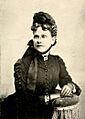
Amelia Stone Quinton
