
Mary Bonney facts for kids
.jpg)
Mary Lucinda Bonney (born June 8, 1816 – died July 24, 1900) was an important American educator and activist in the 1800s. Born in Hamilton, New York, she worked hard to protect the land rights of Native Americans. She also helped create schools for girls. With her friend Harriette A. Dillaye, she started a school in Philadelphia in 1850. This school later became known as the Ogontz School for Young Ladies. Mary Bonney also co-founded the Women's National Indian Association. This group worked to protect Native American lands.
Contents
Early Life and Learning
Mary Bonney was the fourth of six children in her family. Her parents, Benjamin and Lucinda Bonney, were devoted Baptists. Her grandfathers, Benjamin Bonney and Abel Wilder, both fought in the American Revolutionary War.
Mary started her education at Ladies Academy in Hamilton, New York. She then moved to the Emma Willard School in Troy, New York. At Emma Willard, she studied subjects similar to those taught in colleges for men. Mary graduated in 1835 and began her career as a teacher.
She taught in many different cities and states. These included Jersey City, New Jersey, New York City, South Carolina, Providence, Rhode Island, and Philadelphia. In 1842, she became the head of a girls' school in Beaufort, South Carolina. After six years, she returned North and eventually settled in Philadelphia.
Founding the Ogontz School
_p120_Philadelphia,_Ogontz_School_for_Young_Ladies,_front_view.jpg)
In 1850, Mary Bonney wanted to help her widowed mother. She teamed up with Harriette A. Dillaye, another teacher from Emma Willard School. Together, they started the Chestnut Street Female Seminary in Philadelphia. The school quickly grew and became very successful.
To handle the growing number of students, Bonney leased a large estate in 1883. This estate, called Ogontz, was the former home of banker Jay Cooke. It was located in Cheltenham Township, Montgomery County, Pennsylvania. The school was then renamed the Ogontz School for Young Ladies.
The Ogontz School offered a wide range of subjects for girls aged 13 to 18. Students could live at the school or attend during the day. They studied science, humanities, and even physical education. The school continued to grow and needed even more space.
Later, in 1916, the school's owner, Abby A. Sutherland, bought a new, larger property. This 54-acre plot was in Rydal, Pennsylvania. In 1950, she donated this facility to Pennsylvania State University. Today, this campus is known as Penn State Abington.
Standing Up for Native Americans
In 1878, the U.S. Congress wanted to take away land from Native American tribes. These lands were promised to them by treaties. Mary Bonney was very upset by this plan. She decided to act.
She started a petition with the help of her missionary group. They gathered about 13,000 signatures against the plan. This petition was given to President Rutherford B. Hayes and Congress. They then organized a second petition, collecting 50,000 signatures. This was presented to the Senate in 1881.
That same year, Mary Bonney and other leaders formed a group. They called themselves the Indian Treaty-Keeping and Protective Association. Mary Bonney was chosen as their president. In 1882, they presented a third petition to the government. This one had nearly 100,000 signatures. It supported giving tribal lands directly to Native Americans.
Later Life
Mary Bonney stepped down as president of the Association in 1884. However, she continued to support their causes financially.
In 1888, she married Reverend Thomas Rambaut. They had met 40 years earlier when she was teaching in Robertville, South Carolina. They married in London during the World's Missionary Convention.
After returning to the United States, they settled in Mary's hometown of Hamilton, New York. Reverend Rambaut passed away in 1890. Mary Bonney then moved in with her brother in Hamilton. She died in 1900.
Images for kids
-
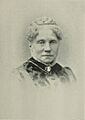
Mary Lucinda Bonney Rambaut, a leader for change
-
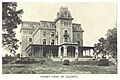
The Ogontz School for Young Ladies in 1892
