
Hong Kong cascade frog facts for kids
Quick facts for kids Hong Kong cascade frog |
|
|---|---|
 |
|
| Conservation status | |
Scientific classification  |
|
| Kingdom: | Animalia |
| Phylum: | Chordata |
| Class: | Amphibia |
| Order: | Anura |
| Family: | Ranidae |
| Genus: | Amolops |
| Species: |
A. hongkongensis
|
| Binomial name | |
| Amolops hongkongensis (Pope and Romer, 1951)
|
|
| Script error: The function "autoWithCaption" does not exist. | |
| Synonyms | |
|
Staurois hongkongensis Pope and Romer, 1951 |
|

Script error: No such module "Check for conflicting parameters".
The Hong Kong cascade frog or Hong Kong torrent frog (Amolops hongkongensis) is a special type of true frog. It lives in southern coastal China. For a long time, people thought it only lived in Hong Kong.
These frogs lay their eggs on rocks right where water splashes from waterfalls. In Hong Kong, this frog is a protected species. This means it is against the law to harm them, thanks to a special rule called the Wild Animals Protection Ordinance.
Contents
Where Do Hong Kong Cascade Frogs Live?
This frog was first found on Tai Mo Shan in Hong Kong. Now, we know there are also groups of them living in Guangdong, a nearby area in China. In Hong Kong, you can find them in the New Territories and on Hong Kong Island. They have even been seen in smaller streams on Lung Fu Shan.
Their Special Home
Hong Kong cascade frogs love to live in small streams found in hills, especially where there are forests nearby and waterfalls or "cascades." Their babies, called Tadpoles, have a cool trick! They have a special 'sucker' on their belly. This helps them stick to rocks and not get washed away by the fast-moving water.
Sadly, their homes are in danger. Things like cutting down trees and building dams or other structures can harm the streams where they live.
What Does the Hong Kong Cascade Frog Look Like?
Both male and female Hong Kong cascade frogs grow to be about 40 mm (1.6 in) long from their snout (nose) to their vent (bottom). That's about the size of a large paperclip! Their tadpoles are a bit smaller, growing up to 25 mm (0.98 in) long.
These frogs have special suction pads on their fingers. These pads are very wide, about 3 to 4 times wider than their fingers. This helps them grip wet, slippery rocks. They also have a fold of skin on their ankle, called a tarsal fold. Male frogs have white, velvety pads on their first fingers, which are called nuptial pads. These pads help them hold onto the female during mating.
Gallery
-
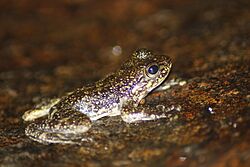
Hong Kong cascade frog (Amolops hongkongensis)
-
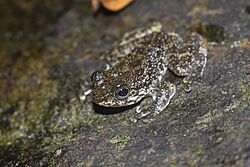
Hong Kong cascade frog (Amolops hongkongensis)
-
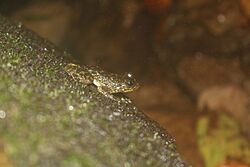
Hong Kong cascade frog (Amolops hongkongensis)
_3.jpg)
.jpg)
_2.jpg)
