
Amorphophallus facts for kids
Quick facts for kids Amorphophallus |
|
|---|---|
_(Amorphophallus_titanum)_Foto_M._Neumann_%26_%C2%A9_W._Barthlott.jpg) |
|
| Titan arum (Amorphophallus titanum) is the Amorphophallus with the largest unbranched inflorescence. | |
Scientific classification  |
|
| Kingdom: | Plantae |
| Clade: | Tracheophytes |
| Clade: | Angiosperms |
| Clade: | Monocots |
| Order: | Alismatales |
| Family: | Araceae |
| Subfamily: | Aroideae |
| Tribe: | Thomsonieae |
| Genus: | Amorphophallus Blume ex Decne. |
| Type species | |
| Amorphophallus campanulatus Decne. |
|
| Species | |
|
See text |
|
| Synonyms | |
|
|
Amorphophallus is a fascinating group of about 200 different plant species. These plants grow from a large underground storage part called a tuber. They are found in warm, tropical, and subtropical regions across Asia, Africa, Australia, and many islands. They belong to the arum family, known for their unique flowers.
One of the most famous Amorphophallus plants is the Titan arum (A. titanum). It comes from Indonesia and has the largest flower structure of all plants in this group. It's often called the 'corpse flower' because it makes a very strong, unpleasant smell when it blooms. This smell helps attract insects for pollination. It can take up to seven years for this giant plant to flower!
Some types of Amorphophallus can be eaten. However, they need special preparation to remove chemicals that can be irritating.
Contents
Discovering Amorphophallus Plants
The first detailed records of these plants appeared in 1692. A scientist named Van Rheede tot Drakenstein wrote about two different Amorphophallus plants.
The name "Amorphophallus" was first used in 1834. It was given by a Dutch botanist, Blume. The name comes from two Ancient Greek words. "Amorphos" means "without form" or "misshapen." The second part refers to the unique, often unusual shape of its central flower spike, called a spadix.
Later, between 1876 and 1911, another botanist, Adolf Engler, grouped many similar plants under the Amorphophallus name. He published a complete study of them in 1911.
Where Amorphophallus Grow
These plants mostly live in warm, low-lying areas. You can find them in tropical and subtropical parts of the world. Their natural home stretches from West Africa all the way to the Pacific Islands.
You won't find any Amorphophallus plants growing naturally in the Americas. However, there's a plant group called Dracontium there that looks very similar. Most Amorphophallus species are endemic. This means they only grow in specific, small areas. They often thrive in places where the ground has been disturbed, like in secondary forests (forests that have grown back after being cleared).
Plant Features and Life Cycle
These plants can be small or very large. They all grow from a tuber hidden underground. Amorphophallus tubers come in many shapes and sizes. Some are round, like a ball. Others are long or grow in strange clusters.
The tubers can weigh from just 10 g (0.35 oz) (like a few grapes) to a massive 139 kg (306 lb) (heavier than a person!). From the top of the tuber, a single large leaf grows. This leaf can be several meters wide in bigger species. It sits on a thick stalk, like a tree trunk. This leaf lasts for one growing season. After the plant matures, a single flower structure, called an inflorescence, appears.
The Unique Flower Structure
Like other plants in the Arum family, Amorphophallus has a special flower. It has a large, leaf-like part called a spathe. This spathe wraps around a central spike, which is called a spadix. The spathe can be many colors, often brownish-purple or whitish-green. Inside, it might have bumps or ridges. These features help to trap insects.
How They Reproduce
Amorphophallus plants have both male and female flowers on the same spadix. The tiny female flowers are at the bottom. Above them are the male flowers. There's also a sterile part, sometimes called the 'appendix'. This part can be very large. The flowers don't have colorful petals like many other flowers.
The female flowers are ready for pollination for only about one day. Many species release a strong smell, like rotting meat. This smell attracts insects. These clever plants have traps inside the spathe. Insects that enter when the female flowers are ready get trapped for a day. While trapped, the male flowers mature and release pollen. When the insects finally escape, they carry this pollen. They can then pollinate another Amorphophallus plant.
Some Lepidoptera (like butterfly and moth) larvae also eat Amorphophallus plants.
After successful pollination, each flower usually turns into a round fruit. These berries can be red, orange-red, white, yellow, or blue. The color depends on the specific plant species.
Famous Amorphophallus Species
The Giant Titan Arum
The Amorphophallus titanum, also known as the 'corpse flower', is truly amazing. It holds the record for the world's largest unbranched flower structure. It can grow up to 2.5 metres (8.2 ft) tall and 1.5 metres (4.9 ft) wide!
In 2015, a Titan Arum over 1.2 metres (3.9 ft) tall bloomed at the Chicago Botanic Gardens. Thousands of people waited in line to see and smell it. A gardener there described its scent as "like roadkill, a barnyard, a dirty diaper, very strong, a little bit of mothball smell too." This plant is from the Indonesian rainforest. It can take about 10 years for it to finally bloom. This particular flower was nicknamed "Alice." Its blooming was even shown live on a webcam! The Chicago Botanic Gardens stayed open late to let everyone experience this rare event.
Another very tall species is Amorphophallus gigas. It can reach 4.36 m (14.3 ft) in height. However, its flower structure is a bit smaller than the Titan Arum's.
Other Interesting Species
The tubers of Amorphophallus konjac are used to make a Japanese food called konnyaku. This is a jelly-like food and a thickening agent. It contains a fiber called glucomannan.
Some Amorphophallus species are also known as "voodoo-lilies." This name is also given to some plants in the Typhonium genus, which are also in the Arum family.
How Amorphophallus Are Grouped
Scientists group plants to understand their relationships. In 2017, the Amorphophallus genus was divided into four main groups. These groups are called subgenera. This was done using phylogenetic analysis, which studies how living things are related through evolution.
| Amorphophallus Subgenera | |||||||||||||||||||||||||||||||||||||||
|
The four subgenera are:
- Subgenus Amorphophallus
- Subgenus Scutrandrium
- Subgenus Metandrium
- Subgenus Afrophallus
There are also a few species from Southeast Asia that haven't been placed into a subgenus yet.
Images for kids
-

Amorphophallus paeoniifolius, the elephant foot yam, a species cultivated in the tropical Indo-Pacific for its edible tubers
-

Amorphophallus infructescence with berry-like fruits
-

Amorphophallus commutatus
-
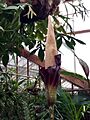
Amorphophallus decus-silvae
-

Amorphophallus galbra
-

Amorphophallus gigas
-
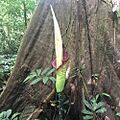
Amorphophallus hewittii
-

Amorphophallus longispathaceus
-
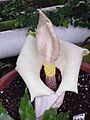
Amorphophallus prainii
-
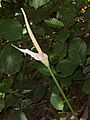
Amorphophallus variabilis
-
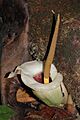
Amorphophallus barthlottii
-
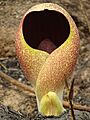
Amorphophallus dracontioides
-
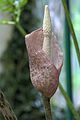
Amorphophallus excentricus
-
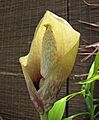
Amorphophallus kachinensis
-
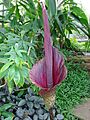
Amorphophallus konjac
-
Amorphophallus atroviridis
-

Amorphophallus bulbifer
-
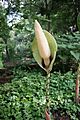
Amorphophallus dunnii
-
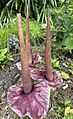
Amorphophallus henryi
-
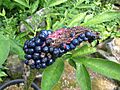
Amorphophallus hirtus
-

Amorphophallus maximus
-
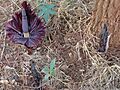
Amorphophallus mossambicensis
-

Amorphophallus sylvaticus
-
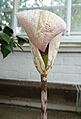
Amorphophallus yunnanensis
_5.jpg)

_04.jpg)


_(24076088639).jpg)


.jpg)


_002.jpg)


.jpg)


