
Apollo 17 facts for kids

Gene Cernan salutes the U.S. flag, with the Apollo Lunar Module Challenger and Lunar Roving Vehicle in the background
|
|
| Mission type | Crewed lunar landing (J) |
|---|---|
| Operator | NASA |
| Mission duration | 12 days, 13 hours, 51 minutes, 59 seconds |
| Spacecraft properties | |
| Spacecraft |
|
| Manufacturer |
|
| Launch mass | 107,165 lb (48,609 kg) |
| Landing mass | 12,120 lb (5,500 kg) |
| Crew | |
| Crew size | 3 |
| Members | |
| Callsign |
|
| EVAs | 1 in cislunar space |
| EVA duration | 1 hour, 5 minutes, 44 seconds (spacewalk to retrieve film cassettes) |
| Start of mission | |
| Launch date | December 7, 1972, 05:33:00 UTC (12:33 am EST) |
| Rocket | Saturn V SA-512 |
| Launch site | Kennedy, LC-39A |
| End of mission | |
| Recovered by | USS Ticonderoga |
| Landing date | December 19, 1972, 19:54:58 UTC |
| Landing site | South Pacific Ocean (17°53′S 166°07′W / 17.88°S 166.11°W) |
| Lunar orbiter | |
| Spacecraft component | Command and service module |
| Orbital insertion | December 10, 1972, 19:53:55 UTC |
| Orbital departure | December 16, 1972, 23:35:09 UTC |
| Orbits | 75 |
| Lunar lander | |
| Spacecraft component | Lunar Module |
| Landing date | December 11, 1972, 19:54:58 UTC |
| Return launch | December 14, 1972, 22:54:37 UTC |
| Landing site | Taurus–Littrow 20°11′27″N 30°46′18″E / 20.1908°N 30.7717°E |
| Sample mass | 115 kg (254 lb) |
| Surface EVAs | 3 |
| EVA duration |
|
| Lunar rover | |
| Distance covered | 35.7 km (22.2 mi) |
  Left to right: Schmitt, Cernan (seated), Evans |
|
Apollo 17 was the very last mission of NASA's Apollo program. It took place from December 7 to 19, 1972. This was the sixth and most recent time humans have ever landed on the Moon.
The crew included Commander Gene Cernan and Lunar Module Pilot Harrison Schmitt. They both walked on the Moon. Ronald Evans was the Command Module Pilot. He stayed orbiting the Moon in the main spacecraft.
Harrison Schmitt was special because he was the first and only professional geologist to walk on the Moon. NASA wanted to send a scientist to the Moon. This mission focused a lot on science. It even carried a fun experiment with five mice!
Scientists chose the Taurus–Littrow valley as the landing spot. They wanted to find old Moon rocks. They also hoped to find signs of recent volcanic activity.
Apollo 17 launched on December 7, 1972, after a small delay. It was a "J-type" mission. This meant it included three days on the Moon. The crew used the third Lunar Roving Vehicle (LRV). Cernan and Schmitt explored the Taurus–Littrow valley. They did three moonwalks. They collected many lunar samples. They also set up scientific instruments. They even found amazing orange soil! This soil turned out to be volcanic.
Ronald Evans orbited above in the Command and Service Module (CSM). He took scientific measurements and photos. The spacecraft safely returned to Earth on December 19.
This mission set many records for human spaceflight. It was the longest Moon landing mission. Astronauts spent the most time on the lunar surface. They also brought back the largest amount of Moon rocks.
Contents
Meet the Apollo 17 Astronauts
| Position | Astronaut | |
|---|---|---|
| Commander | Eugene A. Cernan Third and last spaceflight |
|
| Command Module Pilot (CMP) | Ronald E. Evans Only spaceflight |
|
| Lunar Module Pilot (LMP) | Harrison H. Schmitt Only spaceflight |
|
In 1969, NASA planned for Gene Cernan, Ronald Evans, and Joe Engle to be the main crew for Apollo 17. This was part of a system where backup crews would later become prime crews. However, plans changed.
Why Harrison Schmitt Joined the Crew
In 1970, some Apollo missions were canceled. Scientists really wanted a professional geologist to go to the Moon. So, NASA decided to assign Harrison Schmitt, a geologist and astronaut, to Apollo 17. He became the Lunar Module Pilot.
This meant Joe Engle could not fly on Apollo 17. Deke Slayton, who managed astronaut assignments, then chose Cernan and Evans to complete the crew. The main crew for Apollo 17 was announced in August 1971.
Who Were the Astronauts?
When he was chosen, Cernan was a 38-year-old captain in the United States Navy. He had already flown on Gemini 9A and Apollo 10. Evans was 39 and a lieutenant commander in the Navy. Schmitt was 37 and a civilian with a geology degree from Harvard University. For both Evans and Schmitt, Apollo 17 was their first trip to space!
Support Teams on Earth
NASA also had backup crews ready for each mission. For Apollo 17, the backup crew included experienced astronauts like John W. Young and Charles Duke.
There was also a "support crew" for Apollo missions. These astronauts helped prepare for the missions. They created the mission rules, flight plans, and checklists. For Apollo 17, the support crew included Robert F. Overmyer, Robert A. Parker, and C. Gordon Fullerton.
Mission Control Leaders
At Mission Control in Houston, special teams guided the mission. Flight directors were in charge of making sure the crew was safe and the mission succeeded. Key flight directors for Apollo 17 included Gerry Griffin and Gene Kranz.
Capsule Communicators (CAPCOMs) were the only people who could talk directly to the astronauts in space. They relayed messages between the crew and Mission Control.
Apollo 17 Mission Patch and Spacecraft Names
The Meaning Behind the Mission Patch
The Apollo 17 mission patch is very special. It shows the Greek sun god Apollo with an American eagle behind him. The eagle has red stripes, just like the U.S. flag. Three white stars above the stripes stand for the three astronauts.
In the background, you can see the Moon, the planet Saturn, and even a galaxy. The eagle's wing covers part of the Moon. This shows that humans had already visited the Moon.
.jpg)
The patch uses the colors of the U.S. flag: red, white, and blue. It also uses gold. This gold color represented a "golden age" of spaceflight. The image of Apollo is based on an ancient sculpture. It looks towards the future and the stars. This symbolizes human intelligence, wisdom, and ambition. Artist Robert McCall designed the patch. He used ideas from the crew.
Naming the Spacecraft
The crew chose special names for their spacecraft. They wanted to honor the American public. They also wanted names with a strong history.
The Command Module (CM) was named "America". Commander Cernan said this name reminded him of old sailing ships. It was a way to thank the people of the United States.
The Lunar Module (LM) was named "Challenger". Cernan felt this name described the future for America. It represented a challenge to explore even further. After landing on the Moon, Schmitt said, "I think the next generation ought to accept this as a challenge. Let's see them leave footprints like these."
Planning the Mission and Training
Choosing the Lunar Landing Site
Apollo 17 was the last mission to the Moon. So, scientists wanted to visit a new, important place. They considered a few spots. They wanted to find very old rocks. They also looked for signs of recent volcanic activity.
The Taurus–Littrow valley was chosen. Scientists believed they could find old rocks there. They also thought there might be signs of volcanic activity. This valley was similar to where Apollo 15 landed. But it offered new scientific opportunities.
Astronaut Training for the Moon
The Apollo 17 astronauts trained very hard. They learned how to collect samples on the Moon. They practiced using their spacesuits. They also learned to drive the Lunar Roving Vehicle.

Their training included many geology field trips. They would study maps and then explore areas on Earth that looked like the Moon. They practiced collecting samples and making observations. Cernan and Schmitt worked well together as a team. Cernan became very good at describing what he saw.
Evans, the Command Module Pilot, had his own training. He learned about lunar geology from orbit. He practiced identifying features he would photograph from space.
Apollo 17 Spacecraft and Experiments
The Mighty Saturn V Rocket

The Apollo 17 spacecraft included the Command and Service Module (CSM-114). It also had the Lunar Module (LM-12). A special adapter held the LM during launch. The Saturn V rocket, SA-512, was used to launch Apollo 17. It was one of the largest and most powerful rockets ever built.
Lunar Surface Science Tools
ALSEP: Experiments Left on the Moon
The Apollo Lunar Surface Experiments Package (ALSEP) was a set of nuclear-powered experiments. Astronauts left these on the Moon to keep working after they returned to Earth. For Apollo 17, the ALSEP included:
- A Heat Flow Experiment (HFE) to measure heat from inside the Moon.
- A Lunar Surface Gravimeter (LSG) to measure gravity changes.
- A Lunar Atmospheric Composition Experiment (LACE) to study the Moon's thin atmosphere.
- A Lunar Seismic Profiling Experiment (LSPE) to detect moonquakes.
- A Lunar Ejecta and Meteorites Experiment (LEME) to measure dust particles.
The HFE worked well. The LACE found gases like neon, helium, and hydrogen in the Moon's atmosphere. The LSPE detected explosions set off by ground command. All ALSEP experiments were turned off in 1977 due to budget reasons.
The Lunar Roving Vehicle (LRV)

Apollo 17 carried a Lunar Roving Vehicle. This "Moon buggy" helped astronauts travel far from their landing spot. It also carried their tools and samples. The Apollo 17 LRV traveled about 35.7 kilometers (22.2 miles). This was a record distance!
The LRV also carried other science tools. These included the Traverse Gravimeter Experiment (TGE). This tool measured gravity at different spots. Scientists used this data to learn about the Moon's inside.
Another experiment was the Surface Electrical Properties (SEP). It sent electrical signals through the Moon's ground. This helped scientists learn about the Moon's soil. Results showed almost no water in the landing area.
A Lunar Neutron Probe was placed in a hole in the Moon's surface. It measured neutrons to understand how the Moon's soil mixes over time. This helped scientists learn that the top layer of lunar soil turns over every million years.
Science from Lunar Orbit
Mice in Space: BIOCORE Experiment
Apollo 17's Command Module carried a special experiment called BIOCORE. It had five mice with tiny radiation monitors under their scalps. Scientists wanted to see if cosmic rays harmed them. These mice were called Fe, Fi, Fo, Fum, and Phooey by the crew!
Four of the five mice survived the trip. Scientists found some small changes in their bodies. But they did not find any damage caused by cosmic rays.
Another experiment, Biostack, tested cosmic ray effects on tiny living things. It carried microorganisms, seeds, and eggs of simple animals. Many of the eggs did not hatch or grow normally.
Scientific Instruments in Orbit

The Service Module had a special section called the Scientific Instrument Module (SIM) bay. It held three new experiments for lunar orbit:
- A lunar sounder to study the Moon's interior.
- An infrared scanning radiometer to map the Moon's temperature.
- A far-ultraviolet spectrometer to study the Moon's atmosphere.
It also had cameras and a laser altimeter. These tools helped map the Moon's surface.
Mysterious Light Flashes
Astronauts on Apollo missions often saw light flashes with their eyes closed. These flashes looked like "streaks" or "specks" of light. They happened when the spacecraft was dark.
The Apollo 17 crew did an experiment to study these flashes. They found that charged particles traveling through the eye's retina likely caused them.
Apollo 17 Mission Events
Launch and Journey to the Moon

Apollo 17 was the last Saturn V rocket to launch with a crew. It was also the only night launch in the Apollo program. It lifted off at 12:33 a.m. EST on December 7, 1972. There was a small delay due to a hardware issue.
About 500,000 people watched the launch. It was visible from far away. Observers in Miami, Florida, saw a "red streak" in the sky.
After orbiting Earth, the rocket's third stage fired. This sent the spacecraft towards the Moon. The Command and Service Module then separated from the rocket. It docked with the Lunar Module. The unused rocket stage was sent to crash into the Moon. This helped trigger seismometers left by earlier Apollo missions.

During their journey, the crew took a famous photo of Earth. It is known as The Blue Marble. They also fixed a tricky latch between the CSM and LM. A few hours before reaching the Moon, they jettisoned a door on the Service Module. Then, the engine fired to slow the spacecraft down. This put them into orbit around the Moon.
Landing on the Moon
The day of the landing, Cernan and Schmitt put on their spacesuits. They entered the Lunar Module (LM). The LM, named Challenger, then separated from the Command and Service Module (CSM). The two spacecraft orbited close together.
Cernan and Schmitt began their descent to the Taurus–Littrow valley. The LM's engine fired to slow them down. Cernan guided the spacecraft to the landing spot. The LM touched down on the Moon at 2:55 p.m. EST on December 11. It landed very close to the planned spot.
While Cernan and Schmitt were on the Moon, Evans stayed in orbit. He took observations and performed experiments.
Exploring the Lunar Surface
Cernan and Schmitt spent about 75 hours on the Moon. They performed three moonwalks (EVAs).
First Moonwalk: Setting Up and Exploring
The first moonwalk began four hours after landing. Cernan was the first to step onto the Moon. He dedicated this step to everyone who made the mission possible. Schmitt soon joined him.
Their first job was to unload the rover and other gear. Cernan accidentally broke off a part of the rover's fender. This meant lunar dust would spray onto them. They later made a temporary fix with duct tape and maps.
They set up the ALSEP experiments. Then, they drove the rover to Steno crater. They collected 14 kilograms (31 pounds) of samples. They also set off explosive packages. These explosions were detected by seismometers. The first moonwalk lasted over seven hours.
Second Moonwalk: Orange Soil and a Long Drive
On December 12, Cernan and Schmitt started their second moonwalk. They fixed the rover's fender with taped-together maps. This fix worked well!
They drove to Nansen Crater. They traveled 7.6 kilometers (4.7 miles) from their lander. This was the furthest anyone had ever traveled from a spacecraft on another planet.
At Shorty crater, they made an amazing discovery: orange soil! This turned out to be tiny beads of volcanic glass. It formed over 3.5 billion years ago from ancient lava fountains. This discovery excited scientists back on Earth.
They collected 34 kilograms (75 pounds) of samples. They also set off more explosive packages. This moonwalk lasted over seven and a half hours. It was the longest moonwalk in history at that time.
Third Moonwalk: The Last Steps on the Moon

The third moonwalk, the last of the Apollo program, began on December 13. Cernan and Schmitt explored the base of the North Massif. They examined a huge split boulder called Tracy's Rock.
They collected 66 kilograms (146 pounds) of lunar samples. Schmitt found a special rock, Sample 70215, which was the largest rock brought back by Apollo 17. A small piece of it is now at the Smithsonian Institution. People can even touch it! Another sample, Troctolite 76535, was identified as the oldest known "unshocked" lunar rock.
Before finishing, the crew collected a rock called the Friendship Rock. They dedicated it to all the nations of Earth. Parts of this rock were later given to many countries.
Cernan then unveiled a plaque on the LM. It honored the achievements of the Apollo program. Before re-entering the LM for the last time, Cernan said, "As I take man's last step from the surface, back home for some time to come – but we believe not too long into the future – I'd like to just [say] what I believe history will record. That America's challenge of today has forged man's destiny of tomorrow. And, as we leave the Moon at Taurus–Littrow, we leave as we came and, God willing, as we shall return, with peace and hope for all mankind. 'Godspeed the crew of Apollo 17.'"
The final moonwalk lasted over seven hours.
Ronald Evans' Solo Time in Orbit
While Cernan and Schmitt were on the Moon, Evans stayed alone in the CSM. He had many tasks to do. He operated the science equipment in the SIM bay. He also took many photos and made observations of the Moon's surface.

Evans observed and sketched the solar corona during "sunrise" in orbit. He used Earthlight to photograph parts of the Moon not lit by the Sun. He photographed craters like Eratosthenes and Copernicus.
Evans also reported seeing mysterious light "flashes" from the Moon's surface. These are called transient lunar phenomena (TLP). Scientists are still not sure what causes them.
Evans spent about 148 hours orbiting the Moon. This is more time than any other person has spent orbiting the Moon alone. He also piloted the CSM, making sure its orbit was correct for rendezvous.
Journey Back to Earth
,_19_December_1972_(Ap17-S72-55974).jpg)
Cernan and Schmitt lifted off from the Moon in the LM's ascent stage on December 14. They returned to lunar orbit in just over seven minutes. The LM and CSM then docked together. The crew moved all the equipment and Moon samples to the CSM.
After the transfer, the LM ascent stage was jettisoned. It crashed into the Moon, and seismometers recorded the impact. On December 16, the CSM's engine fired again. This sent the spacecraft on its way back to Earth.
During the trip home, Evans did a 65-minute spacewalk (EVA). He retrieved film cassettes from the Service Module. This was the third "deep space" EVA in history. It was also the very last EVA of the Apollo program.
On December 19, the crew jettisoned the Service Module. Only the Command Module remained for re-entry. The Apollo 17 spacecraft splashed down safely in the Pacific Ocean. It landed near the recovery ship, USS Ticonderoga. Cernan, Evans, and Schmitt were quickly picked up by a helicopter. Mission Control in Houston celebrated the successful end of the final Apollo mission.
After the Mission

After their mission, the crew traveled around the world. They visited many states and countries. The Command Module America is now on display at Space Center Houston in Texas.
None of the Apollo 17 astronauts flew in space again. Cernan retired from NASA in 1976. Evans retired in 1977. Schmitt left NASA in 1975. He later became a U.S. Senator for New Mexico.
The ascent stage of the Lunar Module Challenger crashed into the Moon on December 15, 1972. The descent stage remains on the Moon at the landing site. In 2023, scientists found that the descent stage causes tiny tremors each lunar morning. This happens as its parts expand in the heat.
Eugene Cernan's spacesuit is at the National Air and Space Museum (NASM). Harrison Schmitt's spacesuit is also at NASM. It is in excellent condition. Ron Evans' spacesuit is also stored there.
Scientists have tried to photograph the Apollo 17 landing site. The Lunar Reconnaissance Orbiter took pictures in 2009 and 2011. These images show the LM's descent stage and the LRV still on the Moon.
Images for kids
-
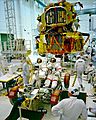
Cernan (seated, right) and Schmitt in the training Lunar Roving Vehicle, with the mockup Lunar Module in the background, August 1972
-
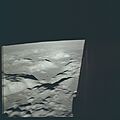
The valley of Taurus-Littrow as seen from the Lunar Module Challenger on the orbit before powered descent there. The Command and Service Module America can just be seen crossing the base of the 2.3 km high South Massif. Between the South and North Massifs, the valley is 7 km wide. Mare Serenitatis, the Sea of Serenity, is on the horizon.
-
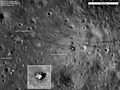
Lunar Reconnaissance Orbiter image of the Apollo 17 mission site taken in 2011, the Challenger descent stage is in the center, the Lunar Roving Vehicle appears in the lower right.
-
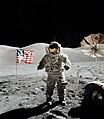
Cernan on the lunar surface, December 13, 1972

.jpg)


See also
 In Spanish: Apolo 17 para niños
- List of Apollo missions
- List of missions to the Moon
- List of astronauts by year of selection
- List of human spaceflights
- List of human spaceflight programs
- List of landings on extraterrestrial bodies
- List of crewed spacecraft
- List of NASA missions
- List of spacewalks and moonwalks 1965–1999
- Moon landing
- The Case of the Missing Moon Rocks
- Apollo in Real Time
