
Arisaema flavum facts for kids
Quick facts for kids Arisaema flavum |
|
|---|---|
 |
|
Scientific classification  |
|
| Kingdom: | Plantae |
| Clade: | Tracheophytes |
| Clade: | Angiosperms |
| Clade: | Monocots |
| Order: | Alismatales |
| Family: | Araceae |
| Genus: | Arisaema |
| Species: |
A. flavum
|
| Binomial name | |
| Arisaema flavum (Forssk.) Schott
|
|
| Script error: The function "autoWithCaption" does not exist. | |
| Synonyms | |
|
|
Script error: No such module "Check for conflicting parameters".
Arisaema flavum is a special kind of flowering plant. It grows in many places, especially in northeastern Africa and southern Asia. You can find it in countries like Ethiopia, Somalia, Pakistan, Afghanistan, and parts of the Himalayas. The name flavum comes from Latin and means "yellow," which tells you about its flower color!
Contents
About the Arisaema flavum Plant
This plant usually grows to about 0.4 meters (about 1.3 feet) tall. It has a round underground part called a tuber, which is like a small potato. This tuber is about 1.5 to 2.5 cm (0.6 to 1 inch) wide.
The plant's stem, called a petiole, can be green or purple. It is about 11 to 35 cm (4 to 14 inches) long.
The Flower's Unique Parts
The most interesting part is its flower. It has a special leaf-like cover called a spathe. This spathe is only about 2.5 to 6 cm (1 to 2.4 inches) long. The lower part of the spathe, called the tube, is yellowish-green and shaped like an egg. It is about 1 to 1.5 cm (0.4 to 0.6 inches) long and 1 to 1.4 cm (0.4 to 0.5 inches) wide.
The opening of the spathe, called the throat, is a dark purple color. The upper part of the spathe, called the limb, can be yellow or green. It is pointed at the end and is dark purple inside. The limb is about 1.5 to 4.5 cm (0.6 to 1.8 inches) long and 0.8 to 2 cm (0.3 to 0.8 inches) wide.
The plant has a central spike called a spadix, which is about 1 to 2 cm (0.4 to 0.8 inches) long. The lower part of the spadix has the female parts (ovaries) and is greenish. The male part is slightly yellow and longer, about 3 to 7 cm (1.2 to 2.8 inches) long. The very tip of the spadix, called the appendix, is short and yellowish-green.
Each flower has two anthers, which are parts that hold pollen. These anthers have two sections, called locules. The flowers bloom from June to July and are pollinated by flies. After flowering, the plant produces berries that are shaped like an upside-down egg. Each berry has three pale yellow seeds, which are about 2 to 2.5 mm (0.08 to 0.1 inches) long.
How Arisaema flavum is Classified
Arisaema flavum is the only member of a group called Arisaema section Dochafa. This group is known for plants that have:
- Round underground tubers.
- One or two leaves with a special fan-like shape.
- A small spathe (the leaf-like cover of the flower).
- Flowers that hang downwards.
Traditional Uses of the Plant
In some areas, like the Konso special woreda in Ethiopia, Arisaema flavum is a very important plant. It is considered a famine food. This means people eat it when other crops fail or during times when food is scarce.
People prefer this plant over other similar Arisaema species. This is because it tastes better, can be prepared quickly, and doesn't spoil as fast. However, all parts of the plant must be crushed and dried first. After drying, they are ground into a powder. This powder is then mixed with water and cooked, similar to how cornmeal is cooked, for about 30 minutes.
Images for kids
-

The Arisaema flavum plant.
-

Seeds of Arisaema flavum.
-
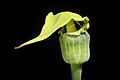
A close-up of the Arisaema flavum flower.
_Schott,_Prodr._Syst._Aroid._40_(1860)_(50064945376).jpg)

_Schott,_Prodr._Syst._Aroid._40_(1860)_(50064951386).jpg)
