
Banksia facts for kids
Quick facts for kids Banksia |
|
|---|---|
 |
|
| Banksia serrata | |
Scientific classification  |
|
| Kingdom: | Plantae |
| Clade: | Tracheophytes |
| Clade: | Angiosperms |
| Clade: | Eudicots |
| Order: | Proteales |
| Family: | Proteaceae |
| Subfamily: | Grevilleoideae |
| Tribe: | Banksieae |
| Genus: | Banksia L.f. |
| Type species | |
| Banksia serrata |
|
| Diversity | |
| About 170 species | |
 |
|
| Distribution of Banksia within Australia | |
| Synonyms | |
Banksia is an amazing group of around 170 species of flowering plants. They belong to the Proteaceae family of plants. Almost all of them grow naturally only in Australia. People recognise them easily by their giant, colorful flower spikes. They also make tough, woody fruiting heads that look like pine cones. They can grow as tiny creeping shrubs or as towering forest trees.
These plants produce large amounts of sweet nectar. Because of this, they are super important for Australian wildlife. Wild birds, tiny mammals, and insects visit them daily to feast on the sweet liquid. People love to grow them in home gardens. Farmers also harvest their blooms for colorful flower arrangements.
Contents
- Discovering the Unique Physical Features of Banksia Plants
- The History and Scientific Discovery of Banksia
- Geographic Distribution and Native Habitats
- Ecological Importance in the Australian Bush
- Environmental Threats and Plant Conservation
- How Humans Use Banksia Plants
- Selected Species
- Images for kids
- See also
Discovering the Unique Physical Features of Banksia Plants

Banksia plants show a fantastic range of sizes and shapes. Some species grow as low shrubs right along the surface of the soil. Others become massive forest giants. For example, the coast banksia and the river banksia can grow up to 30 metres tall. That is as tall as a ten-story building!
The leaves of these plants differ greatly across different species. Some species have tiny, narrow leaves that look just like sewing needles. For example, the heath-leaved banksia has leaves that are only one centimetre long. In contrast, the bull banksia has huge leaves that reach 45 centimetres in length. Most species have leaves with jagged edges like the teeth of a saw. Other species have smooth leaf edges. Young plants often have different leaves than adult plants.
Understanding the Giant Flower Spikes

The most famous part of any banksia plant is its remarkable flower spike. Each spike is actually a dense collection of hundreds or even thousands of tiny flowers. They pack closely together along a tough central woody axis. A single flower head on the bull banksia can hold over 6,000 individual flowers!
These blooms come in bright shades of yellow, orange, red, and pink. Some rare varieties even produce violet blossoms. Each tiny flower has a long, wire-like tube called a style. At first, the style is bent like a bow inside the petals. When the flower is ready, the style pops open. It releases pollen onto visiting animals. Because flowers open in neat waves across the spike, the entire head seems to change colour. This creates an eye-catching display across the bush.
Cones and the Seed Life Cycle

When the flowers finish blooming, the spike slowly withers and changes appearance. The old petals dry out and turn grey or brown. Many people call the dried head a cone, but it is not a true conifer cone. Cones only grow on pine trees and cycads. The banksia structure is actually a cluster of woody fruits called follicles.

Only a small number of the flowers on each spike turn into fruits. These woody follicles form hard lips that lock tightly around the seeds. Inside each follicle, one or two seeds wait safely. Each seed has a thin, papery wing. When the fruit eventually opens, the seed floats away on the wind like a tiny helicopter.
The History and Scientific Discovery of Banksia
Aboriginal Australians knew about banksia plants for thousands of years before Europeans arrived. They used them for food, medicine, and useful tools. European scientists first saw banksias during the famous 1770 voyage of the ship Endeavour. The ship was commanded by Lieutenant James Cook.
Two naturalists on board were Sir Joseph Banks and Daniel Solander. They landed at a sheltered bay on 29 April 1770. They discovered so many unusual plants that Cook named the area Botany Bay. Among the plants they gathered were four completely new species of banksia.
In 1782, a Swedish botanist named Carl Linnaeus the Younger officially described the genus. He named the group Banksia to honour Sir Joseph Banks. Later on, another botanist named Robert Brown studied a related group called Dryandra. Scientists eventually realized that dryandras are true banksias, so they joined them together into one large plant family.
Geographic Distribution and Native Habitats
Banksia plants live in very specific parts of the world. All but one of the living species are endemic to Australia. That means they do not grow wild anywhere else on Earth. The single exception is the tropical banksia. It grows across northern Australia and extends into New Guinea and the Aru Islands.
Geologists have also found ancient plant fossils in New Zealand. This proves banksias once lived across a wider area millions of years ago. Today, living wild banksias grow in two main regions of the Australian continent. One area is eastern Australia, while the other is the southwest corner of Western Australia.
The Southwest Biodiversity Hotspot
Southwest Western Australia is world-famous for its incredible plant biodiversity. More than 90 percent of all banksia species live only in this corner of the continent. They grow from the coastal town of Exmouth down to Esperance.
Many of these plants grow in open heathlands called kwongan. Others grow in the shadow of majestic trees like jarrah and karri. The Stirling Range mountains are home to several rare species that only survive high up on cool, rocky peaks.
Surviving in Sandy Soils and Coastal Scrub
Most banksias love coarse, sandy soil or rocky gravel. These types of ground drain water very quickly. Sandy soils usually contain very few nutrients like nitrogen and phosphorus.
To survive in poor ground, banksias grow special root clusters called proteoid roots. These roots look like dense, bristly bottle brushes under the dirt. They pump out natural acids that break down trapped minerals. This clever trick helps banksias absorb food where other plants would starve.
Ecological Importance in the Australian Bush
Banksia plants are vital to the survival of Australian ecosystems. Because they flower for many months, they provide a reliable banquet of nectar. Many other bush plants stop blooming during cold winter months, but banksias keep producing food.
Bright nectar-feeding birds rely heavily on banksia flowers. Colorful honeyeaters and loud rainbow lorikeets visit the blossoms every single morning. While drinking nectar, the birds get dusted with yellow pollen on their foreheads. As they fly from plant to plant, they spread pollen and help flowers create new seeds.
Animal Partners and Pollinators
Birds are not the only animals that love banksias. Small marsupials come out at night to drink nectar from the flower spikes. The tiny honey possum is an expert banksia feeder with a long, brush-tipped tongue. Pygmy possums, sugar gliders, and native bats also visit the spikes under cover of darkness. Some banksia species even smell stronger at night to help these nocturnal mammals find them.
Insects depend on these plants as well. Weevils and moth caterpillars burrow deep inside the woody cones to eat the seeds. Beautiful native birds like black cockatoos tear open the hard cones with their powerful beaks. They eat both the nutritious seeds and the fat insect grubs hiding inside.
Bushfires and Seed Reproduction
Bushfires happen frequently throughout the dry Australian bush. Many banksia species have evolved clever adaptations to survive these roaring fires. Without fire, some species would never be able to release their seeds.
The tough woody follicles stay clamped shut for years, protecting the seeds from heat and hungry animals. The scorching heat of a bushfire melts the natural resin that seals the valves. After the fire passes, the follicles pop open with a distinct clicking sound. The winged seeds fall onto the cool ash bed below. The fresh ash provides fertile ground and clear sunlight for new seedlings to grow.
Environmental Threats and Plant Conservation
Many banksia species now face serious danger in the wild. People have cleared large areas of native bushland for farms, roads, and cities. This habitat destruction leaves only small, scattered patches of plants.
Another serious danger is an invisible plant disease called dieback. Dieback is caused by a tiny water mould called Phytophthora cinnamomi. It spreads through wet soil and attacks the roots of susceptible plants. Because banksias have dense clusters of proteoid roots, the disease infects them very easily.
The mould rots the root system and prevents the plant from drinking water. Once infected, a healthy banksia tree can wither and die in just a few weeks. In southwest Australia, dieback has destroyed large areas of native forest. Several rare species, such as the feather-leaved banksia, are critically endangered because of this disease. Scientists use special sprays containing phosphite to help save these precious wild populations.
How Humans Use Banksia Plants
Banksias have provided useful materials for people for hundreds of years. Indigenous Australians learned how to collect sweet nectar directly from the blooms. They would pluck the flower spikes and suck the sugary syrup straight off the petals. Sometimes they soaked the fresh spikes in bark bowls filled with water to make delicious, sweet drinks.
Aboriginal peoples also used the cones in clever ways. The Girai wurrung people of Victoria used old, fuzzy cones as natural water filters. They placed the cones in their mouths to strain pond water while drinking. The Noongar people of Western Australia used the smouldering woody cones as natural fire-sticks to carry fire between camps.
Popular Garden Plants
Today, gardeners throughout Australia and around the world love planting banksias. Their unusual flowers bring dramatic colors into suburban yards. Planting banksias also helps local wildlife by bringing wild native birds into neighborhood gardens.
Gardeners must remember that banksias prefer very specific conditions. They need full sunlight and soil that drains water quickly. Because banksia roots are built for poor ground, regular garden fertilizer can harm them. Fertilizers with high amounts of phosphorus can poison the plants.
Cut Flowers and Artistic Crafts
The florist industry loves banksia blooms because they last a long time in vases. Several species, such as the bright scarlet banksia and the woolly bird's nest banksia, are grown on special flower farms. Australian growers ship thousands of freshly cut stems to florist shops across Europe, Asia, and North America.
Woodworkers also prize the massive cones of the bull banksia. The dried cones are rock-hard and have fascinating patterns of holes where the follicles opened. Skilled craftspeople spin the cones on a woodturning lathe to shape beautiful ornamental items. They make items like wooden bowls, pepper grinders, and hollow vases. Slices of the cones are also polished smooth to make unique drink coasters for homes.
Selected Species

Botanists have identified around 170 distinct species in the banksia family. Here are several of the most famous and interesting species:
- Banksia aemula (Wallum banksia)
- Banksia ashbyi (Ashby's banksia)
- Banksia attenuata (Coast banksia of the west)
- Banksia baxteri (Bird's nest banksia)
- Banksia brownii (Feather-leaved banksia)
- Banksia coccinea (Scarlet banksia)
- Banksia cuneata (Matchstick banksia)
- Banksia dentata (Tropical banksia)
- Banksia elderiana (Swordfish banksia)
- Banksia ericifolia (Heath-leaved banksia)
- Banksia grandis (Bull banksia)
- Banksia hookeriana (Hooker's banksia)
- Banksia ilicifolia (Holly-leaved banksia)
- Banksia integrifolia (Coast banksia)
- Banksia marginata (Silver banksia)
- Banksia media (Southern plains banksia)
- Banksia menziesii (Firewheel banksia)
- Banksia prionotes (Acorn banksia)
- Banksia robur (Swamp banksia)
- Banksia serrata (Saw banksia)
- Banksia sessilis (Parrotbush)
- Banksia speciosa (Showy banksia)
- Banksia spinulosa (Hairpin banksia)
Images for kids
-
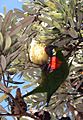
Rainbow lorikeet feasting on a coast banksia flower spike
-
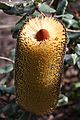
A cultivated dwarf form of southern plains banksia in a garden
-
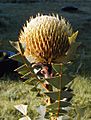
Bird's nest banksia growing in a flower plantation
-
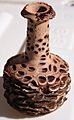
A finished craft bowl turned on a lathe from a bull banksia cone


See also
 In Spanish: Banksia para niños
- Banksiamyces
- Flora of Australia
- Pollination
