
Battle of Bosworth Field facts for kids
Quick facts for kids Battle of Bosworth |
|||||||
|---|---|---|---|---|---|---|---|
| Part of the Wars of the Roses | |||||||
 Battle of Bosworth, as depicted by Philip James de Loutherbourg (1740–1812) |
|||||||
|
|||||||
| Belligerents | |||||||
| House of York | House of Tudor (Lancastrian) Supported by: Kingdom of France Kingdom of Scotland Stanley family |
||||||
| Commanders and leaders | |||||||
|
|
||||||
| Strength | |||||||
| 7,500–12,000 | 5,000–8,000 (including 2,000 French)
4,000–6,000 Stanley men |
||||||
| Casualties and losses | |||||||
| Unknown | 100 Stanley losses unknown |
||||||
The Battle of Bosworth (also known as Bosworth Field) was a very important battle fought in England on August 22, 1485. It was the last major battle in the Wars of the Roses, a long civil war where two powerful families, the Lancastrians and the Yorkists, fought for control of the English throne.
In this battle, Henry Tudor, Earl of Richmond, led an army of Lancastrians and some unhappy Yorkists to victory. He became King Henry VII, the first ruler of the Tudor dynasty. His opponent, King Richard III, the last king from the House of York, was killed during the fight. He was the last English king to die in battle. Many historians see the Battle of Bosworth as the end of the Plantagenet dynasty and a new beginning for England.
Contents
Why the Battle Happened
The Wars of the Roses and Henry Tudor's Claim
For many years in the 1400s, England was caught in the Wars of the Roses. This was a fight between two powerful families, the House of York (whose symbol was a white rose) and the House of Lancaster (whose symbol was a red rose). They both wanted to rule England.
By 1471, the Yorkists had won several key battles. King Henry VI and his son, the last direct Lancastrian heirs, had died. This left the Yorkist king, Edward IV, in charge. However, there was still one person with a distant claim to the Lancastrian side: Henry Tudor. He was living in exile in France and Brittany, protected by local rulers who saw him as a useful pawn in their own politics.
Richard III Becomes King
King Edward IV died in April 1483. His young son, 12-year-old Edward V, was supposed to become king. But Edward V's uncle, Richard, Duke of Gloucester, quickly took control. He claimed that Edward IV's marriage was not valid, which meant Edward V and his younger brother were not rightful heirs to the throne. The two young princes were then kept in the Tower of London and were never seen again. Their disappearance remains a famous mystery in history.
Richard then became King Richard III. Many people were unhappy with how he took the throne. This gave Henry Tudor a chance to try and become king himself.
Henry's Invasion and the Stanleys
Henry Tudor tried to invade England in 1483, but a storm stopped him. He tried again in 1485, landing safely in Wales on August 7. As he marched towards London, more and more people joined his army.
King Richard III quickly gathered his own soldiers. He met Henry's army near Ambion Hill in Leicestershire. Two important noblemen, Lord Stanley and Sir William Stanley, also arrived with their own forces. However, they did not immediately join either side. They waited to see who seemed more likely to win before deciding which leader to support. Lord Stanley was actually Henry Tudor's stepfather, which made the situation even more complicated for King Richard.
Key Leaders and Their Armies
In the 1400s, kings relied on powerful nobles to raise armies. Each nobleman had control over his own soldiers. To get a large army, a king needed the support of these nobles, often by giving them gifts or special positions. At Bosworth, there were three main groups: King Richard III and his Yorkist army, Henry Tudor and his Lancastrian supporters, and the Stanley family, who were undecided.
King Richard III's Forces
King Richard III was a skilled soldier and leader. He had fought bravely in many battles for his brother, Edward IV. He was known for defending England's northern borders.
- Duke of Norfolk: A very loyal supporter of Richard III. He was an experienced military leader who had fought in many battles. Richard rewarded him with land and titles for his support.
- Earl of Northumberland: His family had been Lancastrian, but he later supported the Yorkist kings. He was in charge of defending northern England. He had some disagreements with Richard, but still brought his army to the battle.
Henry Tudor's Supporters
Henry Tudor had spent most of his life outside England and was not an experienced military commander himself. He relied on skilled veterans to lead his army.
- Earl of Oxford: He was Henry's main military leader. Oxford was a very experienced and clever commander. He had fought against the Yorkists for many years and his presence greatly boosted the morale of Henry's army.
The Stanley Family's Role
The Stanley family was very powerful and had a large army. They were known for waiting to see which side was winning before joining the fight.
- Lord Stanley: He was Henry Tudor's stepfather, but he had also served King Richard III. He was very good at politics and always tried to be on the winning side. Richard III did not fully trust him and even took Lord Stanley's son, Lord Strange, as a hostage to try and force his loyalty.
- Sir William Stanley: Lord Stanley's brother. He had often supported the Yorkists in the past. Like his brother, he waited to see how the battle would unfold before committing his forces.
Henry's Journey to Battle
Landing in Wales
Henry Tudor sailed from France on August 1, 1485, with his army of English and Welsh exiles, plus some hired soldiers from France. His journey across the English Channel was smooth. On August 7, he landed in his home country of Wales, at Mill Bay near Dale.
At first, not many local Welsh people joined his army. But as he marched inland, important leaders like Rhys ap Thomas decided to support Henry. Rhys ap Thomas was a powerful figure in West Wales, and Henry promised him a high position if he helped. With more Welshmen joining, Henry's army grew stronger.
Marching Towards Richard
By mid-August, Henry and his men had crossed into England, heading for Shrewsbury. King Richard III had known about Henry's invasion for a while and had ordered his lords to be ready. When he heard Henry had landed, Richard quickly gathered his royal army in Leicester.
Henry moved slowly through the countryside, gathering more recruits. He was also secretly communicating with the Stanley family. The Stanleys had moved their own forces to positions near Henry's path. They met Henry twice to discuss their plans. On August 21, the Stanleys set up camp on a hill near Dadlington, while Henry's army camped nearby.
King Richard rode from Nottingham to Leicester, joining the Duke of Norfolk. The next day, the royal army moved west to stop Henry's march. Richard positioned his army on Ambion Hill, which he thought was a good spot for battle.
The Battle Begins

On the morning of August 22, 1485, King Richard's army, which was larger than Henry's, was ready on Ambion Hill. The Duke of Norfolk led the right side of Richard's army, and the Earl of Northumberland commanded the left. Henry's army, led by the experienced Earl of Oxford, was positioned to the southwest. The Stanley brothers and their men were nearby, still waiting to choose a side.
Richard sent a message to Lord Stanley, threatening to execute his son if Stanley did not join the fight immediately. Lord Stanley famously replied that he had other sons. Henry also sent messages to the Stanleys, asking for their help. The Stanleys remained undecided. Henry had to face Richard's army alone.
Oxford's Strategy and the First Clash
Henry, knowing he was not an experienced fighter, gave full command of his army to the Earl of Oxford. Oxford decided to keep his soldiers close together, forming one strong group, rather than splitting them up. This made them harder to surround.
As Henry's army moved around a marshy area, Richard's cannons fired at them. Once Oxford's men were past the marsh, the Duke of Norfolk's soldiers, along with some of Richard's own men, attacked. Arrows flew, and then the armies clashed in hand-to-hand combat. Oxford's men fought bravely, holding their ground, and some of Norfolk's soldiers began to flee. The Duke of Norfolk lost one of his important officers in this early fighting.
Richard's Bold Charge and Stanley's Intervention

Seeing that his army was struggling, Richard signaled for the Earl of Northumberland to join the battle. But Northumberland's forces did not move. Historians still debate why, but it left Richard in a difficult spot.
At this critical moment, Richard saw Henry Tudor some distance behind his main army. Richard made a daring decision: he would charge directly at Henry, hoping to kill him and end the battle quickly. He led a group of his most loyal knights around the main fight and attacked Henry's bodyguards. Richard fought fiercely, killing Henry's standard-bearer and knocking another knight off his horse. Henry Tudor himself was protected by his guards and did not engage in direct combat.
Seeing King Richard separated from his main army and fighting Henry's group, Sir William Stanley finally made his move. He led his men to Henry's aid. Richard's small group was now surrounded and outnumbered. Richard's horse fell in a marshy area, and he was forced to fight on foot. He refused to retreat, famously saying he would "either win the battle as a king, or die as one." Richard fought bravely until he was killed by Stanley's men. His trusted advisor, Richard Ratcliffe, also died.
News of Richard's death quickly spread, and his army fell apart. Northumberland and his men fled, and the Duke of Norfolk was also killed.
After the Battle
.jpg)
After the battle, King Richard's crown was found and brought to Henry Tudor. Henry was immediately declared king on a nearby hill. He became King Henry VII.
Richard III's body was brought to Leicester and displayed publicly to confirm his death. He was then buried in a church. For a long time, the exact location of his tomb was unknown. However, in 2012, archaeologists discovered a skeleton with injuries matching Richard's in Leicester, under a car park. DNA tests confirmed in 2013 that these were indeed the remains of King Richard III. He was ceremonially reburied in Leicester Cathedral in 2015.
A New Era for England
King Henry VII quickly began to establish his rule. Parliament declared Richard's kingship illegal and reversed the claim that Edward IV's children were not rightful heirs. Henry then married Elizabeth of York, Edward IV's daughter. This marriage united the warring Houses of York and Lancaster, bringing an end to the Wars of the Roses and starting the powerful Tudor dynasty.
Henry rewarded his supporters generously. The Stanley family received many honors and lands. The Earl of Oxford had his lands and titles returned and was given important positions. Henry also made his uncle, Jasper Tudor, the Duke of Bedford.
Even with a new king, there were still some challenges. Two years after Bosworth, a rebellion led by Lambert Simnel claimed to be a Yorkist heir. Henry's army, including some former supporters of Richard III, easily won this battle.
The Battle's Lasting Impact
How History Remembers Bosworth
Historians have studied the Battle of Bosworth using old records from English and foreign writers. Because these accounts sometimes differ, it has been a challenge to piece together all the details of the battle. However, it is clear that Bosworth was a turning point in English history.
William Shakespeare famously included the Battle of Bosworth in his play, Richard III. In the play, Shakespeare shows a dramatic duel between Henry Tudor and Richard III, where good triumphs over evil. Shakespeare's version of the battle, though not entirely historically accurate, helped shape how many people imagined Richard III and the battle for centuries. For example, the famous line, "A horse, a horse! My kingdom for a horse!" comes from Shakespeare's play.
Finding the Battlefield Today

For many years, the exact location of the Battle of Bosworth was debated by historians. The Bosworth Battlefield Heritage Centre was built in 1974 on Ambion Hill, based on one theory of the battle site.
However, new research and archaeological digs from 2003 to 2009, led by archaeologist Glenn Foard, found strong evidence for a different location. They discovered many lead cannonballs and a silver badge with a boar (Richard III's symbol) about 2 miles southwest of Ambion Hill. This suggests the main fighting happened closer to Fenn Lane Farm.

Today, Historic England has updated the official boundaries of the Bosworth Battlefield to include this newly identified area. The St James the Greater Church in Dadlington is the only building in the area directly linked to the battle, as the bodies of those killed were buried there.
Images for kids
-
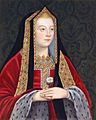
Elizabeth of York: her marriage to Henry Tudor helped unite the warring houses.
-
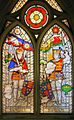
A stained-glass window in St James's Church, Sutton Cheney, commemorates the Battle of Bosworth and its leaders, Richard III (left) and Henry VII (right).
-
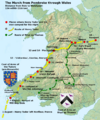
Henry Tudor and Rhys ap Thomas' march through Wales to Bosworth Field.
-
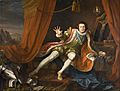
Richard III, Act 5, scene 3: Richard, played by David Garrick, awakens after a nightmare visit by the ghosts of his victims.
-
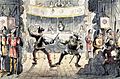
The Battle of Bosworth Field, a Scene in the Great Drama of History, illustrating Beckett's mocking of Victorian attitude towards history.
-
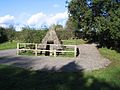
Richard's Well, where the last Yorkist king supposedly took a drink of water on the day of the battle.
-

The newly identified Bosworth Battlefield near Fenn Lane Farm.

.jpg)


.jpg)
See also
 In Spanish: Batalla de Bosworth para niños
