
Beddomeia waterhouseae facts for kids
Quick facts for kids Beddomeia waterhouseae |
|
|---|---|
| Conservation status | |
Scientific classification  |
|
| Kingdom: | Animalia |
| Phylum: | Mollusca |
| Class: | Gastropoda |
| Subclass: | Caenogastropoda |
| Order: | Littorinimorpha |
| Family: | Tateidae |
| Genus: | Beddomeia |
| Species: |
B. waterhouseae
|
| Binomial name | |
| Beddomeia waterhouseae Ponder & Clark, 1993
|
|
| Script error: The function "autoWithCaption" does not exist. | |
Script error: No such module "Check for conflicting parameters".
The Beddomeia waterhouseae, also known as the Claytons Rivulet freshwater snail, is a tiny freshwater snail. It belongs to the Tateidae family. This snail is special because it is endemic to northern Tasmania, Australia. This means it lives naturally only in this one place in the world.
The very first B. waterhouseae snail found, called the holotype specimen, was discovered in a small stream that flows into Little Clayton's Rivulet. This important specimen is kept at the Australian Museum.
Adult B. waterhouseae snails are very small, with shells measuring only about 1.7 to 3.7 millimeters long. That's less than half a centimeter! Their shells are shaped like an oval cone. These snails eat algae and tiny bits of dead plants and animals (called detritus) that they find on rocks. Female snails lay single eggs inside small capsules made of sand grains. They stick these capsules to the underside of rocks or wood.
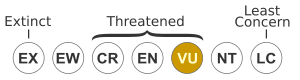
The B. waterhouseae snail is considered vulnerable by the IUCN (International Union for Conservation of Nature). This is because it lives in a very small area and needs clean water to survive. Things like pollution or changes to its home can be a big threat. Efforts are being made to protect this unique snail.
Contents
What Does It Look Like?
The B. waterhouseae snail is part of the Tateidae family, which used to be called Hydrobiidae. It lives only in Australia, especially in northern Tasmania. Even though it looks a bit like many other freshwater snails, its specific shape and how it lives help scientists tell it apart from other snails in the Beddomeia group.
One key feature is its small size. Adult snails are usually shorter than 3.5 millimeters. Their shells are simple and shaped like an oval cone. The shell has a thin inner edge and no big bulge near the opening. Even though the shell is thin, its outer edge curves smoothly. The last part of its shell is usually rounded, or sometimes slightly angled.
Like all other Beddomeia species, B. waterhouseae lives in a very specific place and doesn't move far. It can only be found in its natural home in northern Tasmania, mainly in a small stream that feeds into Little Clayton's Rivulet. Because they live in such tiny areas, protecting them is a top priority for Australian conservation groups.
B. waterhouseae is different from similar snails like B. lodderae and B. forthensis. For example, B. lodderae has a slightly different shell shape, and its belly-button-like opening (called an umbilicus) is more open. B. forthensis is usually even smaller and thinner.
Where Does It Come From?
This snail species was first described by scientists Winston Ponder and G.A. Clark in 1993. The first snail they studied was found in a small stream that flows into Little Clayton's Rivulet. This important specimen is now kept at the Australian Museum.
The Beddomeia group is the largest snail group in the Tateidae family. It includes 42 species that mostly live across the northern part of Tasmania. Many of these species, including B. waterhouseae, are in danger. This is because they live in very small areas, often just one stream or wet spot. Many species might have developed in different places because they are very picky about their habitat. They also can't travel far on their own. They tend to hide in places that are hard for humans to reach, like under rocks.
B. waterhouseae doesn't handle changes to its environment very well. Human activities can make its vulnerable status worse. These snails eat algae and tiny bits of dead plants and animals from rock surfaces. They use a special tongue-like tool called a radula to scrape their food. These snails have separate male and female sexes. Female snails lay single eggs inside capsules, usually made of sand grains. They attach these capsules under rocks or pieces of wood. Tiny young snails then hatch from these eggs.
How Do We Find and Study It?
Like most freshwater molluscs (which include slugs, snails, and mussels), B. waterhouseae can be found near water, living around streams. Because they live in such a small area, you'll find B. waterhouseae close to other snails in small streams. They are mostly, but not completely, in the water. Only one type of Australian freshwater snail, B. tumida, lives only in lakes.
Many Beddomeia species are in danger. Their survival depends on having good water quality. Human actions can harm B. waterhouseae and other freshwater snails. Besides water pollution, changes to their habitat, whether caused by people or nature, also make their numbers go down.
Why Is It Endangered?
The IUCN Red List helps us understand how much attention and care endangered or threatened species need. B. waterhouseae is listed as "endangered". This means a plan is being developed to help this species recover and prevent it from disappearing.
B. waterhouseae is endangered mainly because of habitat loss. Its home range is very small, only a few kilometers. Also, as human development continues, people come into their habitat more often. Even though governments and organizations know about the need to protect this species, specific actions or reservation plans haven't always happened quickly. Many species are in an "emergency" state, and because money and resources are limited, not all endangered species in Australia can be helped at the same time.
Protecting the Snail
The Australian government, through the Environment Protection and Biodiversity Conservation Act 1999, has made protecting Australian plants and animals, including all Beddomeia species, a top priority. Plans have been made to help single species or multiple species recover. The Conservation Act lists over 600 species. However, a lack of money and resources means that action can't be taken for all these species at once.
The protection of B. waterhouseae has been discussed by local and state governments and other groups. While no specific actions are set in stone yet, it's hoped that the Recovery Plan will be put into action by different groups in Tasmania.
These groups have talked about three main ways to protect species like this snail:
- A consistent approach: All regions need to agree on how to protect different species, as each species might need a different plan.
- Transparency: Decisions about which species to prioritize need to be clear and justified. This includes understanding which Beddomeia species are most at risk of extinction.
- Being up-to-date: Many species still don't have recovery plans, while others might have been forgotten or have too much time and money spent on them.
Studying Its Home
New developments and human activities are the main threats to B. waterhouseae. Scientists have looked at aquatic ecosystems to find out which important areas (like species, communities, and habitats) might be affected by new developments, both in water storage areas and downstream. A safe, natural environment is key for animals to survive. So, studying how human activities might change these natural places is important for protecting species.
The Tasmanian Government has laws to protect native Tasmanian species. These laws describe and study some of the main natural environments. Native environments need to be healthy and sustainable. Most have many different native animals (fauna) and some non-native species, including B. waterhouseae. For an environment to be good for animals like B. waterhouseae, it should not have any threatened species already living there. This shows that the environment can support life and keep native animals safe.
The Boobyalla and Tomahawk Rivers in Tasmania are natural homes for hundreds of species. They are in good condition for helping animals survive. B. waterhouseae is found in this area. The fact that an endangered species chooses to live here shows how healthy it is. These rivers are about 7 meters above sea level and are surrounded by green nature and the sounds of thousands of animals. These rivers are open to the public, which can sometimes threaten the animals living there. However, so far, there haven't been many direct negative interactions between animals and humans.
Checking the Plants
Scientists have also checked the vegetation in areas where B. waterhouseae or other animals don't live. This helps them figure out why these places can't support living things. They do this by looking at books, databases, plant maps, aerial photographs, and doing field surveys. The goal is to see if B. waterhouseae or any other important species might be affected by proposed developments.
Animal assessments helped scientists understand the health and quality of B. waterhouseae's habitats. These assessments found that the plants in the study areas could only support four species listed as threatened under the Environmental Protection and Biodiversity Act 1999. It's hard to know exactly how much new projects will affect the long-term survival of animals like B. waterhouseae. More studies are being done to see if human activities directly cause species to disappear from these habitats.
See also
