
Mussel facts for kids
Quick facts for kids Mussel |
|
|---|---|
 |
|
| Blue mussels on rocks in Cornwall, England | |
| Scientific classification | |
| Kingdom: | Animalia |
| Phylum: | Mollusca |
| Class: | Bivalvia |
| Subclasses | |
|
Pteriomorphia (marine mussels) |
|
A mussel is a type of mollusc with two shells, called a bivalve. You can find mussels in both salty ocean water and fresh water like lakes and rivers. They usually have a shell that is longer and not perfectly round, unlike some other clams.
The word "mussel" often refers to marine mussels from the family Mytilidae. Most of these live on rocky shores where the tide goes in and out. They stick firmly to rocks using strong, silky threads called "byssal threads" or their "beard." Some special mussels, like those in the Bathymodiolus group, even live near hot vents deep in the ocean.
Marine mussels often have shells that are longer than they are wide. Their shells are usually dark blue, black, or brown on the outside. Inside, the shell is shiny and silvery, almost like mother-of-pearl.
Many freshwater bivalves are also called mussels, such as the freshwater pearl mussels. These live in lakes, ponds, and rivers. Even though they look a bit like marine mussels, they belong to a different scientific group.
Zebra mussels are another type of freshwater mussel. They look similar to marine mussels and also attach to surfaces with byssal threads. However, they are not closely related to the other mussel groups. They are part of a larger group that includes most animals we call "clams."
Contents
Mussel Body Parts

A mussel's outer shell has two halves, called "valves." These halves are connected by a stretchy band called a ligament. Strong muscles inside the mussel pull the shells shut when needed. The shell helps protect the soft mussel inside from predators and from drying out.
The shell has three layers. The inner layer is shiny and iridescent, made of a material called nacre (or mother-of-pearl). This layer is made of calcium carbonate. The middle layer is chalky white, also made of calcium carbonate. The outer layer is a tough, colored skin-like covering called the periostracum. This outer layer protects the shell from wear and tear, especially from acids in freshwater.
Like most bivalves, mussels have a large organ called a foot. In freshwater mussels, the foot is big and strong, shaped like an axe. Mussels use it to move through sand or mud. They push their foot forward, anchor it, and then pull their body and shell along. It also helps them stay in place.
Marine mussels have a smaller, tongue-shaped foot. This foot has a groove that connects to a special pit. From this pit, a sticky liquid comes out. When this liquid touches seawater, it hardens into very strong, elastic byssal threads. These threads firmly attach the mussel to rocks, helping it stay put in strong currents. Mussels sometimes use these threads to trap predators, like certain sea snails, starving them.
When mussels are prepared for cooking, these byssal threads are often called the "beard." They are usually removed after the mussel has cooked and opened.
How Mussels Live


What Mussels Eat
Both marine and freshwater mussels are filter feeders. This means they eat tiny plants and animals, called plankton, that float in the water. A mussel pulls water into its body through a tube called an incurrent siphon. Tiny hairs, called cilia, on its gills filter out the food. The clean water then leaves through another tube called an excurrent siphon. The food is guided to the mussel's mouth, and digestion begins.
Marine mussels often live in large groups on rocks that are hit by waves. This clumping helps them stay strong against the waves. When the tide is low, mussels in the middle of a clump lose less water because the other mussels protect them.
How Mussels Reproduce
Most mussels have separate male and female individuals. In marine mussels, the males release sperm and females release eggs into the water. Fertilization happens outside the mussel's body. The young mussels then go through a larval stage, floating for weeks or months. Eventually, they settle on a hard surface and grow into young mussels. They can move slowly by attaching and detaching their byssal threads to find a better spot.
Freshwater mussels reproduce sexually. Males release sperm into the water, which then enters the female through her incurrent siphon. After fertilization, the eggs develop into tiny larvae called glochidia. These glochidia temporarily attach to fish, usually on their fins or gills. The fish's body then covers them with cells, forming a small cyst. The glochidia stay there for a few weeks, growing. When they are ready, they break free from the fish and drop to the bottom to live on their own. Some mussels even have special parts that look like small fish to trick real fish into coming closer, helping to spread their glochidia.
Who Eats Mussels
Humans eat marine mussels. Other predators include starfish, seabirds, and certain predatory sea snails. Freshwater mussels are eaten by animals like muskrats, otters, raccoons, ducks, and geese.
Where Mussels Live

Marine mussels are very common in the middle and lower parts of the intertidal zone in temperate oceans around the world. Other types of marine mussels live in tropical areas, but not in such huge numbers.
Some marine mussels prefer calm areas like salt marshes or quiet bays. Others thrive in strong waves, completely covering rocky shores. A few species have even adapted to live deep in the ocean near hot vents. One special South African white mussel doesn't attach to rocks. Instead, it burrows into sandy beaches and extends two tubes above the sand to eat and get rid of waste.
Freshwater mussels live in permanent lakes, rivers, and streams all over the world, except in very cold polar regions. They need a steady supply of cool, clean water. They also prefer water with plenty of minerals, especially calcium carbonate, which they use to build their shells.
Mussel Farming

Mussel farming, also known as aquaculture, is a big industry. In 2005, China produced 40% of the world's farmed mussels. In Europe, where mussels have been farmed for hundreds of years, Spain is a leader. Mussel farming in North America started in the 1970s. The blue mussel (Mytilus edulis) is commonly grown in the US. Most farmed mussels in North America, about 80%, come from Prince Edward Island in Canada.
In New Zealand, the green-lipped mussel (Perna canaliculus) industry produces over 140,000 metric tons each year. In 2009, this was worth more than NZ$250 million.
Growing Mussels
Some marine mussel species, like the blue mussel and the New Zealand green-lipped mussel, are farmed for food. Farmers often collect young mussels (called "seed") from nature or buy them from special hatcheries. These tiny mussels are then placed in a nursery environment. After a few months, they are put into mesh tubes, called "socks." These socks are hung from longlines or rafts in the water. The mussels quickly move to the outside of the sock to get more food. Mussels grow fast and are usually ready to harvest in less than two years. Because mussels use their byssal threads to attach to surfaces, they are good for different farming methods.
Here are some ways mussels are grown:
- Bouchot culture: This method uses wooden poles, called bouchots, planted in the sea. Ropes with mussels growing on them are tied in a spiral around the poles. Nets keep the mussels from falling off. This method works best in areas with large tides.
- On-bottom culture: Young mussels are moved from areas where they settled naturally to new areas. Here, they are spread out to grow faster and to protect them from predators.
- Raft culture: This is a popular method. Ropes with young mussels are hung vertically from a raft floating in the water. The length of the ropes depends on the water depth and how much food is available.
- Longline culture: This method is common in New Zealand. Mussels are attached to ropes that hang from a main rope, which is supported by large floats. Longline culture is good for areas with strong waves.
-
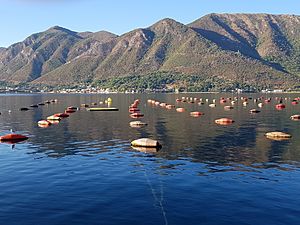
Longline mussel farm in Bay of Kotor, Montenegro
-
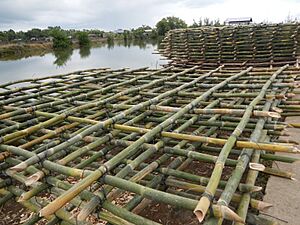
Bamboo raft used for mussel breeding and propagation (Abucay, Bataan, Philippines)


Harvesting Mussels

Mussels usually reach a good size for selling (about 40mm) in 12 to 15 months. How they are harvested depends on how they were grown. For mussels grown on the seabed, special dredges are used. Mussels grown on wooden poles can be collected by hand or with machines. For raft and longline cultures, a platform is lowered under the mussel lines. The lines are then cut, brought to the surface, and put into containers on a boat. After harvesting, mussels are often placed in seawater tanks to clean them before they are sold.

Amazing Mussel Uses
The long byssus threads from a large Mediterranean shell, Pinna nobilis, were historically used to make cloth. This rare fabric is known as sea silk. The byssus of a similar shell, Atrina pectinata, has also been used to weave sea silk.
Scientists have found that the byssal threads that anchor mussels are excellent at sticking things together. Many studies have looked into "mussel glues" for use in industry and even in surgery. These natural glues have inspired new materials for medical implants. Special mussel-inspired proteins have also shown properties that can fight bacteria, even drug-resistant ones.
Byssal threads have also given scientists ideas for creating artificial tendons.
Mussels and the Environment
Mussels are very useful for checking the health of water environments, both fresh and marine. They are good "bio-indicators" because they live all over the world and stay in one place. This means they show what the environment is like where they are found. By studying their populations, health, or how much pollution they have absorbed, scientists can understand the condition of the ecosystem. For example, mussels placed in cages have been used to monitor heavy metal pollution in coastal waters.
Mussels also help clean up water by eating tiny organisms that contain nutrients like nitrogen and phosphorus. When mussels are harvested, these nutrients are removed from the water. This can help reduce pollution in areas where there are too many nutrients, like from human activities. Some countries, like Sweden, even encourage mussel farming to help manage coastal water quality.
Protecting Mussels
Freshwater Mussel Conservation
Many freshwater mussel species around the world are in danger. Out of 511 species studied globally, 44% are considered threatened.
North America has the most diverse freshwater mussel populations. In the United States and Canada, there are 297 known types of freshwater mussels. Sadly, 213 of these (about 72%) are listed as endangered, threatened, or of special concern. Around 37 North American species were thought to be extinct by 2004.
In Europe, 12 out of 16 known freshwater mussel species are threatened. Eight of these are protected by the European Union.
Other parts of the world, like Asia, Africa, and South America, also have many mussel species. However, these are not as well studied. About 61% of Asian freshwater mussels had not been assessed for their conservation status.
The main reasons for the decline of freshwater mussels include:
- Dams that destroy their habitats.
- Increased silt and mud in the water.
- Changes to river channels.
- The introduction of invasive species, like the zebra mussel, which can outcompete native mussels.
Mussels as Food


Humans have eaten mussels for thousands of years. About 17 species are edible. The most common ones are the blue mussel (Mytilus edulis), M. galloprovincialis, M. trossulus, and the New Zealand green-lipped mussel (Perna canaliculus). While freshwater mussels can be eaten, they are not commonly consumed today. Native peoples of North America once ate them widely, and some still do.
During World War II in the United States, mussels became a popular food. This was because red meats like beef and pork were rationed. Mussels offered a good substitute.
Around the world, mussels are prepared in many ways. In Belgium, the Netherlands, and France, mussels are often served with French fries (moules-frites) or bread. In Belgium, they might be cooked with herbs and vegetables in white wine and butter. In Italy, mussels are often steamed with white wine and herbs, served with lemon. In Spain, they are also steamed or boiled. They can be made into "tigres," which are fried croquettes using mussel meat. Mussels are also used in rice dishes, soups, and are commonly sold canned in a seasoned brine.
In Turkey, mussels are either fried on skewers (midye tava) or stuffed with rice and served cold (midye dolma). In Ireland, they are boiled and seasoned with vinegar. In Cantonese cuisine, mussels are cooked in a broth with garlic and fermented black beans. In New Zealand, they are served in a chili or garlic sauce, made into fritters, or used in a chowder.
In Brazil, mussels are often cooked with olive oil, onion, garlic, and other herbs. This dish is popular, especially in warm climates where mussels reproduce well. In parts of India, mussels are prepared with vegetables or stuffed with rice and coconut paste. Fried mussels are a popular spicy dish in north Kerala.
Cooking Mussels Safely

.jpg)


Mussels can be smoked, boiled, steamed, roasted, barbecued, or fried. They are great in soups, salads, and sauces. It's very important to check that mussels are alive just before you cook them. If they are dead before cooking, they can become unsafe to eat. Live mussels will close tightly when you tap them. Any mussels that are open and don't close should be thrown away. You should also rinse mussels well and remove their "beard."
Mussel shells usually open when cooked. Historically, people believed that any mussels that didn't open after cooking were unsafe and should be discarded. However, some experts now say that even unopened mussels are usually cooked and safe to eat if forced open.
Sometimes, mussels can contain natural toxins. This can happen when they eat certain tiny organisms, like those that cause "red tides." These toxins don't harm the mussels, but they can make people very sick if eaten. This is why it's important to avoid eating wild mussels from certain coastlines during warmer months, as advised by local authorities.
Mussel Nutrition Facts
| Serving size | 3 ounces (85 g) |
| Calories | 70 |
| Protein | 10.1 g |
| Carbohydrate | 3.1 g |
| Fiber | 0.0 g |
| Total fat | 1.9 g |
| Saturated fat | 0.4 g |
| Sodium | 243 mg |
- Excellent source of: selenium (44.8 μg), and vitamin B12 (12 μg)
- Good source of: zinc (1.6 mg), and folate (42 μg)
Foods that are an "excellent source" provide 20% or more of the daily recommended amount of a nutrient. Foods that are a "good source" provide between 10% and 20%.
See also
- Brachiopod
- Oyster
- California mussel
- Dwarf wedgemussel
- Water purification
