
Cinnamon-rumped trogon facts for kids
Quick facts for kids Cinnamon-rumped trogon |
|
|---|---|
 |
|
| Conservation status | |
Scientific classification  |
|
| Kingdom: | Animalia |
| Phylum: | Chordata |
| Class: | Aves |
| Order: | Trogoniformes |
| Family: | Trogonidae |
| Genus: | Harpactes |
| Species: |
H. orrhophaeus
|
| Binomial name | |
| Harpactes orrhophaeus (Cabanis & Heine, 1863)
|
|
| Script error: The function "autoWithCaption" does not exist. | |
Script error: No such module "Check for conflicting parameters".
The cinnamon-rumped trogon (Harpactes orrhophaeus) is a beautiful bird. It belongs to the Trogonidae family, also known as Trogons. These birds are known for their bright colours, especially the quetzals. Not much is known about this bird family, and even less about the cinnamon-rumped trogon itself.
Contents
About Trogons
The cinnamon-rumped trogon is part of the Trogon family (Trogonidae). This family has 43 different species. Trogons are quite special because they are the only family in their bird group, called Trogoniformes. This means they don't have any close living relatives.
Trogons have been around for a very long time. They first appeared in Eurasia during the Paleogene era. This was before the continents moved apart. Over time, they spread across different parts of the world. They moved through Laurasia and Africa. Eventually, they settled in tropical areas of Africa, Asia, and America. Scientists think this happened because the world got cooler. Trogons needed specific warm habitats, so they moved to these safer, warmer places.
What They Look Like
The cinnamon-rumped trogon looks a lot like the scarlet-rumped trogon. It can be hard to tell them apart. The cinnamon-rumped trogon is a bit bigger. Its main difference is its pale brown back and tail, which gives it its "cinnamon-rumped" name. The scarlet-rumped trogon is almost completely red.
There are two types, or subspecies, of the cinnamon-rumped trogon. One type (Harpactes orrhophaeus orrhophaeus) lives mostly in Thailand and Malaysia. The other type (Harpactes orrhophaeus vidua) is found in northern and central Borneo. Both types of birds show clear differences between males and females. This is called sexual dimorphism.
The main type of cinnamon-rumped trogon is about 25 cm tall. It usually weighs between 45 and 61 grams. Male birds have a black head and a bright blue beak. Their upper body and tail are pale brown, like cinnamon. They also have a white underside with black edges. The male's belly is pink or red, which helps tell it apart from the female.
Female cinnamon-rumped trogons have a dark brown head. The area around their eyes is a lighter brown. Their belly is not pink. Instead, it is a dusty yellow-brown colour. Young birds look like the females, so it's hard to tell if they are male or female when they are young.
The second type of trogon, the vidua subspecies, is very similar. It's hard to tell them apart from the first type. The vidua subspecies has a slightly larger chest. Female vidua trogons tend to be darker overall. They also have more light brown on their face. The easiest way to tell the two subspecies apart is by where they live.
To identify a trogon, you can look at its flight feathers. These feathers usually don't change, even when the bird grows up. This means their colours can help identify the species. To find out a bird's age, you can look at the patterns on its tail.
Where They Live
The cinnamon-rumped trogon lives in Southeast Asia. You can find them in Peninsular Malaysia, Thailand, and Borneo. In Malaysia and Thailand, they often live in shrubs and trees, about 2 to 4 meters high. In Borneo, they can be found higher up in trees, sometimes 1000 to 1400 meters high.
These birds prefer lowlands and hills. They like forests filled with Dipterocarpaceae trees. They can also be found in peat swamp forests. These are very humid forests with lots of decaying plants, often near mangroves. This happens rarely, like in Brunei.
The cinnamon-rumped trogon does not move around much. It stays in its home area all year long.
How They Behave

Bird Calls
The cinnamon-rumped trogon makes a short, sharp call. It usually repeats this call about 4 or 5 times. The sound is like "ta-y-aup-ta-y-aup." There is a pause of about 10 to 15 seconds between these calls. They also have another call that sounds like a purr, which might be an alarm. These different calls are used for different reasons, but we don't know exactly what they all mean. Trogons also have a special group call that they only use during breeding season.
What They Eat
Cinnamon-rumped trogons mostly eat insects. This is true for trogons found in South Asia. They especially like cicadas and many types of phasmids, like stick and leaf insects. This bird usually hunts alone. However, sometimes they hunt in small groups.
Raising Young
Cinnamon-rumped trogons breed in March, April, and June in Malaysia. In Borneo, they mainly breed in March. These birds usually build their nests in the lower parts of rotten trees. They make their own holes or cavities for nesting, about 1 to 1.5 meters high. They usually lay 2 eggs each time they nest. Both parents help to keep the eggs warm.
During breeding season, trogons form "calling groups." Males and females call to each other. Scientists think this might be a way to find mates or good nesting spots. While calling, males often start a "racing performance." They chase both females and other males from tree to tree, calling constantly. There are usually 3 to 10 males and fewer females in these races.
Their Future
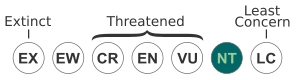
The cinnamon-rumped trogon is not currently considered in danger of extinction. However, it is listed as "Near Threatened." This means its numbers are decreasing. In Thailand, their homes are being destroyed. They only have 3 protected areas where they can live safely. In Malaysia, the cinnamon-rumped trogon has been seen more often in its usual environment.
Sadly, their natural homes are becoming rarer. This is because of deforestation (cutting down forests) in Asia. This loss of habitat also threatens the birds in Malaysia. This species has always been rare. So, being "Near Threatened" is very worrying. It could mean they face extinction if we don't take steps to protect them.
