
Corps Franc de la Montagne Noire facts for kids
Quick facts for kids Corps franc de la Montagne noire |
|
|---|---|

Armband of the Corps Franc de la Montagne Noire
|
|
| Active | April – September 1944 |
| Country |  France France |
| Allegiance |  Free France Free France |
| Type | Paramilitary Irregular military |
| Size | 900 |
| Garrison/HQ | Montagne Noire |
| Engagements | World War II |
| Commanders | |
| Notable commanders |
|
The Corps Franc de la Montagne Noire (which means "Free Corps of the Black Mountain"), or CFMN, was a brave fighting group during World War II. It was part of the French Resistance in France. This unit was based in the Montagne Noire (Black Mountain), a hilly area in southwestern France.
Their main job was to stop German soldiers from moving to help fight against the Allied landings. These landings happened in Normandy and Provence.
Contents
What Was the French Resistance?
The French Resistance was a secret movement in France during World War II. It fought against the German occupation. Many different groups were part of it. They worked to free France from German control.
How the CFMN Started
Starting in 1939, the French Army created special volunteer units called Corps Franc. These groups carried out surprise attacks and bothered enemy troops. In 1942, the Secret Army was formed as part of the Resistance.
By February 1944, all these Resistance forces joined together. They became known as the French Forces of the Interior (FFI). General Marie-Pierre Kœnig was their commander. The Corps Franc units, including the CFMN, were led by Serge Ravanel.
The Corps Franc de la Montagne Noire was officially set up on April 20, 1944. It was created in a town called Castres. This group took orders directly from London. Their goal was to bring many local groups together. This way, they could fight behind German lines when the Allies landed in France.
Forming the Fighting Unit

In September 1943, a secret agent named Henri Sévenet arrived in southwest France. He was known as Commandant Mathieu. His mission was to create a fighting unit. This unit would help the Allied landings in Provence.
In Toulouse, he met Roger Mompezat, also known as Commandant Roger. Roger had fought in World War I. They worked with another agent, Harry Despaigne, known as Major Richardson. Richardson was a skilled radio operator. Together, they arranged for weapons to be parachuted into the region.
Setting Up the Camps
In April 1943, following instructions from London, they set up the Free Corps. This was in the Montagne Noire area. Supplies and weapons began arriving from Algiers. They were dropped on the plateau of Pic de Nore.
The group was divided into five camps: Plo Del May, Fonbruno, Le Rietgé, Co de David, and La Galaube. The Corps Franc de la Montagne Noire had people from 21 different countries! A military trainer, Bernard Jouan de Kervenoaël, known as Capitaine Saint-Michel, trained the soldiers.
The unit had three main platoons. One was made up of French fighters. The second included Spanish Republicans and former Russian prisoners of war. These Russians had been forced to join the German army but then escaped. The third platoon was a Jewish platoon. This group was called the Trumpeldor platoon. They wore special blue-and-white shoulder patches to show their identity.
Working with Allies
The CFMN communicated directly with London through Major Richardson. This group was well-armed and very effective. Because of this, some other Resistance groups felt jealous. They saw the CFMN as working only for the Allies. The CFMN also preferred to stay independent from the French Forces of the Interior. After the Normandy landing, the CFMN had so many volunteers that they had to stop accepting new ones.
Fighting the Enemy

On June 9, the CFMN split into three groups. They attacked a German convoy for the first time. A few days later, on June 12, they attacked another convoy. This happened between Mazmet and Les Martyrs, causing much damage.
On June 29, near Saissac, they ambushed seven German trucks with 30 soldiers. Eight German soldiers were killed, and three were wounded. Two of the Resistance fighters were also killed.
On July 14, about 400 men marched bravely through the town of Revel. They sang the French national anthem, La Marseillaise, before returning to the mountains. Five days later, on July 19, the Corps-franc attacked another German convoy. This was at Pont d'Alzau, causing many casualties and taking prisoners. On July 20, near Alzau, 15 CFMN members attacked German tanks with grenades. They fought for over two and a half hours.
German Attacks and End of the Unit
The Germans soon found out where the CFMN was located. On July 20, 1944, they launched an air attack early in the morning. They bombed all five camps. Many fighters were killed, including one of the commanders, Henri Sévenet.
Right after the bombing, the 11th Panzer Division was sent to destroy the group. This was a large German army unit with 1,500 men. The CFMN was pushed back and split into smaller groups. On August 23, 1944, nine Resistance fighters were killed near Pont de la Mouline. By September, most of the remaining fighters joined the First Army. They helped in the liberation of France.
Remembering Their Bravery
At the Galaube camp, a special memorial was built. It honors the brave Resistance fighters of the Free Corps of the Black Mountain. These men died fighting on July 20, 1944. The memorial lists the names of Henri Sevenet, known as Commandant Mathieu, and his three comrades. They were Simon Gembarowski, Marius Barnes, and Marcel Maurel.
Images for kids
-
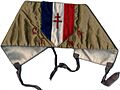
Armband of the Corps Franc de la Montagne Noire
-
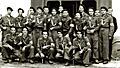
Members of the Corps Franc de la Montagne Noire
-
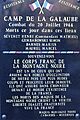
Memorial stele commemorating the men of the Corps franc de la Montagne Noire killed on 20 July 1944.
