
Dark-brown serotine facts for kids
Quick facts for kids Dark-brown serotine |
|
|---|---|
| Conservation status | |
Scientific classification  |
|
| Kingdom: | Animalia |
| Phylum: | Chordata |
| Class: | Mammalia |
| Order: | Chiroptera |
| Family: | Vespertilionidae |
| Genus: | Pseudoromicia |
| Species: |
P. brunnea
|
| Binomial name | |
| Pseudoromicia brunnea (Thomas, 1880)
|
|
| Script error: The function "autoWithCaption" does not exist. | |
| Synonyms | |
|
|
Script error: No such module "Check for conflicting parameters".
The dark-brown serotine (Pseudoromicia brunnea) is a type of vesper bat. These bats live in parts of Central Africa and West Africa.
Contents
What is a Dark-Brown Serotine Bat?
This bat was first described in 1880 by a British zoologist named Oldfield Thomas. He found the bats in a place called Old Calabar, which is now in Nigeria.
The name "brunnea" comes from the Latin word for "brown." This name likely refers to the bat's fur color. In 2020, scientists placed this bat into a new group, or genus, called Pseudoromicia.
How Does It Look?
The dark-brown serotine bat is, as its name suggests, dark brown. It has short ears. Its tail membrane, called a uropatagium, has a special part called a calcar.
The bat's tragus, which is a small flap in its ear, is medium-sized and straight. Its head and body are about 1.8 in (46 mm) long. The tail is about 1.35 in (34 mm) long. Its ears are about 0.55 in (14 mm) long.
The forearm of this bat is about 33–38 mm (1.3–1.5 in) long. Its wings are a blackish-brown color. This bat has 32 teeth in total.
Bat Babies
Female dark-brown serotine bats usually give birth to one baby at a time.
Where Do They Live?
You can find this bat in several countries in West Africa and Central Africa. These countries include Cameroon, Congo, Côte d'Ivoire, Equatorial Guinea, Gabon, Ghana, Liberia, Nigeria, and Sierra Leone.
This bat prefers to live in rainforests. It is usually found in low areas. However, it has been seen at higher places, up to about 1,470 m (4,820 ft) above sea level.
Is This Bat in Danger?
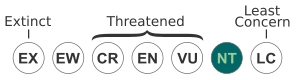
The IUCN says the dark-brown serotine is "near threatened." This means its population is likely decreasing.
The main reasons for this decline are deforestation and land being cleared for farmland. These activities destroy the bat's natural home. The IUCN notes that this bat is close to becoming a "vulnerable" species.
