
Dark mahseer facts for kids
Quick facts for kids Dark mahseer |
|
|---|---|
| Conservation status | |
Scientific classification  |
|
| Kingdom: | Animalia |
| Phylum: | Chordata |
| Class: | Actinopterygii |
| Order: | Cypriniformes |
| Family: | Cyprinidae |
| Genus: | Tor |
| Species: |
T. ater
|
| Binomial name | |
| Tor ater (Roberts, 1999)
|
|
| Script error: The function "autoWithCaption" does not exist. | |
Script error: No such module "Check for conflicting parameters".
The dark mahseer, known scientifically as Tor ater, is a special type of mahseer fish. It lives only in the freshwaters of Central Laos. This fish is quite rare and not much is known about it.
Contents
What is the Dark Mahseer?
The dark mahseer is a type of carp fish. It belongs to a family called Cyprinidae, which includes many well-known fish like carp and minnows. Even though it's a mahseer, it has some unique features. For example, it has fairly small scales, with about 30 or 31 scales along its side, where its lateral line is. The lateral line is a special sense organ that helps fish detect movement and vibrations in the water. This fish also has a head that looks quite large compared to its body.
How is it Different from Other Mahseer?
Compared to another mahseer found in the Mekong River area, called Tor polylepis, the dark mahseer has slightly bigger scales. It also has fewer gill rakers, which are small, comb-like structures on the gills that help fish filter food from the water. Its snout, or nose area, is also shaped differently, being a bit curved inwards.
Where Does the Dark Mahseer Live?
The dark mahseer is very hard to find. Even local fishermen in the area where it lives don't know much about it. So far, this fish has only been found in the Nam Theun watershed in Central Laos. This area is part of the larger Mekong River basin, which is a huge river system in Southeast Asia. The first time scientists officially identified this fish was in a place called Ban Talang.
What Does the Dark Mahseer Eat?
Like other mahseer species, the dark mahseer is likely an omnivore. This means it eats both plants and animals. Its diet probably includes many different things. It might eat small creatures without backbones, like insects and worms, that live in the water or on land. It could also eat fruits, other plant parts, small amphibians like frogs, and even other small fish.
How Does it Reproduce?
Scientists believe that adult dark mahseer probably swim upstream into smaller rivers and streams when the water levels are high. They do this to lay their eggs, a process called spawning. This is a common behavior for many fish species that live in rivers.
Why is the Dark Mahseer Important?
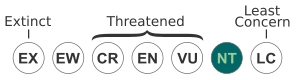
The dark mahseer is currently listed as "Near Threatened" by the IUCN. The IUCN is a global organization that helps protect nature. "Near Threatened" means the species might become endangered soon if we don't protect it. Scientists have only found three dark mahseer specimens so far. This means we don't know much about where they live or how they behave. This lack of information makes it hard to create good plans to protect them.
Threats to the Dark Mahseer
Many things threaten the dark mahseer and other mahseer species. These threats include:
- Habitat loss: As cities grow and people build more, the places where these fish live are destroyed.
- Dams: Building dams on rivers changes the water flow and can block fish from moving to their spawning grounds.
- Pollution: Water pollution from farms and cities can harm fish and their food sources.
- Harmful fishing methods: Some people use dangerous methods like dynamite, poisons, or electricity to catch fish. These methods kill many fish, including young ones, and can destroy entire populations.
Protecting the dark mahseer means protecting its home and making sure fishing is done in a safe way.
