
Deepsea Challenger facts for kids

Drawing of the Deepsea Challenger craft (not to scale)
|
|
Quick facts for kids History |
|
|---|---|
| Australia | |
| Name | Deepsea Challenger |
| Builder | Acheron Project Pty Ltd |
| Launched | 26 January 2012 |
| In service | 2012 |
| Status | On display in touring exhibitions and research centres |
| __1B0X_5H1P__ | career |
| General characteristics | |
| Type | Bathyscaphe |
| Displacement | 11.8 tons |
| Length | 7.3 m (24 ft) |
| Installed power | Electric motor |
| Propulsion | 12 thrusters |
| Speed | 3 knots (5.6 km/h; 3.5 mph) |
| Endurance | 56 hours |
| Test depth | 11,000 m (36,000 ft) |
| Complement | 1 |
| __1B0X_5H1P__ | characteristics |
Deepsea Challenger (DCV 1) is a specialized, 7.3-metre (24 ft) deep-diving research submarine. It was designed to reach the absolute bottom of the Challenger Deep, the deepest known place on Earth.
On 26 March 2012, famous Canadian filmmaker and explorer James Cameron piloted the unique craft down to the seabed. This historic voyage was only the second time in human history that a crewed vessel visited the Challenger Deep.
Engineers and marine scientists built the vessel in Sydney, Australia. The craft carries high-definition 3-D cameras and advanced robotic sampling gear. It reached the ocean's deepest point in just two hours and 36 minutes.
Contents
Understanding Deep-Sea Exploration and Challenger Deep
What Is the Challenger Deep?
The Challenger Deep is the deepest surveyed point in Earth's oceans. It sits at the southern end of the Mariana Trench in the western Pacific Ocean.
The trench plunges nearly 11,000 metres (36,000 ft) deep. If you placed Mount Everest at the bottom, its peak would still sit under two kilometers of water.
The environment at this depth is totally dark, freezing cold, and under crushing physical forces. The water pressure exceeds 1,000 times standard sea-level atmospheric pressure.
The History of Mariana Trench Dives
The first crewed expedition to the trench occurred in 1960. Ocean explorer Jacques Piccard and Navy Lieutenant Don Walsh descended inside the bathyscaphe Trieste.
Trieste proved that humans could safely visit the ocean floor. However, its heavy metal tanks and older systems limited scientific investigation.
For decades after, only uncrewed robotic probes explored these extreme depths. Scientists needed modern technology to spend more time observing living creatures.
Why Do Scientists Explore the Deep Ocean?
Exploring the ocean's deepest trenches helps researchers discover unique marine life, understand plate tectonics, and study extreme biology.
Organisms living in deep trenches survive without sunlight. They rely on chemicals from ocean vents and organic material drifting down from above.
Studying these extreme creatures provides new insights into how life began on Earth. It also helps space scientists imagine life on icy moons.
Engineering and Building Deepsea Challenger
Who Built the Deepsea Challenger?
The submarine was engineered and built by Acheron Project Pty Ltd in Sydney, Australia. The project received backing from the National Geographic Society and Rolex.
Australian engineer Ron Allum led the design and manufacturing team. Many team members were experienced cave divers who understood working in tight spaces.
The team worked out of a specialized workshop in Leichhardt, Sydney. They invented new materials to survive deep-sea conditions.
Developing Isofloat Syntactic Foam
Standard submarines use heavy metal hulls to stay rigid, but this approach makes deep-diving subs too heavy to float easily.
Ron Allum invented a new structural material called Isofloat. This specialized syntactic foam is filled with tiny, hollow glass spheres suspended in resin.
Isofloat made up about 70 percent of the submarine's total volume. The foam is lightweight enough to float, yet strong enough to resist crushing pressure.

The Strong Pilot Sphere
The pilot sphere is a small, heavy steel ball located at the base of the craft. It held only one person: pilot James Cameron.
Its solid steel walls are 64 mm (2.5 in) thick. Engineers tested the sphere in a high-pressure chamber at Pennsylvania State University.
The sphere's interior is packed with oxygen systems, air filters, condensation sponges, and flat-screen monitors. Cameron had to sit with his knees bent for hours.
Electronics, Lighting, and Scientific Tools
Because sunlight disappears within the first 200 meters of the ocean, the sub needed powerful artificial lighting.
Engineers built special light-emitting diode (LED) panels that could illuminate large areas of the seabed. They also designed high-definition 3D cameras inside pressure housings.
The submarine included a mechanical arm to collect rocks and sediment. Powerful lithium batteries supplied electricity to twelve compact thruster motors.
-
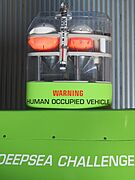
Beacons and antennae on the sub's top
-
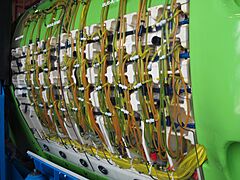
Battery arrays stored in special housings
-
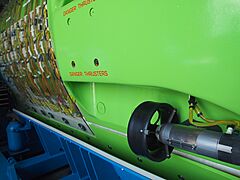
Electric thrusters used for fine maneuvering
-
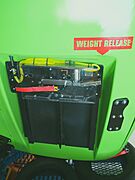
Ballast weight system mounted at the base
-
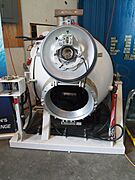
The steel pilot sphere before installation
-
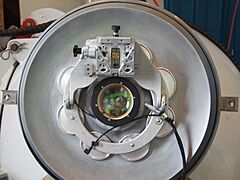
The heavy hatch and viewing port
-
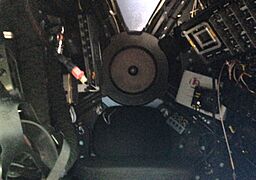
Interior view showing pilot controls


Test Dives and Preparations
Early Shallow and Medium Dives
Before attempting a dive into the Mariana Trench, the team ran a series of safety tests in early 2012.
In late January 2012, Cameron spent three hours submerged in Sydney Naval Yard. This test confirmed that basic life support and controls worked.
In February 2012, the team moved the ship to the Solomon Sea near New Britain Island. They completed dives down to 991 metres (3,251 ft) and 3,700 metres (12,100 ft).
Exploring the New Britain Trench
In March 2012, the expedition team traveled to the New Britain Trench to perform deep-water trials.
During one trial, Cameron guided the submersible to a depth of 8,221 metres (26,972 ft). This dive set a new depth record for an Australian-built vehicle.
Cameron spotted vast plains of sediment, sea anemones, and deep-sea jellyfish. These trials proved the craft was ready for Challenger Deep.
The Historic Dive to Challenger Deep
Setting Out for the Mariana Trench
In mid-March 2012, the team loaded the sub onto the support ship Mermaid Sapphire. They sailed from Guam toward the dive site.
The crew monitored ocean swells and weather forecasts closely. Rough waves can make launching and recovering a tall submarine very dangerous.
On 26 March 2012, conditions were calm. Cameron entered the sphere, sealed the heavy hatch, and prepared for descent.
Descending Through the Water Column
The dive began early in the morning. Deepsea Challenger descended vertically, like a sleek underwater elevator, cutting through the water.


The craft sank at speeds up to 2.5 metres per second (8.2 ft/s). The entire descent to the ocean floor took only two hours and 36 minutes.
Cameron kept in contact with his surface crew using acoustic sound pulses. He regularly reported cabin pressure, battery levels, and oxygen readings.
Discoveries on the Ocean Floor
When the craft touched down at 10,908 metres (35,787 ft), Cameron observed a flat, featureless seabed covered in fine, pale silt.
Cameron spent roughly three hours exploring the bottom. He recorded high-resolution 3D video and captured images of the alien-like landscape.
Some equipment experienced glitches due to the intense pressure. A hydraulic line leaked fluid, preventing the sampling arm from gathering all intended samples.
Surfacing and Recovery
To return home, the pilot activated an electrical switch that released heavy iron ballast weights.
Lighter than water, the sub shot toward the surface, rising in about 70 minutes. It bobbed at the surface until recovery boats arrived.
The support crew attached tow lines, and the crane lifted the submarine safely back onto the deck of Mermaid Sapphire.
Legacy, Display, and Modern Deep Exploration
Where Is the Submarine Today?
Following the expedition, the vessel was donated to the Woods Hole Oceanographic Institution in Massachusetts for study.
Scientists studied its syntactic foam and battery systems to help design next-generation underwater robots.
The craft has appeared in museum exhibits, including the Natural History Museum of Los Angeles County and the Royal Canadian Geographical Society in Ottawa.
Other Deep Trench Expeditions
Modern ocean engineering continues to expand what scientists can learn about extreme ocean depths:
- DSV Limiting Factor: A two-person titanium submarine designed by Triton Submarines. It has made dozens of dives to Challenger Deep.
- Fendouzhe: A deep-diving research submarine built by Chinese engineers, carrying three scientists to deep ocean trenches.
- Autonomous Undersea Vehicles (AUVs): Robotic probes that map ocean trenches using multibeam sonar systems.
See Also
- Challenger expedition
- Deep-sea exploration
- Timeline of diving technology
