
DSV Limiting Factor facts for kids
.jpg) |
|
| History | |
|---|---|
| United States | |
| Name | Limiting Factor (renamed Bakunawa) |
| Operator | list error: <br /> list (help) Caladan Oceanic (2018–2022) Inkfish (2022–present) |
| Builder | Triton Submarines LLC |
| Cost | $37 million (USD) |
| In service | 2018–present |
| Status | In service |
| __1B0X_5H1P__ | career |
| General characteristics | |
| Class & type | Triton 36000/2 crewed full ocean depth deep-submergence vehicle |
| Displacement | 12,500 kg (27,600 lb) total weight |
| Length | 4.6 m (15 ft) |
| Beam | 1.9 m (6 ft 3 in) |
| Propulsion | 10 electric thrusters |
| Speed | Across: 2–3 kn (3.4–5.1 ft/s; 1.0–1.5 m/s), Up/Down: 1–2 kn (1.7–3.4 ft/s; 0.51–1.03 m/s) |
| Endurance | 16 hours normal, plus 96 hours emergency life support |
| Test depth | 14,000 msw (46,000 fsw) |
| Complement | 2 (1 pilot and 1 observer) |
| Armament | None |
| __1B0X_5H1P__ | characteristics |
Limiting Factor (also known as Bakunawa) is a famous crewed deep-submergence vehicle (DSV). It is a special type of submersible built to carry humans to the very deepest places on Earth.
The vehicle was built by Triton Submarines for explorer Victor Vescovo. Between 2018 and 2022, Vescovo used it for deep-sea exploration. In 2022, the vessel was purchased by the research group Inkfish, founded by Gabe Newell, and renamed Bakunawa.
Limiting Factor made history during the famous Five Deeps Expedition. It became the first crewed vehicle to dive to the deepest point in all five of the world's oceans. It has also explored historic shipwrecks at record-breaking depths, including the USS Johnston and the USS Samuel B. Roberts.
Contents
What Is the Deep-Submergence Vehicle Limiting Factor?
A deep-submergence vehicle is a small submarine designed to operate in extremely deep water. Most regular military submarines can only dive a few hundred meters deep. In contrast, Limiting Factor can reach depths of over 11,000 m (36,000 ft). That is deeper than Mount Everest is tall.
The vessel was designed under the model name Triton 36000/2. The number 36,000 stands for its design depth in feet. The number 2 means it holds two people side by side: one pilot and one passenger or scientific observer.
It holds commercial safety certifications from DNV, an international testing organization. This means the submersible was certified to carry humans safely to full ocean depth repeatedly.
Why Was the Submersible Built?
For many decades, reaching the deepest parts of the ocean was very rare. In 1960, the bathyscaphe Trieste reached the bottom of the Mariana Trench. In 2012, film director James Cameron visited the trench in the Deepsea Challenger.
However, both of those earlier craft were experimental. They were only able to make a single dive to the deepest point. Victor Vescovo wanted a new submersible that could dive to the ocean floor over and over again without wearing out.
The project cost around $37 million to design, construct, and test. It gave scientists an unprecedented tool to study extreme marine life, underwater geology, and deep oceanic trenches.
Origin of the Names Limiting Factor and Bakunawa
Victor Vescovo named the vessel Limiting Factor after a spaceship in the science fiction novels of author Iain M. Banks. In the book The Player of Games, a clever ship is named the Limiting Factor.
In 2022, when the Inkfish organization bought the submarine, they gave it the name Bakunawa. In Philippine mythology, Bakunawa is a giant sea serpent or dragon that can swallow the moon and rule the ocean depths.
Engineering and Design Features of the Deep Submersible
Exploring the deep sea is one of the hardest engineering challenges in human history. At the bottom of the ocean, the weight of the water creates immense pressure. In the Mariana Trench, the water pressure is over 1,000 times greater than air pressure at sea level. This is equal to having several large trucks stacked on top of a person's thumb.
To survive these harsh conditions, the team at Triton Submarines used innovative engineering techniques, strong materials, and multiple backup safety systems.
-
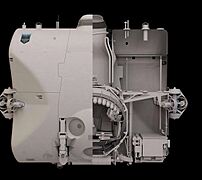
Limiting Factor cutaway view showing the inner pressure sphere
-
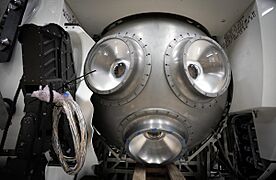
The titanium pressure hull during construction
-
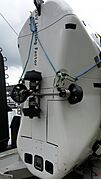
Side view of the vehicle
-
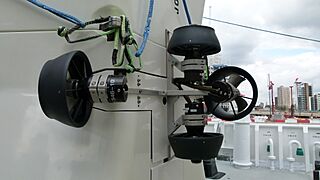
Close-up view of the electric thruster cluster


The Titanium Pressure Hull
The most critical component of the vessel is the cabin where the crew sits, known as the pressure hull.
- The hull is a hollow sphere made from Grade 5 titanium alloy.
- Titanium was chosen because it is lightweight, extremely strong, and resistant to corrosion from salty seawater.
- The sphere has an inner diameter of 1,500 mm (59 in) and walls that are 90 mm (3.5 in) thick.
- It was machined with extreme precision to be 99.933% perfectly round. If a pressure sphere is uneven, the intense water pressure could crush it.
- The sphere was built in two halves that fit tightly together with rubber O-ring seals.
Because the pressure hull is a sphere, the crew inside experiences standard atmospheric pressure. They do not need special diving suits or decompression periods when returning to the surface.
Viewports and Vision Systems

To look out into the deep sea, the submersible has three large windows called viewports:
- The viewports are made of thick, clear acrylic plastic rather than standard glass.
- The windows are shaped like cones. The high water pressure pushes them more tightly into their titanium frames, creating a tighter seal.
- One window is positioned directly in front of each seat, and a third window is located between and below the seats.
The submersible also carries ten exterior LED light panels producing 200,000 lumens of light. High-definition and low-light digital cameras are mounted on the exterior to film scientific footage and help the pilot navigate in complete darkness.
Limiting Factor has an unusual shape. It is wider than it is long, measuring 4.6 m (15 ft) wide and 1.9 m (6.2 ft) long. This shape is optimized for moving straight down through miles of water and straight back up.
- The vehicle has 10 electric thrusters (propellers inside protective tubes).
- Four thrusters control forward and backward movement.
- Four thrusters control vertical ascent and descent.
- Two thrusters handle delicate turning and maneuvering.
- The pilot controls the thrusters using a joystick and a computerized touch screen.
If any thruster gets tangled in fishing nets or underwater cables, the pilot can activate an emergency release to drop that thruster and float safely to the surface.
Life Support and Safety Systems

Safety is the top priority in deep-sea diving. The cabin is equipped with advanced life support system equipment:
- Carbon dioxide scrubbers remove carbon dioxide exhaled by the crew.
- Fresh oxygen tanks continuously replenish the air supply.
- The main life support provides 16 hours of air and power for normal scientific dives.
- An emergency life support system provides an extra 96 hours of air.
- Heavy steel weights called ballast weights pull the submarine downward. When the dive is over, the pilot releases these weights, making the submarine buoyant so it floats back to the top.
- The main battery packs and robotic arm can also be dropped in an emergency to reduce weight.
Scientific Sampling and the Robotic Manipulator Arm
On the right side of the hull, the submersible is fitted with a hydraulic robotic arm called the Raptor manipulator.
The pilot operates the mechanical arm using hand controls inside the cabin. The arm has force-feedback technology, allowing the pilot to feel the resistance of objects picked up off the sea floor.
Scientists use this arm to:
- Collect rock, sediment, and mineral samples from the seabed.
- Capture delicate biological specimens, such as deep-sea worms and sea cucumbers.
- Place oceanographic instruments and memorial markers on the ocean floor.
Surface Operations and Support Ships
Limiting Factor cannot travel long distances on the surface alone. It travels aboard a mother ship called the DSSV Pressure Drop (later renamed Dagon).
The mother ship features a large hydraulic A-frame crane on its stern. The crane lifts the 12.5-ton submersible from the deck, swings it out over the water, and lowers it into the sea. When the dive ends, the crane lifts the vehicle back onto a storage cradle on the ship deck for maintenance and battery recharging.
Record-Breaking Diving Expeditions
The Historic Five Deeps Expedition

In 2018, Victor Vescovo announced the Five Deeps Expedition. The goal was to build a submersible capable of diving to the absolute deepest point of all five world oceans: the Atlantic, Southern, Indian, Pacific, and Arctic oceans. The entire mission was filmed for television and completed in August 2019.
Deepest Dives in All Five Oceans
- Atlantic Ocean (December 2018): The submersible dove to the bottom of the Puerto Rico Trench to a depth of 8,376 m (27,480 ft). This area is called the Brownson Deep.
- Southern Ocean (February 2019): Vescovo piloted the craft to 7,434 m (24,390 ft) in the freezing waters of the South Sandwich Trench near Antarctica.
- Indian Ocean (April 2019): The vehicle explored the Sunda Trench south of the island of Bali, reaching a depth of 7,192 m (23,596 ft). The team discovered several new animal species, including a new type of hadal snailfish.
- Pacific Ocean (April and May 2019): The craft made multiple historic descents to the Challenger Deep in the Mariana Trench, reaching a record depth of 10,928 m (35,853 ft).
- Arctic Ocean (August 2019): The expedition finished in the freezing waters of the Arctic, reaching 5,550 m (18,210 ft) at the bottom of the Molloy Deep.
.jpg)


Challenger Deep Discoveries

The dives to the Challenger Deep in the Pacific Ocean were among the most famous:
- Vescovo set a new world record for the deepest crewed dive in history.
- Scientific sensors on the submersible and unmanned robotic landers measured water salinity, temperature, and depth with high accuracy.
- The expedition observed unusual wildlife, including a pink hadal snailfish swimming at 26,250 ft (8,000 m) and a deep-sea spoon worm at 23,000 ft (7,000 m).
- The team was surprised to spot a piece of plastic waste on the ocean floor, proving that human pollution reaches the most remote areas on Earth.
- More than 20 scientists, oceanographers, and explorers have since made dives to the bottom of the Mariana Trench inside the vessel.
Other Deep Trench Dives
In addition to the five main ocean depths, the expedition explored several other deep trenches:
- Sirena Deep (May 2019): Located in the Mariana Trench, this is the third deepest spot on Earth. The crew collected rock samples from the Earth's upper mantle.
- Horizon Deep (June 2019): Located in the Tonga Trench, this is the second deepest point on Earth and the deepest place in the Southern Hemisphere at 10,823 m (35,509 ft).
Deep-Sea Shipwreck Discoveries
Because of its deep-diving capability, Limiting Factor has been used by marine archaeologists and historians to find and survey shipwrecks lying far beyond the reach of normal diving equipment.
Discovery of USS Johnston

The USS Johnston was an American destroyer that fought during World War II. On October 25, 1944, during the Battle off Samar in the Philippines, the lightly armored ship charged against a much larger Japanese fleet to protect vulnerable aircraft carriers. The ship was sunk during the battle.
In March 2021, Victor Vescovo piloted Limiting Factor down into the Philippine Trench to survey the wreck at a depth of 6,469 m (21,224 ft). The submersible spent hours photographing the ship's hull, guns, and bridge. It became the deepest shipwreck ever surveyed up to that time.
Discovery of USS Samuel B. Roberts


In June 2022, Vescovo led another expedition to find the USS Samuel B. Roberts, nicknamed the "Sammy B." This ship was also sunk during the Battle off Samar in 1944.
The exploration team found the wreck resting on the seabed at a depth of 6,865 m (22,523 ft).
- The ship hit the seabed bow-first and remained mostly intact.
- The team photographed battle damage, including the fallen mast and the painted hull number "413".
- The dive broke the previous record held by USS Johnston, making the Samuel B. Roberts the deepest identified shipwreck in the world.
Survey of the French Submarine Minerve


The French submarine Minerve sank in bad weather in the Mediterranean Sea in January 1968. The wreck was finally located in 2019 in deep water south of Toulon, France.
In February 2020, Limiting Factor performed two dives to the wreck at a depth of 2,350 m (7,710 ft):
- The first dive carried retired French Admiral Jean-Louis Barbier to study how the submarine sank.
- The second dive carried Hervé Fauve, the son of the submarine's captain.
- The crew placed a commemorative granite plaque on the hull to honor the sailors lost aboard the vessel.
Scientific Missions as DSV Bakunawa
Nova-Canton Trough Exploration
In April 2024, operating under its new name Bakunawa, the submersible completed an important scientific mission in the central Pacific Ocean.
Piloted by marine technician Kate Wawatai alongside marine geologist Heather Stewart, the vessel dove to a depth of 8,000 m (26,000 ft) in the Nova-Canton Trough. This was the first time an all-female crew completed a deep-trench submersible dive. During the 10-hour dive, the researchers studied deep ocean currents and the geology of deep undersea canyons.
Images for kids
-
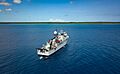
Aerial view of the mothership and the submersible during sea trials in the Bahamas
-
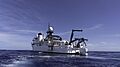
Limiting Factor being prepared on deck before an Atlantic dive
-
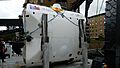
Rear view of Limiting Factor secured in its cradle on deck


Related Ocean Exploration Topics
- Deep-sea exploration – The history and science of exploring the deep ocean.
- Mariana Trench – The deepest ocean trench on planet Earth.
- Bathyscaphe Trieste – The first crewed vehicle to reach the bottom of the Mariana Trench in 1960.
- Deepsea Challenger – The deep-diving submarine built by filmmaker James Cameron.
- Oceanography – The scientific study of the world's oceans, marine life, and underwater geology.
