
Doherty's bushshrike facts for kids
Quick facts for kids Doherty's bushshrike |
|
|---|---|
 |
|
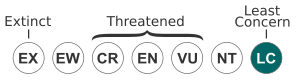
| Conservation status | |
Scientific classification  |
|
| Kingdom: | Animalia |
| Phylum: | Chordata |
| Class: | Aves |
| Order: | Passeriformes |
| Family: | Malaconotidae |
| Genus: | Telophorus |
| Species: |
T. dohertyi
|
| Binomial name | |
| Telophorus dohertyi (Rothschild, 1901)
|
|
| Script error: The function "autoWithCaption" does not exist. | |
| Synonyms | |
|
Malaconotus dohertyi |
|
Script error: No such module "Check for conflicting parameters".
The Doherty's bushshrike (Telophorus dohertyi) is a very colorful bird found in the forests of north-central Africa. It belongs to a bird family called Malaconotidae, known as bushshrikes. This bird is named after William Doherty, an American who collected many animal specimens.
What Does it Look Like?

This bird is medium-sized and very striking! Adult Doherty's bushshrikes are mostly green. They have a bright red forehead and throat, a wide black band across their chest, and a bright yellow belly. Their tail is black.
Young Doherty's bushshrikes look a bit different. They are pale green on top and have light yellow-green stripes on their underside.
Where Does This Bird Live?
Doherty's bushshrike lives and raises its young in several countries in central and eastern Africa. These include the central eastern Democratic Republic of the Congo, Burundi, Rwanda, western Uganda, and parts of western and central Kenya.
Habits and Habitat
Doherty's bushshrike is a shy bird that is often heard but rarely seen. It usually stays hidden in thick plants and moves quietly through dense undergrowth. You can hear its loud, whistling call throughout the year.
This bird finds its food by searching through thick plants and on the ground. It mainly eats arthropods, like beetles and grasshoppers.
Doherty's bushshrikes usually breed between April and July in the Democratic Republic of the Congo. In Uganda and Kenya, they breed in May and June. Young birds with stripes have been seen from November to March.
This species prefers to live in highland areas, usually between 1,500 and 3,350 meters (about 4,900 to 11,000 feet) high. Their homes are often in dense bushes and thickets at the edges of forests or in forest clearings. They also like areas with thick secondary growth, especially where there is bracken and bamboo.
