
Dracula (plant) facts for kids
Quick facts for kids Dracula orchids |
|
|---|---|
 |
|
| Dracula vampira | |
Scientific classification  |
|
| Unrecognized taxon (fix): | Dracula |
| Type species | |
| Masdevallia chimaera (syn of Dracula chimaera) Rchb. f.
|
|
| Species | |
|
See text |
|
The orchid group called Dracula, often shortened to Drac by plant growers, includes 118 different kinds of plants. These special orchids grow naturally in places like Mexico, Central America, Colombia, Ecuador, and Peru.
The name Dracula means "little dragon." It was chosen because some of these orchids have a deep red color, like blood. Also, their flowers have long, strange-looking parts called sepals, which reminded people of the mythical Count Dracula from old stories. These plants were once part of another orchid group called Masdevallia. However, in 1978, scientists decided they were unique enough to have their own separate group.
Contents
Discovering Dracula Orchids
What Makes Them Special?
Dracula orchids are known for their unusual and often beautiful flowers. They are a fascinating part of the plant world.
Where Do They Grow?
Most Dracula orchids are epiphytic. This means they grow on other plants, like trees, but they don't take nutrients from them. They just use the trees for support. Some can also be terrestrial, growing in the soil. You can find them in the forests of Central America and the Andes mountains in the northwest. Almost half of all known Dracula species live in Ecuador. These orchids prefer shady places and cool temperatures to thrive.
Unique Plant Features
These orchids grow in clumps, meaning many stems grow close together from a short underground stem called a rhizome. Unlike many other orchids, they don't have pseudobulbs. Pseudobulbs are thick stems that store water and nutrients.
Instead, each stem of a Dracula orchid has one large, thin leaf. These leaves have clear folds and a strong middle vein. The leaves are smooth and can be light or dark green. They might even be a bit spongy, helping the plant store water since there are no pseudobulbs. Each leaf also has a small, sharp tip at the end.
Amazing Flowers and Pollination
The flower stalks of Dracula orchids can grow in different ways. Some grow sideways from the plant's base, while others hang down, sometimes for a long distance. A few species have flower stalks that grow straight up.
The flowers themselves are usually triangular. They have long, thin "tails" on each of their three sepals. Most species produce one flower at a time. However, a few, like Dracula sodiroi, can have up to three flowers open at once on a single stalk.
The flowers of Dracula orchids often look very unusual. For example, the Dracula simia orchid is famous for its blooms that resemble monkey faces! This is just a natural coincidence.
These unique flowers are pollinated by tiny insects called fungus gnats. The orchid's special lower petal, called the lip, is often quite large. To a fungus gnat, this lip looks like a delicious mushroom or fungus. Scientists at the University of Oregon found that one species, Dracula lafleurii, even smells like mushrooms! This clever trick attracts the mushroom-loving flies, which then help pollinate the orchid. The petals of the flower are small and a bit thick. The edges of the flower parts are often fringed. Inside, there's a well-developed column with two pollinia, which are packets of pollen.

Types of Dracula Orchids
Scientists have identified 118 different species within the Dracula genus. These species are grouped based on their unique features. Some examples include Dracula bella, Dracula vampira, and the famous Dracula simia. Each species has its own special look and characteristics.
Natural Hybrids
Sometimes, different species of Dracula orchids can naturally cross-pollinate and create new plants called hybrids. These are rare and fascinating. Two known natural hybrids are:
- Dracula × anicula (a mix of D. cutis-bufonis and D. wallisii) found in Colombia.
- Dracula × radiosyndactyla (a mix of D. radiosa and D. syndactyla) found in southwestern Colombia.
Images for kids
-

Dracula cordobae
-
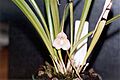
Dracula houtteana
-
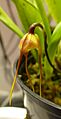
Dracula olmosii
-
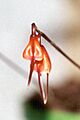
Dracula sodiroi


