
Eastern Cape redfin facts for kids
Quick facts for kids Eastern Cape redfin |
|
|---|---|
 |
|
| Conservation status | |
Scientific classification  |
|
| Kingdom: | Animalia |
| Phylum: | Chordata |
| Class: | Actinopterygii |
| Order: | Cypriniformes |
| Family: | Cyprinidae |
| Subfamily: | Barbinae |
| Genus: | Pseudobarbus |
| Species: |
P. afer
|
| Binomial name | |
| Pseudobarbus afer (Peters, 1864)
|
|
| Script error: The function "autoWithCaption" does not exist. | |
| Synonyms | |
|
|

Script error: No such module "Check for conflicting parameters".

The Eastern Cape redfin (Pseudobarbus afer) is a small freshwater fish found in Africa. It belongs to the family called Cyprinidae, which includes carps and minnows. Scientists now think that what was once called one species of Eastern Cape redfin is actually a group of very similar species.
Where They Live
The Eastern Cape redfin lives only in a few specific rivers in the Eastern Cape province of South Africa. These rivers include the Sundays, Swartkops, and Baakens river systems. Being found only in one area is called being endemic.
Scientists have found that the redfins in different rivers are actually slightly different types. For example, some redfins found near St Francis Bay are now called Pseudobarbus swartzi. Another type from the Krom River is called Pseudobarbus senticeps. The original Eastern Cape redfin (Pseudobarbus afer) is now thought to be just one of these types.
Why They Are in Danger
Sadly, all these types of Eastern Cape redfins are becoming rare. Their homes are being damaged, which is called habitat destruction. Also, new fish species that are not native to the area have been introduced. These are called invasive species. For example, types of bass fish, like those from the genus Micropterus, compete with the redfins for food and even eat them.
Other problems include dirty water and changes to their river homes. These issues make it hard for the redfins to survive.
What They Are Like
Eastern Cape redfins like to live in clear, rocky pools within rivers. Young redfins, called fry and juveniles, swim together in large groups called shoals. Adult redfins usually form smaller groups.
These fish eat both plants and small animals, which means they are omnivores. They are bottom feeders, meaning they find their food near the riverbed. They eat algae and small creatures without backbones, like insects.
Redfins lay their eggs during the summer months. They usually lay their eggs in fast-flowing, shallow parts of the river, just above the deeper pools.
Images for kids
-
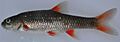
An Eastern Cape redfin fish
