
Eastern quoll facts for kids
Quick facts for kids Eastern quoll |
|
|---|---|
 |
|
| Fawn morph in Dorset, Tasmania |
|
 |
|
| Black morph in Mulligans Flat Woodland Sanctuary, Canberra, ACT |
|
| Conservation status | |
Scientific classification  |
|
| Kingdom: | Animalia |
| Phylum: | Chordata |
| Class: | Mammalia |
| Infraclass: | Marsupialia |
| Order: | Dasyuromorphia |
| Family: | Dasyuridae |
| Genus: | Dasyurus |
| Species: |
D. viverrinus
|
| Binomial name | |
| Dasyurus viverrinus (Shaw, 1800)
|
|
 |
|
| Eastern quoll range, not including reintroduced populations in Victoria, New South Wales and the Australian Capital Territory | |
| Script error: The function "autoWithCaption" does not exist. | |
Script error: No such module "Check for conflicting parameters".
The eastern quoll (Dasyurus viverrinus) is an amazing meat-eating marsupial native to Australia. Long ago, people also called it the eastern native cat. It belongs to a group of dasyurid animals within the family Dasyuridae. These animals are famous for carrying their tiny babies inside a warm belly pouch. It is one of six living kinds of quolls. Today, wild populations survive naturally on the island state of Tasmania. People once thought they were completely gone from mainland Australia. However, scientists have built safe, protected havens to bring them back.
Contents
What Does an Eastern Quoll Look Like?

An eastern quoll is about the same size as a small domestic cat. Adult males grow to between 53 and 66 centimetres long, including their bushy tail. They weigh around 1.1 kilograms. Females are slightly smaller, weighing about 0.7 kilograms. They have pointy snouts, short legs, and sharp, upright ears. You can tell them apart from other quoll cousins because their back feet have only four toes. They do not have an inside big toe at all.
Their thick fur coats come in two distinct colours: light fawn brown or sleek jet black. Both colours can appear together in the very same litter of babies. Fawn quolls are about three times more common than black ones. Bright white spots cover their bodies from head to rump. However, their spots never spread onto their bushy tails.
Glowing Under Special Lights
A thrilling discovery showed that eastern quolls show biofluorescence. When scientists shine invisible ultraviolet light on them in the dark, their fur glows with hidden colours. Wildlife photographers captured this glowing effect in the wild for the first time.
-
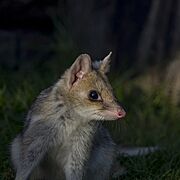
Fawn morph
-
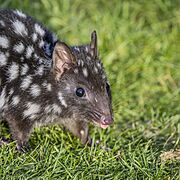
Black morph
-
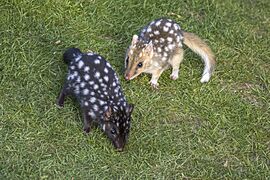
Black and fawn morphs


Where Do Eastern Quolls Live in the Wild?
Eastern quolls once roamed widely across southeastern mainland Australia. They lived from coastal South Australia, through most of Victoria, up to New South Wales. Many lived around the city of Adelaide and the nearby Adelaide Hills. Sadly, their numbers dropped quickly there during the early 1900s.
By the 1960s, these animals had disappeared from the wild mainland. Today, their natural stronghold is the island of Tasmania and nearby Bruny Island. They love living in open grasslands, brushy forests, and alpine meadows. They often hunt around open farm pastures where juicy grass grubs live underground.
Daily Life and Nocturnal Behaviour

Eastern quolls are nocturnal, which means they sleep during the day and hunt during the night. They rest inside snug underground dens, hollow logs, or rock piles. A den might be a simple tunnel or a chamber lined with soft grass. Each animal uses up to five different dens, switching homes from day to day.
Eastern quolls are solitary creatures that like to live alone. They explore an area of land called a home range. They use scents to mark their space, although they do not set up formal dung stations. If two neighbours bump into each other, they hiss, cough, or let out sharp warning shrieks. If neither backs down, they may stand up on their back legs to wrestle.
Hunting and Diet
These fierce little hunters eat insects, small mammals, birds, and lizards. Sometimes, they even scavenge leftover meat dropped by the much bigger Tasmanian devil. During warm summer months, they like to nibble sweet fruits, and they eat grass all year round. In turn, they must watch out for predators like the Australian masked owl and Tasmanian devils.
Reproduction and Life Cycle

The breeding season starts in early winter during the mother's oestrus cycle. A female quoll can give birth to up to 30 tiny babies after just three weeks. However, her belly pouch has only six to eight teats. The first babies to reach the pouch survive, while the others do not.
The tiny pups stay safely latched inside the pouch for about two months. They begin growing their spotted fur after 51 days and open their eyes around 79 days. Mother quolls communicate with their growing young using gentle, soft clicking calls. Young quolls leave their mother at about five months old. They grow to adulthood in their first year. In the wild, they usually live for two to three years. In safe animal parks, they can reach seven years old.
Conservation and Protecting the Species
The eastern quoll is listed as an endangered species on the IUCN red list. On the Australian mainland, introduced red foxes hunted them until none remained. Feral cats, sudden harsh weather, and illnesses also caused their numbers to drop. Tasmania remained safer because red foxes never established wild populations there.
Bringing Eastern Quolls Back to the Mainland
The last known wild quoll on the mainland was found in Sydney at Nielsen Park near Vaucluse in 1963. Another reported museum specimen came from the Gloucester region years later. Today, conservation groups work hard to bring this special marsupial back to its old home.
In Victoria, conservationists brought eastern quolls back to a protected sanctuary at Mount Rothwell in 2003. Another group released quolls at Tiverton Farm with leader Nigel Sharp. In the Australian Capital Territory, scientists released quolls inside the fenced Mulligans Flat Woodland Sanctuary. By studying the animals through adaptive management, scientists discovered that releasing mother quolls with pouch young helped the group flourish.
In New South Wales, the Aussie Ark team started a captive-breeding program inside the Barrington Wildlife Sanctuary. Dozens of new joeys are born there every year. Another release took place at Booderee National Park and Botanic Gardens, where rangers manage feral foxes and domestic dogs. In 2025, another breeding program began at Conmurra Wildlife Sanctuary near Bathurst. These safe havens give this spotted hunter a bright, hopeful future.
See also
 In Spanish: Cuol oriental para niños
