
Ferrari Lampredi engine facts for kids
.jpg)
Lampredi V12 in Ferrari 342 America
|
|
Quick facts for kids Overview |
|
|---|---|
| Manufacturer | Ferrari |
| Production | 1950–1959 |
| Layout | |
| Configuration | DOHC, 8-valve, Inline-4, two-valves per cylinder DOHC, 12-valve, Inline-6, two-valves per cylinder SOHC, 24-valve, 60°, V12, two-valves per cylinder |
| Displacement | 2.0–5.0 L (122.0–305.1 cu in) |
| Cylinder bore | 72–103 mm (2.8–4.1 in) |
| Piston stroke | 68–105 mm (2.7–4.1 in) |
| Block material | Aluminium |
| Head material | Aluminium |
| Combustion | |
| Fuel system | Weber carburetor |
| Fuel type | Petrol |
| Oil system | Wet sump Dry sump |
| Cooling system | Water-cooled |
| Output | |
| Power output | 121–279 kW (165–379 PS; 162–374 hp) |
| Torque output | 170–270 lb⋅ft (230–366 N⋅m) |
| Chronology | |
| Predecessor | Ferrari Colombo engine |
| Successor | Ferrari Jano engine Ferrari Dino engine |
The Ferrari Lampredi engine was a powerful car engine made by Ferrari between 1950 and 1959. It was designed by Aurelio Lampredi. This engine was special because it was made of aluminium and had a V12 shape. Later, smaller versions with 4 or 6 cylinders were also made for racing.
Aurelio Lampredi was hired by Ferrari to create a new type of engine. This was different from the smaller V12 engines designed by Gioacchino Colombo. Lampredi's engines helped Ferrari win many championships in the 1950s. However, these engines were eventually replaced by newer designs like the Dino V6 and V8 and improved Colombo V12s.
Contents
V12 Engines
A V12 engine has 12 cylinders arranged in a "V" shape. These engines are known for being very smooth and powerful.
275 Series
Ferrari wanted a new V12 engine for Formula One racing. Aurelio Lampredi designed a 3.3-liter (3322 cc) engine for this. It was first used in the 275 S car as a test. This engine produced about 270 horsepower. Soon, it was updated to make 300 horsepower for Formula One races.
Applications:
- 1950 Ferrari 275 S
- 1950 Ferrari 275 F1
340 Series
To compete better, Lampredi made the engine bigger. It became a 4.1-liter (4101 cc) unit for the 340 F1. This boosted power to 335 horsepower. However, this racing car was quickly replaced by an even more powerful Ferrari.
Lampredi's engines also found their way into road cars. The 1950 340 America and later 340 Mexico/MM used these large 4.1-liter engines. They produced between 220 and 280 horsepower. Most road cars used a "wet sump" oil system. The 340 America, however, used a "dry sump" system, like the racing engines.
Applications:
- 1950 Ferrari 340 F1
- 1950 Ferrari 340 America
- 1951 Ferrari 342 America
- 1952 Ferrari 340 Mexico
- 1953 Ferrari 340 MM
375 Series
In the same year as the 340 F1, Lampredi's biggest Formula One engine was introduced. It was a 4.5-liter (4493 cc) engine. This engine, used in the 375 F1, made 350 horsepower. With this engine, Ferrari finally beat Alfa Romeo at the 1951 British Grand Prix.
For the 1952 Indianapolis 500 race, Ferrari changed the 375 F1 engine. Its size was slightly reduced to just under 4.4 liters. New Weber carburettors helped it produce an impressive 380 horsepower. All Formula One Lampredi V12s used a "dry sump" oil system.
In 1953, the Lampredi V12 was used in customer cars like the Ferrari 375 MM. Its size was increased to 4.5 liters (4522 cc), and it made 340 horsepower. A less powerful version also powered the 375 America.
Applications:
- 1950 Ferrari 375 F1
- 1953 Ferrari 375 MM
- 1952 Ferrari 375 Indianapolis
- 1953 Ferrari 375 America
250 Series
Lampredi engines were also used in the 250 series, starting with the 1953 250 Europa. Unlike earlier engines, the 250 used a "square" design. This means the engine's bore (width of the cylinder) and stroke (how far the piston moves) were the same: 68 mm. This made it a 3.0-liter (2963 cc) engine. It produced 200 horsepower.
375 Plus & 410 Series

In 1954, the engine grew even larger with the 375 Plus. This nearly 5.0-liter (4954 cc) engine made 330 horsepower. This powerful engine helped Ferrari win races like Le Mans and Carrera Panamericana that year.
The "America" engine became even bigger for the 1955 410 Superamerica. It was a 5.0-liter (4962 cc) engine, producing 340-360 horsepower. The same engine also powered the last Lampredi V12 racing car, the 410 S. Some 410 S engines were upgraded to make 380 horsepower.
Applications:
- 1954 Ferrari 375 Plus
- 1955 Ferrari 410 S
- 1955 Ferrari 410 Superamerica
Inline-4 Engines
An inline-4 engine has 4 cylinders arranged in a straight line. Lampredi also designed these for Ferrari's racing cars.

Lampredi created an inline-4 engine for Formula Two racing. This design was later used in Formula One and sports car racing throughout the 1950s. The first 2.0-liter version, made in 1951, was used for many years. All Lampredi inline-4 engines used a "dry sump" oil system.

500 Series
The first inline-4 engine was a 2.0-liter (1984.86 cc) unit. It appeared in 1951 in the Ferrari 500 F2 for Formula Two. This aluminium engine produced 165 horsepower. By 1953, its power increased to 185 horsepower. Its first race was in Italy in 1951, won by Alberto Ascari.
A different 2.0-liter four-cylinder engine was used in the 1953 553 F2. This one made 180 horsepower.
The original 1951 2.0-liter engine was brought back for the World Sportscar Championship in 1953. It was used in the Ferrari 500 Mondial. This version made 170 horsepower. The same engine, now making 180 horsepower, was used in the famous Ferrari 500 TR. This car was nicknamed "red head" because of its red cylinder head. Another car with this engine, the 1957 Ferrari 500 TRC, was made for customer racing.

Applications:
- 1951–1953 Ferrari 500 F2
- 1953 Ferrari 500 Mondial
- 1956 Ferrari 500 TR
- 1957 Ferrari 500 TRC
- 1953 Ferrari 553 F2
625 Series
The Ferrari 625 F1 was Ferrari's first Formula One car with an inline-4 engine. It was a 2.5-liter (2498.32 cc) engine, producing 210-230 horsepower. It was first tested in 1951.
The 625 F1 car was updated in 1953 to become the 1954 553 F1. The engine was changed to a similar 2.5-liter (2497.56 cc) size. This engine produced 260 horsepower. The same engine was also used in the 1955 555 F1.
Lampredi's four-cylinder engine was first used outside Formula One and Formula Two in the 1953 625 TF. This 2.5-liter (2498.32 cc) aluminium engine made 220 horsepower. After a big accident at Le Mans in 1955, the 2.5-liter inline-4 was used again in the 1956 625 LM. It still made 220 horsepower, which was enough for a third-place finish at Le Mans.
,_Bj._1954.jpg)
Applications:
- 1954 Ferrari 553 F1
- 1955 Ferrari 555 F1
- 1951 Ferrari 625 F1
- 1953 Ferrari 625 TF
- 1956 Ferrari 625 LM
- 1957 Ferrari 625 TRC
735 Series
A larger version of the inline-4 engine was made for the 1953 735 S. This engine was 2.9-liters (2941.66 cc) and produced 225 horsepower.
750 Series
For 1954, the Lampredi inline-4 engine was made slightly bigger for the 3.0-liter (2999.62 cc) unit used in the 750 Monza. This engine was a development of an earlier type and produced 260 horsepower.
857 & 860 Series
In 1955, the "Type 129" engine appeared in the 857 S. This engine was 3.4-liters (3432 cc). At the 1955 Targa Florio race, the 857 S finished third. The same engine was later used in the 1956 860 Monza. It produced 280 horsepower. These cars finished first and second at Sebring and second and third at Mille Miglia that year.
Applications:
- 1955 Ferrari 857 S
- 1956 Ferrari 860 Monza
Inline-6 Engines
An inline-6 engine has 6 cylinders in a straight line. Ferrari produced its first inline-6 engine in 1954.
306 S
Aurelio Lampredi designed a prototype 3.0-liter (2977.28 cc) engine for the experimental 306 S sports car. This car never raced.
376 S
A larger 3.7-liter (3747.48 cc) version was put into the 376 S sports car in 1955. This engine was based on the earlier Lampredi 625 F1 inline-4 engine. It produced 280 horsepower.
Applications:
- 1955 376 S
735 LM

Later in 1955, the 735 LM was created for the 1955 24 Hours of Le Mans race. Lampredi modified the 376 S engine to a 4.4-liter (4412.49 cc) size. This engine produced 330 horsepower. With this power, the 735 LM could reach 282 km/h (175 mph) on the Mulsanne Straight at Le Mans. Both these inline-6 engines used a "dry sump" oil system.
Applications:
- 1955 735 LM
Images for kids
-
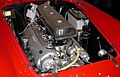
A 5.0-liter Lampredi V12 in Ferrari 375 Plus
-
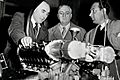
Aurelio Lampredi (right), Enzo Ferrari (center) and Luigi Bazzi (left) next to a Lampredi inline-4 engine
-
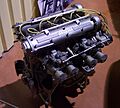
Ferrari Lampredi four-cylinder engine
-
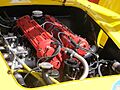
Red head Lampredi engine in 1956 Ferrari 500 TR
-
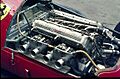
Ferrari 553 "Squalo", 2.5-liter engine
-
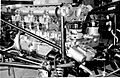
Lampredi Tipo 121 I6 engine
See also
- List of Ferrari engines
