
Green barbet facts for kids
Quick facts for kids Green barbet |
|
|---|---|
_(cropped).jpg) |
|
| The nominate race in Kenya | |
| Conservation status | |
Scientific classification  |
|
| Kingdom: | Animalia |
| Phylum: | Chordata |
| Class: | Aves |
| Order: | Piciformes |
| Family: | Lybiidae |
| Genus: | Cryptolybia Clancey, 1979 |
| Species: |
C. olivacea
|
| Binomial name | |
| Cryptolybia olivacea (Shelley, 1880)
|
|
 |
|
| ● C. o. olivacea ● S. o. uluguruensis ● C. o. rungweensis ● S. o. howelli ● C. o. hylophona ● S. o. belcheri ● C. o. woodwardi |
|
| Script error: The function "autoWithCaption" does not exist. | |
| Synonyms | |
|
|

Script error: No such module "Check for conflicting parameters".
The Green Barbet (Cryptolybia olivacea) is a type of bird found in Africa. It belongs to the Lybiidae family, which are known as African barbets. You can find these birds in countries like Kenya, Tanzania, Malawi, Mozambique, and South Africa.
Green Barbets live in forests, from areas near the sea all the way up to mountains 1,800 metres (5,900 ft) high. Some groups of these birds live in isolated areas. Their homes are at risk when forests are cut down.
Contents
What Does a Green Barbet Look Like?
Green Barbets have feathers that are a dull ginger-olive color. Their wings are a bit yellower, and their undersides are paler. The top of their head and their chin are dark brown. This is true for the most common type of Green Barbet.
Their eyes can be dull red or orange. They have a black beak and blackish feet. Young Green Barbets look a bit duller than adults. Their eyes are brown.
What Sound Does a Green Barbet Make?
The Green Barbet has a very clear call. It sounds like a repeated chock, chock, ... or chop, chop, .... Sometimes, two birds will call together in a duet.
Green Barbet Habits and Lifestyle
Green Barbets often visit branches that have fruit on them. They like to stay in the lower parts of the forest canopy, which is the layer of branches and leaves. They can be found alone or in groups when they are looking for food or resting.
These birds do not travel far from their homes. They are known as a "sedentary" species, meaning they stay in one place. They especially love to eat the fruit of wild fig trees.
Reproduction and Life Cycle
Green Barbets build their nests in holes found in tree trunks. They usually breed during the middle of summer.
Types of Green Barbets
Scientists sometimes disagree on how many different types, or "races," of Green Barbets there are. This is important because it affects how we protect them.
One type, C. o. hylophona, is sometimes grouped with woodwardi. These birds are sometimes called Woodward's Barbet. They have yellow markings near their ears and above their eyes. Other types have dusky, or dark, heads.
Another type, C. o. belcheri, does not have the yellow ear markings. This type lives only on two isolated mountains. Some scientists think it might be a separate species entirely.
The International Ornithologists' Union recognizes five main subspecies:
- Cryptolybia olivacea olivacea – Found along the coast of Kenya and in the uplands of central Tanzania.
- Cryptolybia olivacea howelli – Lives in the eastern Udzungwa Mountains in Tanzania.
- Cryptolybia olivacea rungweensis – Found in Mt Rungwe and the Poroto Mts in Tanzania, extending to the Misuku Hills in northern Malawi.
- Cryptolybia olivacea belcheri – Lives on Mt Thyolo in Malawi and Mt Namuli in Mozambique.
- Cryptolybia olivacea woodwardi – Found in oNgoye in KwaZulu-Natal, South Africa.
Other scientists recognize two more subspecies:
- Cryptolybia olivacea hylophona – Found in the Ngarama, Rondo, and possibly Mitundumbea forest reserves along the coast of Tanzania.
- Cryptolybia olivacea uluguruensis – Lives in the Uluguru Mountains of eastern Tanzania.
Images for kids
-
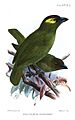
An illustration from 1897 of two Woodward's barbets by J.G. Keulemans.

