
Hemocyanin facts for kids
Quick facts for kids Hemocyanin, copper containing domain |
|||||||||||
|---|---|---|---|---|---|---|---|---|---|---|---|

Single oxygenated functional unit from the hemocyanin of an octopus
|
|||||||||||
| Identifiers | |||||||||||
| Symbol | Hemocyanin_M | ||||||||||
| Pfam | PF00372 | ||||||||||
| InterPro | IPR000896 | ||||||||||
| PROSITE | PDOC00184 | ||||||||||
| SCOP2 | 1lla / SCOPe / SUPFAM | ||||||||||
|
|||||||||||
| Hemocyanin, all-alpha domain | |||||||||
|---|---|---|---|---|---|---|---|---|---|

Crystal structure of hexameric haemocyanin from Panulirus interruptus refined at 3.2 angstroms resolution
|
|||||||||
| Identifiers | |||||||||
| Symbol | Hemocyanin_N | ||||||||
| Pfam | PF03722 | ||||||||
| InterPro | IPR005204 | ||||||||
| PROSITE | PDOC00184 | ||||||||
| SCOP2 | 1lla / SCOPe / SUPFAM | ||||||||
| OPM protein | 1HCY | ||||||||
|
|||||||||
| https://www.rcsb.org/structure/1HC1 | |||||||||
| Hemocyanin, ig-like domain | |||||||||
|---|---|---|---|---|---|---|---|---|---|

crystallographic analysis of oxygenated and deoxygenated states of arthropod hemocyanin shows unusual differences
|
|||||||||
| Identifiers | |||||||||
| Symbol | Hemocyanin_C | ||||||||
| Pfam | PF03723 | ||||||||
| InterPro | IPR005203 | ||||||||
| PROSITE | PDOC00184 | ||||||||
| SCOP2 | 1lla / SCOPe / SUPFAM | ||||||||
|
|||||||||
Hemocyanins are special proteins that help some animals carry oxygen in their bodies. Think of them like the oxygen delivery service for creatures like octopuses, crabs, and spiders! Unlike the red blood we have, hemocyanins make the blood (or "hemolymph") of these animals turn a beautiful blue color when they pick up oxygen. This happens because hemocyanins contain two copper atoms that grab onto oxygen molecules. When there's no oxygen, they are colorless.
Contents
What Animals Have Blue Blood?
Scientists first found hemocyanin in an octopus in 1878. But people knew about copper in mollusks even earlier, in 1833! You can find hemocyanins in many Mollusca (like cephalopods such as squids and octopuses) and Arthropoda (like crustaceans such as crabs and lobsters). Even some land arthropods, like the tarantula Eurypelma californicum, the emperor scorpion, and the centipede Scutigera coleoptrata, use hemocyanins. Interestingly, some insect larvae also have proteins similar to hemocyanins that help them store nutrients.
How Hemocyanins Carry Oxygen
Hemocyanins and hemoglobin (what makes our blood red) both carry oxygen, but they do it differently. Hemoglobin uses iron atoms, while hemocyanins use copper atoms. These copper atoms are held in place by special parts of the protein. Each hemocyanin molecule is made of many smaller parts called subunits. Each subunit has two copper atoms and can carry one oxygen molecule. These subunits often link up to form larger structures, sometimes in groups of six, called hexamers. Animals that live in cold places with little oxygen, like some crustaceans, find hemocyanins very useful. They work well even in these tough conditions. Some spiders and scorpions in warm climates also use hemocyanins, showing they are very stable proteins, even at high temperatures. Because hemocyanins are quite large, they float freely in the animal's blood-like fluid, called hemolymph, instead of being inside special blood cells.
.png)
The Hemocyanin Protein Family
Hemocyanins are part of a bigger family of proteins. This family includes other proteins that look similar but have different jobs. For example, some related proteins help arthropods heal wounds or protect themselves from germs. Others act as storage proteins in insects, holding onto important nutrients during their growth. Scientists study this whole family to understand how these proteins evolved and what they do in different animals.
Hemocyanins and Health Research
Scientists are always looking for new ways to help people stay healthy. They have found that hemocyanins from certain animals might have special health benefits. For example, hemocyanin from the Chilean abalone, a type of sea snail, has shown promise in studies against unhealthy cells in mice. Another type, called Keyhole Limpet Hemocyanin (KLH), comes from a marine mollusk. Studies have shown that KLH can help stop the growth of certain unhealthy cells, like those found in breast, pancreatic, and prostate issues, in laboratory tests. This research suggests hemocyanins could be useful in future treatments.
How Environment Affects Hemocyanins
Just like our health can be affected by what we eat and where we live, the same is true for animals and their hemocyanins. A study in 2003 looked at white shrimp. Shrimp that lived outdoors and ate natural live food had higher levels of oxyhemocyanin (hemocyanin with oxygen) compared to shrimp kept indoors with a commercial diet. This shows that an animal's diet and environment can influence how much hemocyanin it has and how well it works. Animals that are more active or need more energy might have higher levels of these important blood proteins.
Images for kids
-
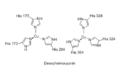
A close-up of the copper site in hemocyanin when it is not carrying oxygen.
-
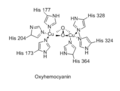
A close-up of the copper site in hemocyanin when it is carrying oxygen.
-
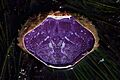
The purple color on the underside of this red rock crab is caused by hemocyanin in its blood.


See also
 In Spanish: Hemocianina para niños
- Myoglobin
- Respiratory pigment
