
History of the University of St Andrews facts for kids
The history of the University of St Andrews began a long time ago, in 1410. That's when it officially started with a special document called a charter. This charter was given to a religious group called the Augustinians at St Andrews Cathedral.
The University grew quite fast! St Salvator's College was built in 1450. Then came St Leonard's College in 1511. And finally, St Mary's College was added in 1537. Some of the buildings you see today are from this early time, like St Salvator's Chapel. Back then, most of the teaching was about religion. It was done by clerics, who were religious leaders from the cathedral.
Contents
How the University Started
The University of St Andrews began with a group of smart people in 1410. Key figures included Laurence of Lindores and Henry Wardlaw, who was the Bishop of St Andrews. In 1411, Bishop Wardlaw gave a special paper, a charter. This paper helped bring many clever teachers to Scotland.
In 1413, a Pope named Avignon Pope Benedict XIII officially recognized the group as a university. He sent six special letters, called bulls, to confirm it. For a while, classes were held in different parts of the town. But in 1430, Bishop Wardlaw let them use a building called the Paedagogium.
The First Colleges
Bishop Kennedy started St Salvator's College in 1450. He gave it a lot of money. Seven years later, this college could give out special degrees in theology (the study of religion) and philosophy (the study of knowledge). It quickly became a main part of the university.
In 1512, two leaders, John Hepburn and Archbishop Alexander Stewart, started St Leonard's College. It was built where a hospital for travelers used to be. The old Paedagogium building became St Mary's College in 1537. It was named after the Blessed Virgin Mary. This college was meant for studying religion, law, and medicine. But soon, it focused only on theology. It has been a college for religious studies ever since.
Growing and Changing Over Time
From the 1600s to the 1800s, the university changed a lot. The famous red gowns that students still wear today were first used in 1672. At one point, people even thought about moving the university to Perth, but they decided not to.
In 1747, St Salvator's and St Leonard's joined together. They formed the United College of St Salvator and St Leonard.
Tough Times and New Opportunities
During the 1800s, not many students attended the university. It was even possible that it might have to close down. In the 1870s, there were fewer than 150 students. To help the university grow, University College was started in Dundee in 1897. This new college became a strong center for medicine and science.
Women Join the University
In 1876, the university decided to let women study there. They could take exams similar to the ones men took for their degrees. This was called the 'L.L.A. examination'. Women had to pass several subjects to get a diploma.
In 1889, a new law made it possible for women to officially join St Andrews. The L.L.A. diploma was then seen as a university degree. In October 1895, Agnes Forbes Blackadder became the first woman to graduate from St Andrews with the same degree as men. She later became a famous skin doctor. St Andrews was the first university in Scotland to let women study alongside men. As more women came, the first women's living hall, University Hall, was built in 1896.
University of Dundee Becomes Separate
The connection with Dundee ended in 1967. The college in Dundee, which was then called Queen's College, became its own university: the University of Dundee. Because of this, St Andrews lost some of its medical teaching facilities. Its Bute Medical School then partnered with the University of Manchester.
When Dundee became separate, St Andrews also stopped teaching some other subjects. These included Law and Dentistry.
The University Library
The University library holds all the older college libraries. It was started in 1612 by King James VI. He and other members of the Royal Family gave 228 books to start the collection.
The library was in a special building. This building was changed and improved several times over the years. The main hall in the old part of the building was used for university meetings and exams. Sometimes, it was even used for meetings of the Scots Parliament. Today, the St Leonards School uses the buildings of the old St Leonard's College.
Modern Times
New buildings in the Jacobean style were built between 1827 and 1847. In 1887-1888, a common dining hall for students was created. More places for women students to live were opened in 1896. New medical buildings were opened in 1899, thanks to a generous gift from the 3rd Marquess of Bute. Many of these modern improvements happened when Dr James Donaldson was in charge.
The university still owns the small St Leonards college chapel. Candle-lit services are held there every week during term time. The United College is on the site of St Salvator's College. Most of the old buildings are gone, except for the college chapel. This chapel is now the university chapel. It's a beautiful Gothic building with a fancy tomb for Bishop Kennedy. It also has John Knox's pulpit. The entrance gate with its tall clock tower (152 feet high) and the janitor's house are also still there.
Since 2006, the university has allowed equal rights to The St Andrews Pagan Society, but with certain rules.
In 2009, Louise Richardson became the head of the university. She was the first woman to hold this important position. She said, "I don’t believe that talent resides predominantly among males, or among the upper classes." Dr Sally Mapstone took over from her later.
See also
- Governance of the University of St Andrews
- General Council of the University of St Andrews
Images for kids
-
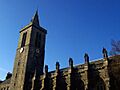
St Salvator's Chapel, a beautiful Gothic building.
.jpg)
