
Inclined plane facts for kids


An inclined plane, often called a ramp, is a flat surface that is tilted. One end is higher than the other. People use ramps to help move heavy things up or down. It makes the job easier!
The inclined plane is one of the six classic simple machines. Scientists from the Renaissance era first described these machines. Simple machines help us do work with less effort. Think of a ramp used to load boxes onto a truck. Or a path that goes up a hill. Even a train climbing a gentle slope uses an inclined plane.
Moving an object up a ramp needs less pushing force. However, you have to push it over a longer distance. This trade-off is called "mechanical advantage". It means you use less force, but cover more distance. This is because of how energy works. The total "work" (energy used) is the same. But the ramp lets you spread that work out. This makes it feel much easier.
Two other simple machines come from the inclined plane. A wedge is like two ramps joined together. An axe head is a good example. A screw is like a ramp wrapped around a pole.
Contents
How Inclined Planes Help Us
Inclined planes are super useful in many ways. They help us move things and even ourselves!
Everyday Ramps and Slopes
Many ramps are used for loading and unloading. Trucks, ships, and airplanes use them for goods. Wheelchair ramps help people in wheelchairs move easily. They overcome steps or curbs without needing a lot of strength. Escalators and slanted conveyor belts are also types of inclined planes. They move people or items up or down.
In a funicular or cable railway, a train car is pulled up a steep track. This uses strong cables. Inclined planes also help lower heavy or fragile items safely. They use the surface to slow down the pull of gravity. For example, aircraft evacuation slides let people get off a plane quickly and safely.


Permanent Structures and Fun
Many inclined planes are part of buildings or landscapes. Roads for cars and trains have gentle slopes. These help vehicles climb hills without losing grip. Pedestrian paths and sidewalks also have ramps. This makes them easier and safer for walking.
Inclined planes are also used for fun! Think of playground slides and water slides. Ski slopes and skateboard parks also use them. They let people slide or roll down in a controlled way.


A Look Back in Time
People have used inclined planes for thousands of years. They helped move very heavy objects. Ancient civilizations, like the Romans, built sloping roads. These show they knew how useful ramps were for moving things uphill.
Historians believe that huge stones for places like Stonehenge were moved using earth ramps. The Egyptian pyramids were also built with the help of giant ramps. Ancient armies used Siege ramps to get over fortress walls. The ancient Greeks even built a 6 km (3.7 miles) long paved ramp. It was called the Diolkos. They used it to drag ships across the Isthmus of Corinth.
For a long time, the inclined plane was not seen as a "machine." This was because it doesn't move itself. It's just a tilted surface. Ancient Greek thinkers defined five other simple machines. But they didn't include the inclined plane. Some scientists even in the 1800s felt it was "no more a machine than is the slope of a mountain."
It wasn't until the Renaissance that scientists truly understood ramps. In the late 1500s, smart thinkers figured out how they worked. One famous person was Simon Stevin. In 1586, he showed how ramps make work easier. He used a clever idea involving a string of beads. Later, Galileo Galilei also studied inclined planes. In 1600, he explained how they amplify force, just like other simple machines.
Even earlier, Leonardo da Vinci studied how things slide on ramps. He discovered basic rules about friction. But his notes were not published then. Later, other scientists like Guillaume Amontons and Charles-Augustin de Coulomb rediscovered and developed these ideas.
Understanding the Slope
To understand inclined planes, we need to know about their slope. Slope means how steep something is. A gentler slope makes it easier to move a weight. But you have to move it over a longer distance.
A plane's slope is measured by its "rise" and "run." The "rise" is how much it goes up. The "run" is how far it goes horizontally. You can also think of it as the angle the ramp makes with the ground.

What is Mechanical Advantage?
Mechanical advantage is a way to measure how much a simple machine helps you. For an inclined plane, it's about how much less force you need. You compare the weight of the object to the force you use to push it up.
Imagine you want to lift a heavy box. Lifting it straight up takes a lot of force. But if you push it up a ramp, you use less force. The mechanical advantage tells you how many times easier it is. For a ramp without friction, it's the length of the ramp divided by its height. So, a longer, less steep ramp gives you more mechanical advantage.
How Ramps Work Without Friction

Imagine a perfect ramp with no friction at all. This is like rolling a barrel up a very smooth surface. In this ideal situation, the energy you put in equals the energy you get out. This is called the "conservation of energy".
To lift an object, you do "work." Work is the force you use multiplied by the distance you move it. If you lift a box straight up, the work is its weight times the height. On a frictionless ramp, you use less force. But you push it over the entire length of the ramp.
The amazing thing is, the total work done is the same! The ramp just lets you spread out the effort. This means you use a smaller force over a longer distance. So, a longer, less steep ramp makes it much easier to move something.
How Friction Changes Things
In the real world, there's always friction. Friction is a force that slows things down. It works against movement. When you slide a heavy box up a ramp, friction makes it harder. Some of your effort turns into heat because of friction. This means you need to push with more force than on a frictionless ramp.
Friction also helps things stay put. If a ramp isn't too steep, an object might not slide down. This is because friction holds it in place. There's a special angle called the "angle of repose". If the ramp is flatter than this angle, the object won't slide. This angle depends on how rough the surfaces are. It doesn't depend on how heavy the object is.
Because of friction, there's a range of forces where an object will stay still on a ramp. It won't slide up or down. On a perfect, frictionless ramp, it would only stay still with one exact amount of force.
More About Inclined Planes
- Canal inclined plane
- Grade (slope)
- Inclined plane railroad
- Ramp function
- Schiefe Ebene
- Stairs
Images for kids
-

Key: N = Normal force, W = weight, θ = Angle of inclination of the plane.
-
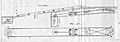
Layout of the cable drive system for the Liverpool Minard inclined plane.


See also
 In Spanish: Plano inclinado para niños
