
Inverted relief facts for kids


Imagine a valley that turns into a hill! That's what inverted relief or inverted topography means. It happens when the lowest parts of a landscape, like valleys or riverbeds, get filled with something strong. This could be hot lava or tough sediment (like sand and rocks).
Over time, this new material hardens. It becomes much stronger than the softer ground around it. Then, erosion (wind and water wearing away rock) starts to remove the weaker surrounding material. What's left behind is the strong, hardened material. It now stands tall as a ridge or a hill, where a valley used to be! This amazing process has shaped landscapes on Earth and even on planets like Mars.
How Inverted Relief Forms
Inverted relief happens in a few cool ways. Each method makes the bottom of a low area, like a valley, much tougher than the land around it.
Valleys Filled with Tough Sediment
Sometimes, rougher rocks and sand, like gravel, collect in a valley or lake bed. Later, wind and water might blow away the finer, lighter sand from nearby areas. This leaves the heavier, tougher gravel behind. It then forms a hill or ridge where the valley once was.
River Valleys Filled with Lava
Imagine a river valley. Hot, flowing lava or hardened volcanic ash (called welded tuff) can pour into it. This volcanic material cools and becomes very hard. As the softer land around the valley erodes away, the hardened lava stands out as a ridge.
Natural Cementation of Sediments
Water flowing underground often carries dissolved minerals. These minerals can act like a natural glue. They can harden the sand and rocks at the bottom of a valley. This process is called cementation. On Earth, this can create very hard crusts, like silcrete or ferricrete. These "natural concrete" layers resist erosion much better. The surrounding, softer land wears away, leaving the cemented valley floor as a ridge.
Folded Mountains and Erosion
In areas with folded rocks, like mountains, sometimes the harder top layers of a fold (called an anticline) erode first. This exposes softer rocks underneath. These softer rocks then erode quickly. This can leave the lower parts of the folds (called synclines) standing as hills or ridges. It's like the landscape flips upside down!
Amazing Examples on Earth
California's Table Mountain
One famous example is Table Mountain in California, USA. Millions of years ago, hot lava flowed into an ancient river valley. This valley cut through the Sierra Nevada mountains. The lava cooled and hardened into a very tough rock. This rock was much stronger than the surrounding older rocks. Over time, wind and water wore away the softer surrounding land. The hardened lava, which once filled the valley, now stands as a long, winding ridge. It looks like a giant table in the landscape!
South Africa's Table Mountain

Another interesting example is Table Mountain near Cape Town, South Africa. Here, the story is a bit different. The original high ridges of very hard sandstone were actually eroded away first. This exposed softer rocks underneath. These softer rocks eroded much faster. What was once a valley bottom, made of tough sandstone, was left standing high. It now forms the flat top of the famous Table Mountain. It's a great example of how landscapes can completely flip!
Inverted Landscapes on Mars
Scientists have found many examples of inverted relief on Mars! They see winding ridges that look just like ancient, dried-up riverbeds. These "inverted channels" are strong evidence that water once flowed on the Martian surface. One place where these features are seen is Miyamoto Crater. In 2010, this crater was even suggested as a good spot to search for signs of past life on Mars. It's amazing to think that valleys on Mars could have turned into hills!
Martian Inverted Terrain: Aeolis Quadrangle
-
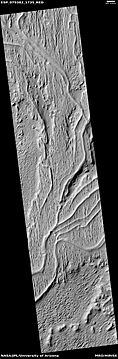
Inverted channels in Aleolis Planum. These channels may have formed when the area was buried and then eroded. They appear as ridges because they resisted erosion.
-
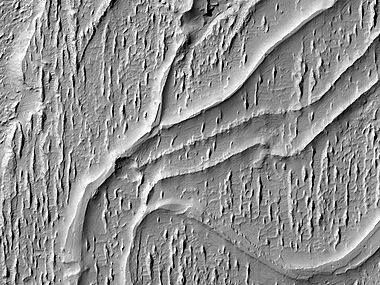
A closer look at inverted channels. Notice how some have flat tops.
-
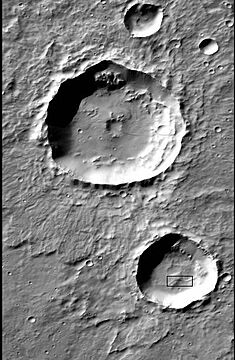
A CTX image of craters in Aeolis quadrangle. The black box shows where the next image is located.
-

This image shows a curved ridge. It might be an old stream that has become inverted. The light comes from the northwest. Taken with HiRISE under the HiWish program.
-
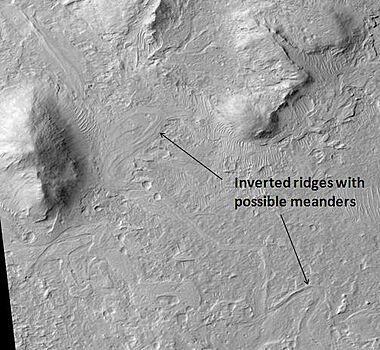
Winding ridges that are likely inverted stream channels. The light comes from the northwest. Taken by HiRISE.
-
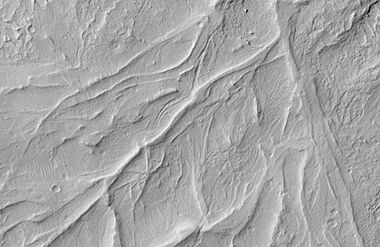
Winding ridges within a branching fan in the Medusae Fossae Formation. Seen by HiRISE. Light from the northwest.


Martian Inverted Terrain: Syrtis Major Quadrangle
-
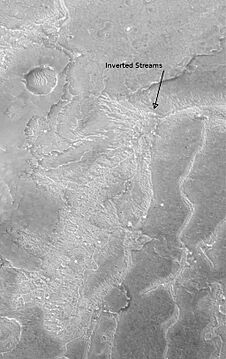
Inverted streams near Juventae Chasma, Syrtis Major quadrangle. Seen by Mars Global Surveyor. These streams start at the top of a ridge and then join together.
-
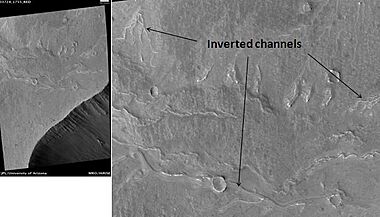
Inverted channels near Juventae Chasma. Seen by HiRISE. These channels were once regular stream channels. This image is in Coprates quadrangle. The scale bar is 500 meters long.
-
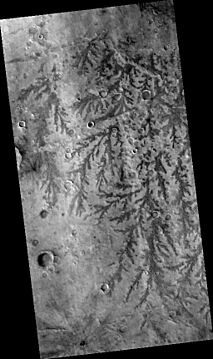
An inverted channel with many branches in Syrtis Major quadrangle.
-
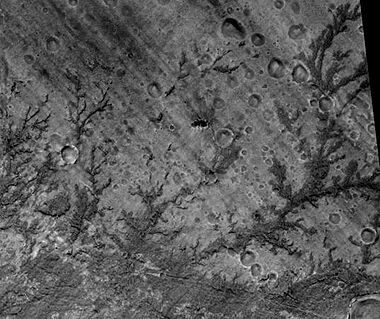
Inverted stream channels in Antoniadi Crater. Seen by HiRISE.


Martian Inverted Terrain: Margaritifer Sinus Quadrangle
-
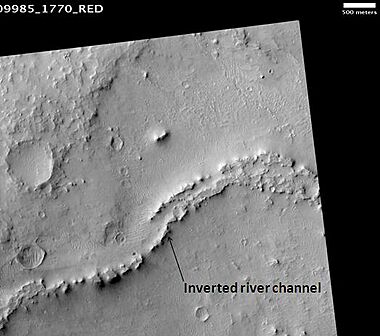
An inverted channel in Miyamoto Crater, Margaritifer Sinus quadrangle. Seen by HiRISE. The light comes from the northwest. The scale bar is 500 meters long.
-
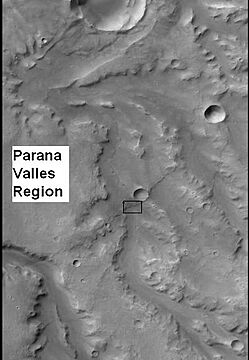
A CTX context image for the next HiRISE image. Notice the long ridge across the image, which is probably an old stream. The box shows the area for the HiRISE image.
-
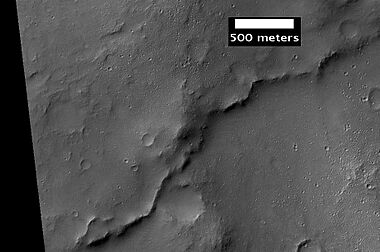
An example of inverted terrain in the Parana Valles region. Seen by HiRISE under the HiWish program. The light comes from the northwest.


Martian Inverted Terrain: Amazonis Quadrangle
-
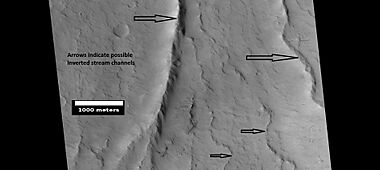
Possible inverted stream channels in Amazonis quadrangle. Seen by HiRISE under the HiWish program. These ridges were likely once stream valleys filled with hardened sediment. This made them resistant to erosion, which removed the surrounding material. The light comes from the left (west).

See Also
- Exhumed river channel
