
Ipbuk-dong facts for kids
Quick facts for kids
Ipbuk-dong
|
|
|---|---|
| Korean transcription(s) | |
| • Hangul | 입북동 |
| • Hanja | 笠北洞 |
| • Revised Romanization | Ipbuk-dong |
| • McCune–Reischauer | Ippuk tong |

Map of Ipbuk-dong
|
|
| Country | South Korea |
| Region | Sudogwon |
| Administrative divisions | Ipbuk-dong, Dangsu-dong |
| Area | |
| • Total | 7.19 km2 (2.78 sq mi) |
| Population
(2014)
|
|
| • Total | 18,220 |
| • Density | 2,534/km2 (6,560/sq mi) |
| Dialect | Seoul |
Ipbuk-dong is a neighborhood, called a dong, located in Gwonseon-gu, Suwon, Gyeonggi-do, South Korea. It's a cool place that's mostly green spaces!
Ipbuk-dong is actually split into two parts: one is also called Ipbuk-dong, and the other is Dangsu-dong (당수동). A stream called the Hwanggujicheon separates these two areas. This stream flows south from the Wangsong Reservoir, which is on the northern edge of the neighborhood, all the way to Asan Bay. Dangsu-dong is also special because it touches the city of Ansan and almost meets Hwaseong. Even though 96% of Ipbuk-dong is green land, new apartment buildings are being planned.


Contents
A Look at Ipbuk-dong's History
Ipbuk-dong has a long history, going all the way back to the Joseon Dynasty, which was a kingdom in Korea. Back then, it was part of a larger area called Wolgok-myeon.
- 1895: "Ipbuk-ri" was first listed as a village.
- 1914: Both Dangsu-ri and Ipbuk-ri became villages in Suwon-gun. The Hwanggujicheon stream acted as a border between them.
- 1949: Wolgok-myeon joined Banwol-myeon, but it was under the control of Hwaseong-gun.
- 1994: Finally, on December 26, these areas became part of Gwonseon-gu, Suwon-si, known as Ipbuk-dong and Dangsu-ri.
Exploring Ipbuk-dong's Geography
Ipbuk-dong is located south of the Wangsong Reservoir. The Hwanggujicheon stream divides it into Ipbuk-dong and Dangsu-dong. There are eight bridges over this stream within the neighborhood. Four of these bridges are part of the Seosuwon I.C., which is a big road interchange. There's also another bridge just north of the Wangsong Dam.
The highest point in Ipbuk-dong is over 160 meters above sea level. This spot is at the northern end of Chilbosan mountain, where Dangsu-dong meets the city of Ansan to the west.

How Ipbuk-dong is Managed
Ipbuk-dong is run from its Community Centre, which is like a local town hall. The current leader of the dong office is a person named Yang Inseop.
Who Lives in Ipbuk-dong?
In 2014, there were 18,220 people living in Ipbuk-dong. A little more than half of them were boys and men (9,190), and the rest were girls and women (9,030). The number of people living here grew by 25% between 2011 and 2014. This was mainly because a new apartment complex called Prugio Apartments opened up.
Schools in Ipbuk-dong
Ipbuk-dong has three public schools where kids can learn and grow:
Ipbuk Elementary School
This school opened in 2004 in the Ipbuk-dong area. It teaches 545 children, and another 64 kids attend its kindergarten. The head of the school is Kim Gwangsu, and there are 53 staff members in total. Address: 10 Yuljeon-ro, Gwonseon-gu, Suwon, Gyeonggi-do
Dangsu Elementary School
Located in Dangsu-dong, this school is the oldest in Ipbuk-dong, having opened on March 1, 1969. It's also the biggest, with 1,083 children attending, plus 27 more in kindergarten. The current head of the school is Lee Yonggil, and there are 66 staff members. Address: 6 Dangjin-ro, Gwonseon-gu, Suwon, Gyeonggi-do
Gyeonggi Daemyeong High School
This high school was started in 2002 in Dangsu-dong, north of Road 42. It's an alternative school, which means it might have a different way of teaching compared to regular schools. It has 78 male students and 21 female students. Oh Cheolhyeon is the current head, and there are 33 staff members. Address: 3-24 Suin-ro 598-beon-gil, Gwonseon-gu, Suwon, Gyeonggi-do
Homes in Ipbuk-dong


While there are many individual houses, Ipbuk-dong also has several large apartment complexes. In Ipbuk-dong itself, the Seosuwon Xii Apartments were finished in 2009. This huge complex has 17 buildings, each 15 stories tall, with 921 homes. Another big complex, Lakeside Prugio, was being built near Wangsong Reservoir and was expected to be finished in 2014. It has 13 buildings, each 30 stories high, with 1,366 homes.
Dangsu-dong has several older apartment complexes:
- Samjeong Green View (opened 1997)
- Injeong Prince (opened 1998)
- Halla Vivaldi (opened 2005, with two complexes)
- Seosuwon Ssangyong Sweet Dot Home (opened 2005)
Getting Around Ipbuk-dong
Ipbuk-dong is a key spot for transportation. The Seosuwon I.C., a major road interchange, is right in the middle of the neighborhood. Here, Road 42, which goes from Ansan to Suwon, connects with the Gwacheon-Bongdam highway. A new expressway, the Suwon-Munsan Expressway (17), is also planned to open through Dangsu-dong in 2016.
For public transport, Ipbuk-dong is close to Sungkyunkwan University Station on the Seoul Subway system. The Shinbundang Line subway is also planned to pass south of the neighborhood in 2019. To make traffic flow better, a roundabout was built near Ipbuk Primary School in 2013, replacing the old traffic signals.
You might also see planes flying overhead, as Ipbuk-dong is on the flight path from Suwon Air Base.
Fun and Relaxation in Ipbuk-dong
Ipbuk-dong doesn't have huge recreation centers, but it has plenty of public walking paths. One popular path is next to the Hwanggujicheon stream. There are also several outdoor gyms where people can exercise for free.
Farming in Ipbuk-dong
Since 96% of Ipbuk-dong is green belt, there's a lot of farmland. Most of this land is used for small farms, often worked by families.
Images for kids
-
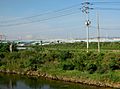
Seosuwon IC, seen from across the Hwanggujicheon in Dangsu-dong
-
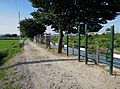
An outdoor gym by the Hwanggujicheon in Dangsu-dong
-
Riverside paths in Dangsu-dong
-
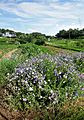
Small farms in Ipbuk-dong


