
Japanese mantis shrimp facts for kids
Quick facts for kids Japanese mantis shrimp |
|
|---|---|
 |
|
Scientific classification  |
|
| Kingdom: | Animalia |
| Phylum: | Arthropoda |
| Subphylum: | Crustacea |
| Class: | Malacostraca |
| Order: | Stomatopoda |
| Family: | Squillidae |
| Genus: | Oratosquilla |
| Species: |
O. oratoria
|
| Binomial name | |
| Oratosquilla oratoria (De Haan, 1844)
|
|
| Script error: The function "autoWithCaption" does not exist. | |
| Synonyms | |
|
|
Script error: No such module "Check for conflicting parameters".
The Japanese mantis shrimp, known scientifically as Oratosquilla oratoria, is a fascinating sea creature. It lives in the western Pacific Ocean. In Japan, people call it shako and often enjoy it as sushi.
This unique shrimp is famous for its powerful "spear-like" claws. It uses these claws to catch its food, like small invertebrates and tiny fish.
Contents
- What Does the Japanese Mantis Shrimp Look Like?
- Where Do Japanese Mantis Shrimp Live?
- How Do Japanese Mantis Shrimp Hunt and What Do They Eat?
- Reproduction and Life Cycle of the Japanese Mantis Shrimp
- Japanese Mantis Shrimp as Food
- Adaptations
- Cool facts about the Japanese mantis shrimp
- Images for kids
- See also
What Does the Japanese Mantis Shrimp Look Like?

The Japanese mantis shrimp has a body that is usually light grey or light brown. It has cool dark red lines, or grooves, along its middle section (thorax) and tail area (abdomen). The very tips of its tail are often a dark green color.
The Japanese mantis shrimp can grow up to about 18.5 centimeters (7 inches) long.
Where Do Japanese Mantis Shrimp Live?

These mantis shrimp live in many different places in the ocean. You can find them near shores, in coral reefs, and on flat sandy or muddy bottoms. Their natural home is in the northwestern Pacific Ocean. This includes the waters around countries like Korea, Japan, Taiwan, China, and Vietnam.
The shrimp digs long, U-shaped tunnels in soft sand or mud. It uses special mouthparts called maxillipeds to dig these burrows. During the day, it stays hidden inside its burrow to be safe. It usually only comes out at night to find food. These burrows are also important places for laying eggs. If a burrow is too small, the shrimp will make it bigger or dig a new one.
How Do Japanese Mantis Shrimp Hunt and What Do They Eat?

The Japanese mantis shrimp is a skilled hunter. It actively searches for and catches its food. At night, it leaves its burrow to find prey. Then, it brings its meal back to the burrow to eat.
These shrimp are unique because they use two different hunting styles. Some mantis shrimp are "spearers" and use sharp claws to stab soft prey. Others are "smashers" and use a club-like claw to break hard shells. The Japanese mantis shrimp uses a mix of both!
Its diet changes depending on where it lives. It eats many different things, such as crustaceans, molluscs, small fish, worms, and even some algae. If food is very scarce, they might even eat smaller mantis shrimp of their own kind.
Reproduction and Life Cycle of the Japanese Mantis Shrimp

Japanese mantis shrimp reproduce when adult males and females pair up. Females are ready to lay eggs from late spring to early summer, and this period lasts until fall. Males can reproduce all year long.
They have special ways of showing interest in each other. Sometimes, a male and female will face each other and gently touch antennas for a few seconds. They might also walk closely side-by-side. The male might even gently brush the female with his body parts.
After the eggs are fertilized, the female lays them inside her burrow. She then takes care of the eggs until they hatch. Females spend a lot of time looking after their eggs. Because of this, they usually stay in their burrows and only leave to find food. If she does leave, the female carries her eggs safely with her mouthparts.
The eggs usually hatch after about 14 days. The baby mantis shrimp, called larvae, go through 11 different stages of development. They start swimming and eating actively during their third stage. The larval stage lasts about 32 to 51 days. After this, they become young mantis shrimp, known as juveniles.
Japanese Mantis Shrimp as Food
.jpg)
In Japan, the Japanese mantis shrimp is called shako. It is a popular food there. It is not as common in other countries because it can be expensive and hard to find.
Many people say shako tastes best in the spring. This is when they are breeding. Sometimes, people eat it with its eggs, called roe. Its taste and texture are often described as being like a mix between eel and shrimp.
Shako started appearing as sushi in the 1950s. It was often brushed with a sweet sauce called nitsume, which is like an eel sauce. Traditionally, shako was boiled in a sugar syrup. Today, it is usually simmered slowly. This method helps keep it fresh and tasty for longer.
Adaptations
The Japanese mantis shrimp (scientific name: Oratosquilla oratoria) has developed several incredible adaptations that make it a super-powered hunter and survivor in its ocean home. These adaptations include its unbelievably complex eyes, lightning-fast spear-like claws, clever camouflage, and the ability to dig protective burrows.
Eyes
One of the most mind-blowing adaptations of the Japanese mantis shrimp is its eyes. Forget about human eyes; these creatures have vision that's out of this world!
- More Colors Than a Rainbow: Humans have three types of color-sensing cells in our eyes, allowing us to see millions of colors. Mantis shrimp, however, can have up to 16 different types of color-sensing cells! This means they see a spectrum of colors that we can't even imagine.
- Seeing the Invisible: Their eyes can also detect something called "polarized light" and "ultraviolet (UV) light." Polarized light helps them see through reflections on the water's surface, making it easier to spot prey or avoid predators. UV light might help them find food, communicate with other mantis shrimp, or even spot camouflaged creatures.
- Independent Vision: Each of their two eyes can move independently, meaning they can look in two different directions at once! This gives them a super-wide view of their surroundings, helping them keep an eye out for danger and potential meals.
This incredible vision helps the Japanese mantis shrimp find its prey. It also helps them spot predators and navigate their complex underwater world.
Punching Power
The Japanese mantis shrimp has sharp, spiny, spear-like claws that fold up neatly under its body. These aren't just any claws; they are incredibly strong and designed for speed. When a Japanese mantis shrimp spots its prey, it can unfold and strike with its spear-like claws at an astonishing speed. This strike is one of the fastest movements in the animal kingdom! It's so fast that it creates a tiny bubble of super-heated water, which then collapses with a shockwave. This shockwave can stun or even kill its prey, making it easier to catch.
These spears are perfect for catching soft-bodied prey like small fish, worms, and other shrimp. The sharp spines help them grip their slippery meals.
This powerful and rapid strike is essential for hunting. It allows the mantis shrimp to ambush and capture fast-moving prey that would otherwise escape. It's a perfect example of how evolution has given them a specialized tool for survival.
Master of Disguise
The body coloration of the Japanese mantis shrimp often matches its environment. They can have shades of green, brown, or sandy colors, sometimes with patterns or spots. This helps them disappear against the seabed, making it harder for both predators and prey to spot them.
Their camouflage is especially important because they are ambush predators. They often wait patiently, hidden in their burrows or among the sand, until an unsuspecting meal swims by.
Camouflage helps the mantis shrimp stay safe from larger predators like fish and octopuses. It also allows them to get very close to their prey without being noticed, increasing their chances of a successful hunt.
The Burrow Builder
Japanese mantis shrimp are not just hunters; they are also skilled architects! They spend a lot of their time digging and living in burrows in the sandy or muddy seafloor. These burrows can be quite complex, with multiple entrances and tunnels.
Their burrows provide a safe place to hide from predators, rest, and even raise their young. When they're not hunting, they're usually tucked away in their underground homes.
Living in a burrow is a fantastic way to stay protected in the open ocean. It offers shelter from strong currents, a hiding spot from danger, and a secure base from which to launch their hunting attacks.
Cool facts about the Japanese mantis shrimp
- They've been around for a very, very long time, branching off from other crustaceans about 400 million years ago. That's even before dinosaurs roamed the Earth!
- Its eyes are arguably the most complex in the animal kingdom.
- Despite the name, mantis shrimp are not true shrimp. They belong to a completely different group of animals which are known as stomatopods.
- When they strike their prey, they hit it with about 1,500 newtons of force. That's like getting hit by a small, very fast bowling ball!
- Despite being solitary, mantis shrimp are quite smart! They can learn and remember things, and they can even recognize their neighbors by sight and smell. This helps them know who is a friend and who is a rival.
- In recent years the Japanese mantis shrimp has been artificially introduced to oceans near Australia and New Zealand. There, it became an invasive species. This means it started to spread and could harm the local environment.
Images for kids
-
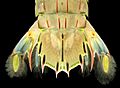
Close-up of the telson and uropods
-

For sale at a Japanese market
-
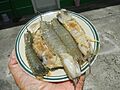
Raw
-

Cooked


See also
 In Spanish: Oratosquilla oratoria para niños
