
Krampus facts for kids

Krampus is a legendary figure often described as a horned, furry, and sometimes scary-looking creature. In many European traditions, he's known as a companion to Saint Nicholas. While Saint Nicholas is busy giving gifts to children who have been good, Krampus has a different job: he's there to remind children who haven't been so well-behaved to try harder next year. Think of him as a spooky but important part of a very old holiday story.
Contents
- Mysterious Origins
- A Helper for Saint Nicholas
- What Does Krampus Look Like?
- Krampusnacht: The Night of Krampus
- Krampus Runs and Parades
- Krampuskarten: Holiday Greeting Cards
- Krampus in Modern Times
- Krampus in Popular Culture
- Similar Figures Around the World
- Interesting facts about Krampus
- See also
- Images for kids
Mysterious Origins
The exact beginning of the Krampus legend is a bit of a mystery, like a puzzle with some missing pieces. Some people think that Krampus might have very old roots, possibly even going back to times before Christianity, to ancient pagan traditions. These traditions often involved masked figures and spirits during the winter months. However, historians usually say that we don't see clear mentions of Krampus until around the 16th century. It's believed that over time, these older traditions blended with Christian customs, and Krampus became linked with Saint Nicholas.
Anthropologists, who study human cultures, have observed that people in places like Austria are quite aware that their Saint Nicholas customs mix "heathen" (older, non-Christian) elements with Christian ones. They often believe Krampus comes from an ancient supernatural being that was later connected to the Christian idea of a devil.
A Helper for Saint Nicholas

In the 17th century, Krampus really started to be seen as a helper for Saint Nicholas. Since Saint Nicholas is a holy figure, it didn't quite fit for him to be the one giving out punishments. So, helpers like Krampus, or other figures such as Farmhand Rupert or Schmutzli, were introduced. These helpers would sometimes go down chimneys or, in Krampus's case, remind naughty children to improve their behavior. Krampus served Saint Nicholas in this special role, making sure that children understood the importance of being kind and good throughout the year.
What Does Krampus Look Like?

Krampus has a very distinctive look. While there are many different versions of him, most share some common features:
- Horns: He almost always has impressive horns, like a goat or a demon.
- Fur: He's usually covered in dark, shaggy fur, often brown or black.
- Hooves: Interestingly, he often has one human-like foot and one cloven hoof, like a goat.
- Tongue and Fangs: You might see a very long, pointed tongue lolling out of his mouth, and sometimes he has sharp fangs.
- Chains and Bells: Krampus often carries chains, which are thought to symbolize the binding of evil. He might rattle these chains for dramatic effect, sometimes with bells attached, making a spooky sound as he moves.
- Birch Branches: He also carries a bundle of birch branches. In the tradition, these are used to playfully swat children as a reminder to be good. Sometimes, these are replaced with a whip in artistic depictions.
- Sack or Basket: Krampus is sometimes shown with a sack or a basket on his back. In older stories, this was said to be for carrying away badly behaved children. Don't worry, it's all part of the folklore to encourage good behavior.
These features have made Krampus a popular character for costumes, especially around the holidays, and even in some fun, spooky movies!
Krampusnacht: The Night of Krampus
The Feast of Saint Nicholas is celebrated in many parts of Europe on December 6th. But the night before, on December 5th, is a very special evening called Krampusnacht, or "Krampus Night"!
On Krampusnacht, the "wicked hairy devil" is said to appear on the streets. Sometimes he's with Saint Nicholas, and sometimes he's on his own. He visits homes and businesses. In these celebrations, Saint Nicholas focuses on the good children, giving them gifts, while Krampus is responsible for reminding the naughty ones to be better. Saint Nicholas might give out presents, and Krampus might leave behind a lump of coal or those birch rods as a playful warning.
Krampus Runs and Parades
One of the most exciting ways people celebrate Krampus is through events called Krampuslauf, which means "Krampus run," or Perchtenlauf. These are parades where young men (and sometimes women) dress up in incredible, often scary, Krampus costumes with elaborate masks. They run through the streets, making lots of noise with their chains and bells, trying to playfully scare the audience with their antics.
These runs have a long history, possibly linked to even older pagan traditions where people would dress up as devilish figures called Percht. Over time, these lively processions became intertwined with the Saint Nicholas story, and the Percht figure transformed into the Krampus we know today, often seen as being under Saint Nicholas's command. It's a very energetic and fun way to experience the folklore.
Krampuskarten: Holiday Greeting Cards
Did you know that people have been exchanging greeting cards featuring Krampus since the 19th century? These cards are called Krampuskarten. They often say "Gruß vom Krampus" (Greetings from Krampus) and include funny rhymes or poems.
On these cards, Krampus is often shown playfully looming over children, or sometimes just looking mischievous. His appearance on the cards has changed over time; older versions might show a more frightening Krampus, while modern ones can sometimes be cuter or more cartoon-like. It's a unique way to send holiday greetings.
Krampus in Modern Times
After a period in the 1930s and 1950s when the Krampus tradition was discouraged by some governments (who worried it might be too scary for children), there has been a huge comeback. Towards the end of the 20th century and into today, Krampus celebrations have become very popular again, not just in Europe but around the world. People love the unique blend of spooky fun and tradition.
Today, you can find Krampus in the folklore of many countries, including Austria, Germany, Croatia, Slovenia, Hungary, and parts of Italy.
Krampus in Popular Culture
Krampus has become a global sensation. He's been "imported" and adapted into all sorts of popular culture, especially in North America:
- Books: You can find him in collections of vintage postcards, like "Krampus: The Devil of Christmas," and in novels such as "Krampus: The Yule Lord."
- Television: He's appeared in animated shows like "The Venture Bros." and "American Dad!", and live-action shows like "The League."
- Video Games: Krampus has made appearances in video games like "CarnEvil" and "The Binding of Isaac: Rebirth."
- Movies: He's been the star of films like the 2015 Christmas comedy horror film "Krampus," and he's even in the 2024 Christmas action-adventure comedy film "Red One".
Similar Figures Around the World
Krampus isn't the only figure who helps remind children to be good during the holidays. Many cultures have similar companions to Saint Nicholas or other winter spirits:
- Knecht Ruprecht in Germanic folklore.
- Zwarte Piet (Black Pete) in the Netherlands, who used to carry a "roe" (a bundle of twigs) and a bag for naughty children, but is now mostly a friendly helper.
- Perchta, an Alpine goddess whose processions are similar to Krampus runs.
- Mari Lwyd in Wales, a horse skull figure in a Christmas folk custom.
- Namahage in Japan, an ogre-like character who enforces good behavior during New Year's rituals.
Interesting facts about Krampus
- In Styria, Austria, Krampus sometimes gives families a bundle of birch rods. These twigs are painted gold and kept in the house all year. They serve as a reminder for children to behave well.
- In cities like Salzburg, Austria, you can find a milder version of Krampus at Christmas markets. These versions are more humorous and less scary for tourists.
- Believe it or not, Krampus is so unique that some scientists have even named real-life creatures after him! For example, there's a species of caddisfly called Anisocentropus krampus, a type of sweat bee called Austrosphecodes krampus, and even a freshwater fish called Protomelas krampus. How cool is that?
- There's even a Krampus comic book series!
See also
 In Spanish: Krampus para niños
Images for kids
-

A person dressed as Krampus at Morzger Pass, Salzburg, Austria
-
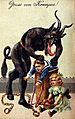
A 1900s greeting card reading 'Greetings from Krampus!'
-
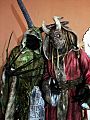
Dallas Krampus Society Walk, 2016
-
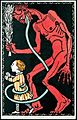
Krampus mit Kind ("Krampus with a child") postcard from around 1911
-
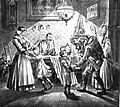
Krampus and Saint Nicholas visit a Viennese home in 1896
-
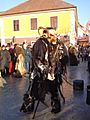
A Krampus from Sveti Martin na Muri, northern Croatia, at local carnival in Čakovec (2015)
-
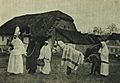
A St. Nicholas procession with Krampus, and other characters, c. 1910
-
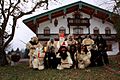
St. Nikolaus with 12 Krampuses in Berchtesgadener Land, Germany (2016)
-
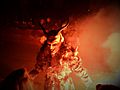
In Sexten, Italy (2016)
-
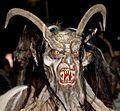
A modern Krampus at the Perchtenlauf in Klagenfurt (2006)
-
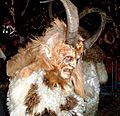
Krampus in Toblach, Italy (2006)


