
Leonid Plyushch facts for kids
Quick facts for kids
Leonid Ivanovych Plyushch
|
|
|---|---|
| Леонід Іванович Плющ | |
 |
|
| Born | 26 April 1938 Naryn, Kirghiz SSR
|
| Died | 4 June 2015 (aged 77) Bessèges, France
|
| Nationality | Ukrainian |
| Citizenship |  Soviet Union,  France |
| Alma mater | Odesa University, Taras Shevchenko National University of Kyiv |
| Occupation | mathematics |
| Known for | human rights activism with participation in the Ukrainian Helsinki Group |
| Movement | dissident movement in the Soviet Union |
| Spouse(s) | Tatyana Ilinichna Zhitnikova |
| Awards | Order For Courage Antonovych prize (1987) |
Leonid Ivanovych Plyushch was a Ukrainian mathematician. He was also a Soviet dissident, meaning he spoke out against the Soviet government. He was born on April 26, 1938, in Naryn, which was then part of the Soviet Union. He passed away on June 4, 2015, in France.
Even though he worked on important Soviet space missions, Leonid became unhappy with some things the Soviet Union did. He started to protest by sending letters and signing petitions. Because of this, he was questioned and later arrested in 1972. He was held in prison and treated badly. His trial was kept secret from the public. In 1976, he was allowed to leave the Soviet Union. He then moved to France and worked to promote human rights.
In 1979, with help from his wife, he wrote a book. It described how he and other people who disagreed with the government were put into mental health facilities. Later in his life, he continued to support publications that spoke out against strict governments.
Contents
Early Life and Studies
Leonid Plyushch was born in 1938. His family was a working-class family in Naryn, Kirghizia. His father worked on the railway. Sadly, his father died in 1941 during World War II. Leonid had a difficult childhood. When he was 8 years old, he got a bone illness called tuberculosis.
Leonid studied mathematics at Kyiv University. He graduated in 1962. In his final year, he became interested in using math to understand living things. He wanted to use computers to model how the brain works. This was a very hard task. But he did publish papers on simpler biological systems, like how blood sugar levels are controlled. After university, he got a job at the Institute of Cybernetics. This institute often helped with the Soviet space program.
Standing Up for Human Rights
Leonid Plyushch became a dissident by speaking out about political issues. In 1968, he protested against an unfair trial. He sent a letter to a newspaper, but it was not published. When Soviet troops entered Czechoslovakia in 1968, Plyushch and 16 other Soviet dissidents signed a statement. It showed their support for the democratic movement in Czechoslovakia.
In the same year, he joined a group called the Initiative Group for the Defense of Human Rights in the USSR. This group wrote to the UN Human Rights Commission. They asked the UN to look into how the USSR was violating people's rights. They wanted the UN to investigate if people could hold their own beliefs. Plyushch was one of fifteen people who signed this important appeal. Because of his political actions, he lost his job in 1968. The KGB, which was the Soviet secret police, took many of his writings. They also questioned him many times.
Arrest and Detention
Leonid Plyushch was arrested in January 1972. He was accused of working against the Soviet government. He was held in jail for a year before his trial started. During his trial, the court met in secret. Leonid was not even allowed to be there. No expert witnesses were called to speak for him. Even so, he was declared to be mentally unwell. The court ordered him to be sent for "treatment in a special type of hospital."
He was placed in a ward for very ill patients. This was at the Dnipropetrovsk Special Psychiatric Hospital. Several groups of doctors examined him after a year. They said he had "reformist delusions" and "Messianic elements." They also said he had "sluggish schizophrenia." On November 28, 1976, Plyushch said that Moscow was using a peace agreement to help its economy. But at the same time, it was increasing its control over people who spoke out.
While he was held, he wrote letters to Tatiana Khodorovich. These letters later became a book called The Case of Leonid Plyushch. Many people, including doctors who study ethics, paid attention to his story. His imprisonment caused protests around the world. Over 650 American mathematicians sent a letter to the Soviet embassy. Henri Cartan brought his case to a big meeting of mathematicians in 1974. Amnesty International held a special day for Plyushch in April 1975. Andrei Sakharov, another famous dissident, also spoke up for him.
Freedom and Later Life
Finally, Leonid Plyushch and his family were allowed to leave the Soviet Union in 1976. His arrival in the West caused more tension between Western and Soviet doctors. This led to the World Psychiatric Association criticizing Soviet practices. At a press conference in Paris, Plyushch shared a powerful story. He described how being held and given medicines affected him:
I noted with horror the daily progression of my degradation. I lost interest in politics, then in scientific problems, finally in my wife and children. My speech became blurred; my memory worsened. In the beginning, I reacted strongly to the sufferings of other patients. Eventually I became indifferent. My only thoughts were of toilets, tobacco and the bribes to the male nurses to let me go to the toilet one more time. Then I began to experience a new thought: 'I must remember everything I see here, I told myself, so that I can tell about it afterwards.'

In 1977, Plyushch became a member of the Ukrainian Helsinki Group. This group worked to promote human rights in his home country, Ukraine.
On July 23, 1978, Plyushch visited Ukrainians in Australia. He also spoke to the Australian Parliament.
In 1979, with his wife's help, Plyushch published his book History's Carnival: A Dissident's Autobiography. In this book, he wrote about how he and other dissidents were sent to mental health hospitals. The book was translated into English that same year.
Later in his life, Leonid Plyushch still held some communist beliefs. However, he supported publications that spoke out against strict governments in other communist countries, like Vietnam.
In 2006, he and his wife Tatiana translated a book called Talking with angels into Russian and Ukrainian.
Leonid Plyushch passed away on June 4, 2015, in Bessèges, France. His death was announced by a friend, Arina Ginzburg, who was also a former Soviet dissident.
Images for kids
-
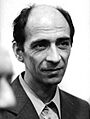
Leonid Plyushch
