
Leptothorax pocahontas facts for kids
Quick facts for kids Leptothorax pocahontas |
|
|---|---|
| Conservation status | |
| Scientific classification | |
| Kingdom: | |
| Phylum: | |
| Class: | |
| Order: | |
| Family: | |
| Subfamily: |
Myrmicinae
|
| Genus: |
Leptothorax
|
| Species: |
L. pocahontas
|
| Binomial name | |
| Leptothorax pocahontas (Buschinger, 1979)
|
|
| Synonyms | |
|
Doronomyrmex pocahontas |
|
The Leptothorax pocahontas is a special kind of ant that lives only in Alberta, Canada. Its name, pocahontas, comes from the Powhatan language and means "playful one." This ant is a threatened species, which means it is at a high risk of disappearing forever.
Contents
About the Pocahontas Ant
What Does It Look Like?
A female Leptothorax pocahontas ant is about 4 mm long. That's about the size of a small grain of rice! This measurement includes her mandibles, which are like her jaws.
The queen ant of this species can look quite different from one another. They vary in size, how hairy they are (called pilosity), how shiny their bodies are (called sculpture), and their color.
Where Does It Live?
This tiny ant has only ever been found in one specific place: Maligne Canyon, which is near Jasper, Alberta, Canada. This single location is called its "type locality," meaning it's the first and only place where this species was officially discovered and identified.
A Changing Name
When the Leptothorax pocahontas ant was first discovered in 1979, scientists thought it was very similar to a European ant called Leptothorax pacis. They even thought it might not have worker ants, just like L. pacis. Because of these similarities, it was first placed in a different group, or genus, called Doronomyrmex.
However, later studies by scientists like Heinze (1998) and Bolton (2003) showed that Doronomyrmex was actually part of the Leptothorax genus. This means that all the ants previously in the Doronomyrmex group, including Leptothorax pocahontas, are now considered to be part of the Leptothorax genus.
Why Is It Endangered?
What Does "Vulnerable" Mean?
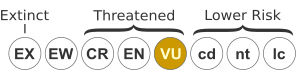
The Leptothorax pocahontas ant is listed as "Vulnerable" (VU) by the IUCN Red List. The IUCN is a big group that keeps track of how threatened plants and animals are around the world. Being "Vulnerable" means that this ant's population is very small and lives in a very limited area.
Specifically, it means the ant lives in an area smaller than 100 square kilometers (about 38 square miles) or in fewer than five different places. Because it lives in such a small area, it's at high risk. Things like human activities or unexpected events could quickly make it even more endangered, or even cause it to become extinct.
Protecting This Tiny Ant
The last time scientists checked on the risk of extinction for this ant was in 1996. Since then, it's still considered vulnerable. Protecting its habitat in Maligne Canyon is very important to make sure this unique Canadian ant continues to thrive.
