
List of New York State Historic Markers in Queens County, New York facts for kids
Have you ever walked around Queens, New York, and noticed special signs that tell you about important places or people from the past? These signs are called New York State Historic Markers! They help us learn about the rich history of Queens County, from famous writers and politicians to old buildings and important events. Each marker shares a little piece of history, showing us where important things happened or where famous people lived.
Contents
Discovering Queens' History
Queens County is full of history, and these markers help us explore it. They point out places that might look ordinary today but were once very important. Let's take a look at some of these cool historical spots!
Homes of Famous People
Many important people lived in Queens, and their homes are remembered with historic markers.
Betty Smith's Home
In Woodhaven, you can find a marker for Betty Smith. She was a famous writer who lived here while she wrote her well-known book, "A Tree Grows in Brooklyn." This book was so popular that it even became a movie in 1945!
Cadwallader Colden House
Near Flushing, there was once the home of Cadwallader Colden. He was a very important person in New York's government, serving as the Lieutenant Governor from 1760 to 1775. He passed away in his home in 1776.
Dewitt Clinton House
In Maspeth, a marker shows where the Dewitt Clinton House once stood. Governor Dewitt Clinton, a key figure in New York's history, worked on plans for the famous Erie Canal right here. The Erie Canal was a huge project that helped connect New York City to the Great Lakes.
Francis Lewis's Estate
In Whitestone, you can find the former estate of Francis Lewis. He was one of the brave people who signed the Declaration of Independence, a document that declared America's freedom from Great Britain.
Moore Homestead
In Elmhurst, the Moore Homestead was built in 1662. This was the family home of Dr. C.O. Moore, who is famous for writing the classic poem "Twas the Night Before Christmas." Later, it was also the home of his grandson, Commodore O.H. Perry, a well-known naval hero.
Prince Homestead
The Prince Homestead in Flushing was built in 1780. Even George Washington, America's first president, stopped here in 1789 to visit the famous Prince Nurseries during his trip to Long Island.
Walter Bowne's Residence
In Flushing, a marker shows the site of Walter Bownes home. He served as the Mayor of New York City from 1829 to 1833. He was also a great-great-grandson of John Bowne, one of the original settlers of Flushing.
Important Historical Sites
Queens is home to many places where significant events happened or where important community buildings stood.
Arbitration Rock
In Maspeth, there's a special spot called Arbitration Rock. This rock marks where a disagreement about the boundary line between the towns of Newton and Bushwick was finally settled in 1769.
First House Number in Queens
In Woodhaven, a marker points to the First House Number in Queens. This was the first house to get a number under a new system started in 1913. This system helped organize streets and houses with numbers, making it easier to find places.
Jackson's Mill
In Jackson Heights, a marker shows where Wessel's Grist Mill stood in 1640. A grist mill is a place where grain is ground into flour. This mill was destroyed during an early Indian War, but other mills continued to use the same spot for many years.
Prospect Cemetery
In Jamaica, you can visit Prospect Cemetery, which was the original burying ground for the town of Jamaica, started way back in 1660. Many important people are buried here, including Egbert Benson, who was the first Attorney General of New York State.
Quaker Meeting House
The Old Quaker Meeting House in Flushing is a very old building. The oldest part was built in 1694, and more was added in 1717. It has almost always been used for worship, except during the American Revolutionary War (1776-1783) when the British used it as a prison, hospital, and even a stable!
Rapelye's Mill
In Corona, a marker shows the site of Rapelye's Mill. This was where Captain John Coe built the very first grist mill in Newtown in 1655. It was used as a mill until 1875.
Remsen Cemetery
In Forest Hills, Remsen Cemetery is the burial place of Colonel Jeromus Remsen. He was a colonel in the local militia during the Battle of Long Island in the Revolutionary War.
Woodhaven Library
The Woodhaven Library has its own historic marker. It was the very last public library built with money from Andrew Carnegie, a famous businessman and philanthropist. The library opened its doors on January 7, 1924.
Revolutionary War Stories
Queens played a role in the American Revolutionary War, and some markers tell us about those times.
Foster House
Near Alley Pond, the Foster House once stood. The stone part of this house was used for protection during Indian attacks. During the Revolutionary War, Thomas Foster was captured by Hessian soldiers (German soldiers fighting for the British), but his son bravely rescued him.
Gen. Howe's Headquarters
In Elmhurst, a marker shows where General Howe's Headquarters was located. General Howe was a British commander during the Revolutionary War. He wrote his report about the Battle of Long Island here on September 3, 1776.
Gen. Nathaniel Woodhull
In Hollis, a marker tells the sad story of General Nathaniel Woodhull. He was captured and badly wounded by the British in a nearby house during the Revolutionary War. He later died from his wounds.
Stevens House
In Astoria, the Stevens House was the home of Major General Ebenezer Stevens. Born in 1752, he was a brave soldier who took part in the famous Boston Tea Party and was a major of artillery in the Revolutionary War.
Images for kids
-
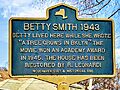
Betty Smith's historic marker in Woodhaven.
-
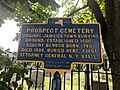
A detailed view of a historic marker.
-
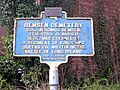
The sign for Remsen Cemetery.
-
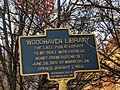
The historic marker for Woodhaven Library.


See also
