
Little big-eared bat facts for kids
Quick facts for kids Little big-eared bat |
|
|---|---|
_by_Merlin_Tuttle.jpg) |
|
| Conservation status | |
Scientific classification  |
|
| Kingdom: | Animalia |
| Phylum: | Chordata |
| Class: | Mammalia |
| Order: | Chiroptera |
| Family: | Phyllostomidae |
| Genus: | Micronycteris |
| Species: |
M. megalotis
|
| Binomial name | |
| Micronycteris megalotis Gray, 1842
|
|
 |
|
| Distribution | |
| Script error: The function "autoWithCaption" does not exist. | |
Script error: No such module "Check for conflicting parameters".
The little big-eared bat (Micronycteris megalotis) is a small bat with very large ears. It belongs to the family of leaf-nosed bats. You can find this bat in South America and Central America. It lives in countries like Colombia, Venezuela, Brazil, Peru, Argentina, and Trinidad.
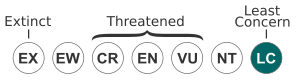
Even though we don't know the exact number of these bats, they are found in many places. They also live in protected areas. While deforestation (cutting down forests) might be a small problem, this bat is not in danger. Scientists say it is of "Least Concern," meaning it's not close to becoming extinct.
These bats live in different kinds of forests, including wet evergreen forests and dry thorn forests. They often look for food near streams. During the day, they rest in hollow trees, logs, caves, or even houses. They usually roost in groups of up to twelve bats.
Male bats are about 44 millimeters (about 1.7 inches) long from head to body. Females are a little longer, at 45 millimeters (about 1.8 inches). Males usually weigh about 5 grams (0.18 ounces), and females weigh about 5.7 grams (0.2 ounces).
What Does It Look Like?
The little big-eared bat is considered small for its group of bats. Its size can change a bit depending on where it lives. A special feature of this bat is its very large ears. It also has a big nose pad, which is usually twice as tall as it is wide.
This bat has a long head and small, black eyes. Its wings are short and wide. They are connected to its long, thin feet. These short, wide wings help the bat fly easily and turn quickly in its forest home.
The fur of the little big-eared bat is brown. It has white spots on its belly. The color of its fur can also change depending on the area. Young bats have slightly shorter fur. The fur around the inner edge of its ears is thick and can be different lengths. This also changes as the bat gets older.
The bat has a small, thin skull with a high forehead. Its teeth are quite simple. The front upper teeth are large, while the outer ones are small. Its upper canine teeth are strong and different from each other. The teeth before the molars are about the same size. The molars have W-shaped ridges.
What Does It Eat?
The little big-eared bat mainly eats insects. It might also eat some fruit, but scientists need more information about that. Small beetles are a big part of this bat's diet. Other common foods include grasshoppers, crickets, cockroaches, and katydids.
What the bat eats can change with the seasons. It might also depend on where it is looking for food. However, it usually eats noisy insects. This bat is an "opportunistic feeder," which means it eats whatever food is available.
Its stomach is quite simple. The little big-eared bat might switch its diet between insects, fruit, nectar, and pollen. It might eat more nectar and pollen when there are fewer insects around. This bat flies slowly and can turn very well. It can also hover in the air. Even though it mostly catches flying insects in mid-air, it can also find food while resting on plants.
Where Does It Live?
The little big-eared bat lives in many different places. You can find it in wet and dry areas. It lives in evergreen and deciduous forests, swamps, and open clearings. These bats are found all over South America, Central America, and Mexico. Among bats in its group (Micronycteris), the little big-eared bat is thought to be the most widespread.
These bats like to rest in small caves or cracks in rocks. They also use spaces under bridges, tunnels, and even buildings or houses. In lower areas, they might roost inside hollow trees and logs.
Scientists don't have records of what causes these bats to die. Some people think that losing their habitat (their home) might be a big problem for them. However, there isn't clear proof of this yet.
