
Loop jump facts for kids
Quick facts for kids Figure skating element |
|
|---|---|
| Element name | Loop Jump |
| Alternative name | Rittberger Jump |
| Scoring abbreviation | Lo |
| Element type | Jump |
| Take-off edge | Back Outside |
| Landing edge | Back Outside |
| Inventor | Werner Rittberger |
The loop jump is an exciting jump in the sport of figure skating. Skaters perform this jump by taking off from the back outside edge of one foot. They spin in the air one or more times, then land on the back outside edge of the same foot. It's often used as the second jump in a series of jumps, called a combination.
Contents
All About the Loop Jump
The History of the Loop Jump
The loop jump was invented by a German figure skater named Werner Rittberger. Because of him, many people in Europe still call it the "Rittberger jump." U.S. Figure Skating says the loop jump is "the most fundamental of all the jumps." This means it's a very basic and important jump to learn.
The name "loop jump" also comes from the shape a skater's blade would make on the ice if they practiced the spin without actually leaving the ice. This creates a "loop" pattern.
In competitions, judges give points for each jump. A single loop jump is worth 0.50 points. A double loop is worth 1.70 points, and a triple loop is 4.90 points. If a skater performs an amazing quadruple loop, it's worth 10.50 points! There's even a base value for a quintuple loop, which is 14 points, though it's incredibly rare.
Who Performed the First Loop Jumps?
Here are some of the first skaters to successfully land these amazing loop jumps in major competitions:
| Abbr. | Jump element | Skater | Nation | Event | Ref. |
|---|---|---|---|---|---|
| 3Lo | Triple loop (men's) | Dick Button |  United States United States |
1952 Winter Olympics | |
| Triple loop (women's) | Gabriele Seyfert |  East Germany East Germany |
1968 skating competition | ||
| 4Lo | Quadruple loop (men's) | Yuzuru Hanyu |  Japan Japan |
2016 CS Autumn Classic International | |
| Quadruple loop (women's) | n/a | n/a | none ratified |
How to Perform a Loop Jump
The loop jump is an "edge jump." This means the skater takes off and lands using only the edge of their skate blade, not the toe pick. To do a loop jump, a skater glides backward, usually after doing "back crossovers" (a way of moving backward on the ice). This helps them get ready and set their body position.
They take off from the back outside edge of their skating foot. While in the air, they spin around one or more times. Then, they land smoothly on the back outside edge of the same foot they took off from. It's like a toe loop jump, but without using the toe pick to help push off the ice.
Many skaters find the loop jump a bit easier than jumps like the flip or Lutz. This is because the timing for body coordination and shifting weight doesn't have to be perfectly exact. However, it can be harder than the toe loop or salchow. This is because the free leg is already crossed at the start, so the spin has to begin mainly from the skating foot and upper body.
The loop jump is often the second jump in a combination of jumps. This is because it takes off from the same edge that skaters usually land on. If a skater's free foot doesn't leave the ice before they jump, it's considered an incorrect takeoff.
Images for kids
-
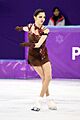
Evgenia Medvedeva gets ready for a loop jump.
-
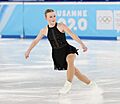
Nella Pelkonen bends her knees to prepare for her jump.
-
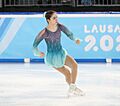
Regina Schermann starts to lift off the ice.
-
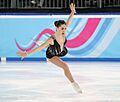
Alessia Tornaghi lands her jump.

_by_Sandro_Halank%E2%80%93081.jpg)
_by_Sandro_Halank%E2%80%93209.jpg)
_by_Sandro_Halank%E2%80%93656.jpg)
