
Merida small-eared shrew facts for kids
Quick facts for kids Merida small-eared shrew |
|
|---|---|
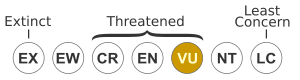
| Conservation status | |
Scientific classification  |
|
| Kingdom: | Animalia |
| Phylum: | Chordata |
| Class: | Mammalia |
| Order: | Eulipotyphla |
| Family: | Soricidae |
| Genus: | Cryptotis |
| Species: |
C. meridensis
|
| Binomial name | |
| Cryptotis meridensis Thomas, 1898
|
|
 |
|
| Range of the Merida small-eared shrew | |
| Script error: The function "autoWithCaption" does not exist. | |
Script error: No such module "Check for conflicting parameters".
The Merida small-eared shrew (Cryptotis meridensis) is a tiny mammal. It's a type of shrew. This animal lives only in Venezuela. When an animal lives only in one place, it's called endemic.
Contents
Meet the Merida Small-Eared Shrew
The Merida small-eared shrew is one of the biggest small-eared shrews. Its body, from head to tail, is about 7 to 10 centimeters (about 3 to 4 inches) long. Its tail adds another 2.5 to 4 centimeters (about 1 to 1.5 inches).
Both male and female shrews are about the same size. Adult shrews usually weigh between 9 and 18 grams. That's about the weight of two to four quarters!
What Does It Look Like?
This shrew has long, chocolate-brown fur. The fur on its belly is a lighter olive-brown color. Its eyes and ears are quite small. They are hard to see from the outside.
The Merida small-eared shrew has large front paws. These paws have long claws. This helps them dig in the ground.
Special Teeth
One special thing about this shrew is its upper canine teeth. These teeth are unusually small. In about 25% of these shrews, one or both of these teeth might even be missing! This helps scientists tell them apart from other shrews.
Female shrews have four teats. These are located near their back legs. Male shrews have small scent glands on their sides.
Where Do Merida Shrews Live?
Merida small-eared shrews are found only in the mountains of Venezuela. They live in three states: Trujillo, Mérida, and Táchira.
Their Mountain Home
These shrews live in cloud forests. They also live in sub-alpine páramo habitats. These are high-altitude grasslands. They can be found at elevations between 1,640 and 3,950 meters (about 5,380 to 12,960 feet).
They prefer places with lots of dense plants. They also like areas with thick layers of fallen leaves on the ground. Sometimes, they can be found in areas where forests have been disturbed. This includes places like secondary scrubland near their natural homes.
Behaviour and Diet of the Merida Shrew
Merida small-eared shrews mainly eat small animals without backbones. These are called invertebrates. Their diet includes earthworms, insects, spiders, centipedes, and snails.
What They Eat
They are not very picky about what invertebrates they eat. About 70% of their food comes from creatures found under the soil. They also sometimes eat dead animals with backbones. They have even been seen eating eggs or baby rodents.
Who Hunts Them?
Even though they live in a small area, Merida shrews are common there. Many shrews can live in one place. Some animals that hunt them include barn owls and hawks. Opossums, long-tailed weasels, and mountain coatis also prey on them.
Reproduction and Life Cycle
Merida small-eared shrews seem to have babies all year long. However, they might have more babies during certain times. These times are usually between March and April, and again from July to October.
When a female shrew has babies, it's called a litter. A litter usually has two to four pups. Three pups is the most common number.
