
Messier 82 facts for kids
Quick facts for kids Messier 82 |
|
|---|---|

A mosaic image taken by the Hubble Space Telescope of Messier 82, combining exposures taken with four colored filters that capture starlight from visible and infrared wavelengths as well as the light from the glowing hydrogen filaments
|
|
| Observation data (J2000 epoch) | |
| Constellation | Ursa Major |
| Right ascension | 09h 55m 52.9200s |
| Declination | +69° 40′ 46.140″ |
| Redshift | 0.000897±0.000007 |
| Helio radial velocity | 269±2 km/s |
| Distance | 11.4–12.4 Mly (3.5–3.8 Mpc) |
| Type | I0 |
| Apparent dimensions (V) | 11.2′ × 4.3′ |
| Apparent magnitude (V) | 8.41 |
| Notable features | Edge-on starburst galaxy |
| Other designations | |
| Cigar Galaxy, 3C 231, IRAS 09517+6954, NGC 3034, Arp 337, UGC 5322, MCG +12-10-011, PGC 28655, CGCG 333-008 | |
| See also: Galaxy, List of galaxies | |


.jpg)
_(weic2410b).jpg)


Messier 82 (also known as NGC 3034 or the Cigar Galaxy) is a fascinating galaxy located about 12 million light-years away. You can find it in the constellation Ursa Major, which is home to the Big Dipper! M82 is famous for being a "starburst galaxy." This means it's making new stars much faster than most other galaxies, including our own Milky Way.
It's the second-largest member of a group of galaxies called the M81 Group. M82 shines incredibly bright, about five times more than the Milky Way. Its central part is even brighter, about one hundred times more luminous! Scientists believe this burst of star formation happened because M82 got too close to its larger neighbor, M81.
In 2014, a bright Type Ia supernova called SN 2014J was discovered in M82. This was one of the closest supernovae of its type seen in decades! Later that year, scientists also found the brightest pulsar ever known, named M82 X-2, within the galaxy. More recently, in November 2023, a powerful gamma-ray burst was seen coming from M82. This burst came from a special type of star called a magnetar, and it was the first time such an event was detected outside our Milky Way galaxy.
Contents
How Messier 82 Was Found
A German astronomer named Johann Elert Bode first saw M82 in 1774. He described it as a "nebulous patch," meaning a cloudy, faint area in the sky. He noted it was "very pale and of elongated shape."
A few years later, in 1779, another astronomer, Pierre Méchain, also found M82 without knowing Bode had seen it. Méchain then told Charles Messier, who added it to his famous catalog of celestial objects.
What Messier 82 Looks Like
For a long time, astronomers thought M82 was an irregular galaxy, meaning it didn't have a clear shape like a spiral or an oval. However, in 2005, new images taken with near-infrared cameras showed a surprise! Scientists discovered two hidden spiral arms in M82.
These arms were hard to see because M82 is very bright and we view it almost edge-on, like looking at a coin from its side. Also, a lot of dust and gas clouds block our view in regular light. These spiral arms stretch out from a central bar-like structure. They show that M82 is more organized than it first appears.
A Galaxy Full of New Stars
The heart of M82 is a very busy place, full of energy and new stars being born. In 2005, the Hubble Space Telescope found almost 200 young, massive star clusters there. These clusters are huge, each weighing as much as 200,000 of our Sun!
Stars are forming in M82's center about 10 times faster than in our entire Milky Way galaxy. This rapid star birth creates a powerful "superwind." This superwind is a strong outflow of gas and energy, powered by many supernovae (exploding stars) happening in the galaxy's core. These explosions happen about once every ten years!
The Chandra X-ray Observatory also found something interesting: fluctuating X-ray signals about 600 light-years from the center. Scientists think this might be from an intermediate-mass black hole, which is bigger than a regular black hole but smaller than a supermassive black hole. Like most galaxies, M82 does have a supermassive black hole at its very center, weighing about 30 million times the mass of our Sun.
The Mystery Object in M82
In April 2010, astronomers in the UK found a strange object in M82. It started sending out radio waves, but its signals were unlike anything they had ever seen before in the universe.
Scientists have many ideas about what this object could be. One idea is that it's a very unusual "micro quasar." Micro quasars are usually very bright in radio waves and X-rays. However, this object is very bright in radio waves but very faint in X-rays, which is puzzling. It also seems to be moving incredibly fast, about four times the speed of light, away from the galaxy's center! This "apparent superluminal motion" is a trick of perspective when things move very fast towards us, not actual faster-than-light travel. The mystery continues!
Why Messier 82 Makes So Many Stars
M82's amazing star-making activity is mostly due to its larger neighbor, the spiral galaxy M81. About 100 million years ago, the strong gravity of M81 started pulling on M82. These "tidal forces" deformed M82, causing a lot of gas to rush into its center.
This interaction made star formation in M82 increase by ten times compared to normal galaxies. Scientists believe that M81 and M82 have had several close encounters. The most recent one, about 200 to 500 million years ago, pushed a huge amount of gas into M82's core. This led to the intense starburst we see today.
It's thought that M82 might have been a "low surface brightness galaxy" before these interactions. This means it was a faint galaxy with not much star formation. The close encounters with M81 "woke it up," triggering all the new star births. Even though they are interacting, M81 and M82 are still quite far apart, about 130,000 light-years from each other in the sky.
Exploding Stars: Supernovae in M82
Because M82 is a starburst galaxy, it creates many massive stars. These huge stars live fast and die young in spectacular explosions called supernovae. This means M82 often has supernovae happening.
Astronomers have observed several supernovae in M82 over the years. For example, SN 2004am was a Type II supernova discovered in 2004. Other events, like SN 2008iz, were "radio-only" supernovae. This means they were hidden by thick dust and gas, so we could only detect their radio waves, not their visible light. Scientists have also found evidence of older supernova remnants, suggesting many more explosions happened in the past.
The Bright Supernova of 2014
One of the most exciting events was the discovery of SN 2014J on January 21, 2014. An astrophysics lecturer, Steve Fossey, and his students at the University of London Observatory spotted a new, bright star in M82.
This supernova quickly brightened, becoming visible even with small telescopes and large binoculars. It was classified as a "Type Ia supernova," which is a specific kind of stellar explosion. SN 2014J was especially important because it was the closest Type Ia supernova seen since 1972, giving astronomers a rare chance to study it in detail.
Gallery
-
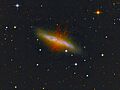
Messier 82 imaged by amateur astronomer W4SM with 17" PlaneWave CDK astrograph
-
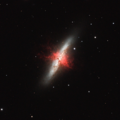
M82 cigar galaxy with its hydrogen emissions taken in France by amateur astrophotographer Anthony MICHEL


See also
 In Spanish: Galaxia del Cigarro para niños
