
Northern banded groundling facts for kids
Quick facts for kids Northern banded groundling |
|
|---|---|
._-_Flickr_-_gailhampshire_(1).jpg) |
|
| Conservation status | |
Scientific classification  |
|
| Kingdom: | Animalia |
| Phylum: | Arthropoda |
| Class: | Insecta |
| Order: | Odonata |
| Infraorder: | Anisoptera |
| Family: | Libellulidae |
| Genus: | Brachythemis |
| Species: |
B. impartita
|
| Binomial name | |
| Brachythemis impartita (Karsch, 1890)
|
|
| Script error: The function "autoWithCaption" does not exist. | |
| Synonyms | |
|
Zonothrasys impartitus Karsch, 1890 |
|

Script error: No such module "Check for conflicting parameters".
The Northern banded groundling (Brachythemis impartita) is a cool type of dragonfly. It's part of the skimmer family, called Libellulidae. You can find these dragonflies in central and northern Africa, and they've also spread to southern Europe and the Middle East. For a long time, people thought it was the same as another dragonfly, B. leucosticta, but scientists later found they were different!
Contents
What Does It Look Like?
The Northern banded groundling has special pale cream spots on its wings called pterostigma (say: tur-oh-STIG-muh). Both male and female dragonflies have these spots. Their eyes also look like they have stripes.
Male and Female Differences
- Female Northern banded groundlings have a light, buffy color on their body (abdomen) and chest area (thorax).
- Males are darker. As they get older, mature males can turn dark blue or even black on their abdomen and thorax.
- Males also have dark bands on the outer parts of their wings. These bands are lighter when the dragonfly is young, but they get darker as it grows up.
Size
These dragonflies are about 25 to 34 millimetres (0.98 to 1.34 in) long. That's about the length of a paperclip! Their back wings can spread out to 20 to 26 millimetres (0.79 to 1.02 in) wide.
Where Do They Live?
The Northern banded groundling lives in many places. You can find them in central Africa, as far south as the Democratic Republic of the Congo and Tanzania. From there, they spread north across Africa to the Mediterranean Sea.
Spreading to New Places
They also live in the Middle East, including the Arabian Peninsula, the Levant, Cyprus, and southern Anatolia (which is part of Turkey). These dragonflies have even started living in southern Europe. They were first seen in Portugal in 1957. Now, you can find them in Spain, Sardinia, Corsica, Sicily, and by 2015, they were even in mainland Italy.
Habitat and Behavior
Northern banded groundlings usually live near slow-moving rivers, lakes, and still waters. They like open areas. They prefer water with soft ground, like sand or mud.
Following Animals
Both this species and B. leucosticta are known for a cool habit in Africa. They often follow and fly around bigger animals, and even people! They do this to catch insects that get disturbed and fly up when the larger animals move. In some places, these dragonflies are the most common type of dragonfly you'll see.
How Scientists Named Them
For a while, scientists thought the Northern banded groundling was the same species as B. leucosticta. But then, researchers noticed something interesting. The adult males of these two dragonflies looked different, even though their living areas overlapped in central Africa.
Discovering Differences
- Even though the females looked very similar, the male dragonflies had clear differences.
- Their reproductive organs looked different.
- The bands on their outer wings were always there and looked different.
The name Brachythemis impartita was given to dragonflies collected at Ngaoundaba Ranch in Cameroon. A scientist named Ferdinand Karsch described them in 1890. Cameroon is where B. impartita lives, so these original dragonflies helped scientists confirm the species. It's possible that where the two species live close together, B. leucosticta prefers to lay eggs in muddy areas, while B. impartita likes sandier spots.
Images for kids
-
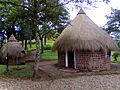
A traditional hut at Ngaoundaba Ranch.
-
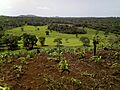
The landscape of Ngaoundaba.


