
Operation Leader facts for kids
Quick facts for kids Operation Leader |
|||||||
|---|---|---|---|---|---|---|---|
| Part of World War II | |||||||
 A US Navy Dauntless dive bomber flying near the Norwegian coast during Operation Leader |
|||||||
|
|||||||
| Belligerents | |||||||
 United States United States United Kingdom United Kingdom Norway Norway |
 Germany Germany |
||||||
| Commanders and leaders | |||||||
 Bruce Fraser Bruce Fraser Olaf M. Hustvedt Olaf M. Hustvedt |
|||||||
| Strength | |||||||
| 42 aircraft | |||||||
| Casualties and losses | |||||||
| 4 aircraft | 5 ships destroyed 7 ships damaged 2 aircraft |
||||||
Operation Leader was a surprise air attack during World War II. It happened on October 4, 1943, near Bodø, Norway. American planes from the United States Navy aircraft carrier USS Ranger carried out the attack. This carrier was part of the British Home Fleet.
American pilots found many German and Norwegian ships in the area. They destroyed five ships and damaged seven others. Two German planes looking for the Allied fleet were shot down. Four American planes were lost during the operation.
This attack was a big surprise for the German forces in Norway. No Allied aircraft carriers had attacked Norway for two years. The Allies knew where to strike thanks to secret German radio messages and reports from Norwegian spies. Two Norwegian pilots even flew with the attack force to help with local knowledge. Operation Leader not only sank ships but also messed up German supply lines. It greatly reduced shipments of iron ore, which was important for the German war effort.
Contents
Why Operation Leader Happened
During 1943, the British Home Fleet, based in the United Kingdom, got help from the United States Navy. This was needed to counter powerful German warships in Norway. These German ships included the huge battleships Tirpitz and Scharnhorst.
In May, the first US Navy group arrived. It included two battleships, a heavy cruiser, and five destroyers. This group patrolled the Norwegian Sea with British ships. They did not find any German forces. These US ships later left for the Pacific Ocean in August.
The USS Ranger Joins the Fleet
In September 1943, the aircraft carrier USS Ranger joined the Home Fleet. It came with two heavy cruisers and five destroyers. The Ranger's air wing had three types of planes:
- 27 Grumman F4F Wildcat fighters
- 27 Douglas SBD Dauntless dive bombers
- 18 Grumman TBF Avenger torpedo bombers
Before Ranger arrived, the Home Fleet only had one old aircraft carrier, HMS Furious. That ship was being repaired. Ranger had last seen battle in November 1942, helping with the Operation Torch landings in Morocco.
Changing Plans for the Fleet
On September 22, 1943, British midget submarines attacked the German battleship Tirpitz in Norway. This attack badly damaged Tirpitz. It could not go to sea until it was fixed.
When the Allies learned this, the commander of the Home Fleet, Admiral Bruce Fraser, decided to go on the attack. He thought his fleet could now strike German ships off Norway. He also planned to restart the Arctic Convoys to the Soviet Union.
Planning the Attack
Admiral Fraser decided to send the main Home Fleet to attack German ships and ports in northern Norway. Ranger was chosen to attack the port of Bodø. Bodø was a key meeting point for German and German-controlled Norwegian ships.
Fraser also wanted to use another aircraft carrier, HMS Formidable, to attack ships in Brønnøysund. But bad weather stopped this part of the plan. The planes on Formidable needed cloud cover to fly over enemy areas.
German Air Defenses
There were some German air bases near Bodø. However, most German planes had been moved elsewhere. The remaining planes were not a big threat to the Allied fleet. If no ships were found, the American pilots had other targets. These included the Bodø Air Station, the oil depot in Bodø, and radar stations at Røst.
Gathering Secret Information
The Home Fleet had a lot of secret information about German ships in northern Norway. The Royal Navy's intelligence center collected this data. They learned that a large oil tanker called Schleswig was in the area. This tanker was carrying fuel for the German battle group.
Also, two groups of Norwegian spies, "Crux III" and "Pisces," had radio transmitters on the coast. They sent reports to the Allies about the weather and ship movements. Before the attack, "Crux III" sent weather reports every half hour.
The Attack Begins
The Home Fleet left its base on October 2, 1943. The British ships included two battleships, a light cruiser, and seven destroyers. The US Navy part had Ranger, Tuscaloosa, and four destroyers.
The German forces did not detect the Allied ships as they sailed north. The fleet reached the launch point for Ranger's planes about 140 miles (225 km) off Bodø. This was just before dawn on October 4.
_and_Tuscaloosa_(CA-37)_off_Norway_1943.jpg)

Northern Attack Group
The American attack force split into two groups. The Northern Attack Group would strike ships at Bodø. The Southern Attack Group would target ships near Sandnessjøen, about 100 miles (160 km) south. Both groups had a Norwegian navigator in the lead plane. These navigators knew the local area well.
The Northern Attack Group had 20 Dauntless dive bombers and eight Wildcat fighters. They took off at 6:18 am. They flew low towards Bodø. The weather was clear, and the pilots could see well.
Four Dauntlesses and two Wildcats broke off to search for ships near Åmøya island. They soon found the German freighter La Plata. Two dive bombers attacked it. The Americans thought La Plata was badly damaged. These six planes then rejoined the main group.
The other American planes continued north. They saw many small cargo ships and fishing boats but did not attack them. At 7:30 am, they found a German convoy. It included the steamer Kerkplein and the tanker Schleswig. A minesweeper called M 365 was protecting them.

Eight Dauntlesses attacked Schleswig, and two attacked Kerkplein. Both ships were badly damaged. One Wildcat fighter was hit by gunfire and returned to Ranger. Schleswig was run ashore to avoid sinking. It was later saved and taken to Bodø for repairs.
After this, eight Dauntlesses continued to Bodø. They attacked four small German cargo ships:
- The ore carrier Rabat was sunk.
- Cap Guir was badly damaged.
- Malaga got minor damage from a bomb that missed.
- The small steamer Ibis was shot at with machine guns.
Two dive bombers were shot down by German anti-aircraft guns. The crew of one plane survived and were captured. The two men on the other plane were killed.

Southern Attack Group
The Southern Attack Group launched from Ranger at 7:08 am. It had ten Avenger torpedo bombers and six Wildcats. Two Avengers attacked the Norwegian cargo ship Topeka near Løkta island. The ship caught fire and was run ashore to avoid sinking. Three Norwegian crew members and some German soldiers on board were killed. One attacking plane was shot down, but its pilot survived. Local fishermen helped rescue people from the burning ship.
After attacking Topeka, the American planes flew north. They bombed and sank the Norwegian cargo ship Vaagan near Fagervika. No one on Vaagan was killed. The crew had seen the attack on Topeka and prepared their lifeboats. Vaagan was carrying food for civilians. Its sinking caused a shortage of margarine in northern Norway.
The planes then bombed La Plata again. It was run ashore on Rødøya island. The ammunition on board exploded, and the ship burned for days. They also bombed the German troop ship Skramstad. This ship had about 850 German soldiers and two escorts. Skramstad was badly damaged and run ashore, burning for days. Reports on casualties vary, but many German soldiers were likely killed or wounded.
The American planes also shot at the German cargo ship Wolsum. They attacked the ammunition barge F231, which was hit by a bomb and run ashore. All planes returned to Ranger before 9:00 am. Besides the four American planes destroyed, six others were damaged by anti-aircraft fire.
German communication networks were poor during the raid. This made it hard for them to send warnings once the attack began.
After the Attack
Around 2 pm on October 4, three German reconnaissance planes approached Ranger. Two pairs of Wildcat fighters were sent to stop them. One pair shot down a Junkers Ju 88 bomber. The other pair shot down a Heinkel He 115 float plane. The third German plane escaped. These were the first German planes shot down by US Navy aircraft. One Wildcat crashed during landing, but its pilot survived. All Allied ships returned to base by October 6.

Success of Operation Leader
Military leaders and historians later called Operation Leader a success. Rear Admiral Hustvedt believed the best part was how well American and British ships worked together. The air commander of the US Navy's Atlantic Fleet was also happy with the pilots. However, the captain of Ranger noted that the planes used were old. He felt the US Navy should use better aircraft. Pilots who took part in the operation received awards for their bravery.
Historians have found it hard to say exactly how many ships were sunk. Some ships that were run ashore might have been repaired later. Most agree that five ships were destroyed: Cap Guir, La Plata, Rabat, Skramstad, and Vaagan.
Operation Leader also caused great disruption to German convoys. This was even more damaging than the ships lost. The British Ministry of Economic Warfare estimated that iron ore shipments from the important port of Narvik dropped by 58 percent in October 1943 because of the raid.
Operation Leader was the only offensive operation by the US Navy in northern Europe during World War II. It was also the last major American operation in this area. Ranger stayed with the Home Fleet until November 1943. It then returned to Boston and was used for training and transport for the rest of the war.
German Response and Legacy
The Germans in Norway were completely surprised by Operation Leader. They had not prepared for such an attack. After the raid, they improved their defenses. Later British carrier attacks on Norway did not find as many ships as Ranger's planes did.
Operation Leader showed that German forces in Norway lacked enough combat aircraft to respond well. After the attack, the Germans searched for radio transmitters. They arrested some Norwegians but missed the "Pisces" spy group. The "Pisces" team was evacuated to the United Kingdom. The "Crux" group's agents were also evacuated, but a local volunteer kept sending reports from the island.
The wreck of an Avenger torpedo bomber shot down in the operation was found in 1987. Parts of it were recovered. The remains of two airmen killed were found and identified. A memorial for the American pilots was built at Fagervika. It includes a propeller blade from the Avenger wreck. Other blades are in museums. The memorial is used for remembrance ceremonies.
One of the Dauntless dive bombers shot down was found in 1990. Its engine is now displayed at the Norwegian Aviation Museum in Bodø. The remains of its two crew members were found and identified. The 50th anniversary of Operation Leader in 1993 was marked in Norway with a special postal cover and a sculpture at Bodø Airport.
Images for kids
-
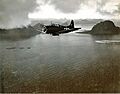
A US Navy Dauntless dive bomber flying near the Norwegian coast during Operation Leader
-
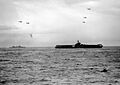
USS Ranger and USS Tuscaloosa underway during the air strike
-
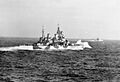
HMS Anson and HMS Belfast underway
-
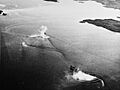
The tanker Schleswig and the minesweeper M 365 under attack
-
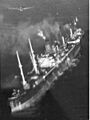
The freighter La Plata being strafed by Wildcat fighters
-
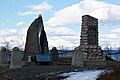
A memorial (left) for the American pilots killed during Operation Leader, next to a memorial to Norwegian war dead from the Nesna area
