
Peter Wells (athlete) facts for kids
 |
|
| Personal information | |
|---|---|
| Nationality | English, New Zealand |
| Born | 23 May 1929 Friern Barnet, London |
| Died | 5 January 2018 (aged 88) Christchurch, New Zealand |
| Education | Byng Road Council School, Queen Elizabeth's School, Barnet |
| Height | 1.82 m (5 ft 11.5 in) |
| Sport | |
| Country |  Great Britain Great Britain England England New Zealand New Zealand |
| Sport | Athletics |
| Event(s) | High Jump |
| Coached by | Arthur Gold |
| Achievements and titles | |
| Olympic finals | 1952 Summer Olympics 1956 Summer Olympics |
| Commonwealth finals | 1950 British Empire Games 1954 British Empire and Commonwealth Games |
| Personal best(s) | 2.02 m (6 ft 7+1⁄2 in) |
Peter Wells (born May 23, 1929 – died January 5, 2018) was an amazing athlete. He was born in Britain but later lived in New Zealand. Peter was a high jumper who competed in two Olympic Games: 1952 and 1956.
He also represented England at the 1950 British Empire Games in Auckland. Later, he competed for New Zealand at the 1954 British Empire and Commonwealth Games in Vancouver. After the 1950 Games, Peter decided to stay in Christchurch, New Zealand. He lived there for the rest of his life. He passed away in Christchurch in 2018 after a short illness.
Contents
Early Life and School
Peter Wells was born in North London, England. He was the youngest child in his family. He went to Byng Road Council School. Later, he attended Queen Elizabeth's Grammar School starting in 1939.
Peter's High Jump Achievements in England
Peter had many great moments in high jump while in England. Here are some of his top achievements:
| Date | Height | Place | Achievement | Location |
|---|---|---|---|---|
| 1947 - April 19 | 6 ft 0in | 1st | First English schoolboy to clear 6 ft 0in | Motspur Park, London |
| 1947 - August 9 | 6 ft 0in | 1st | Won AAA Junior Championships | Fallowfield, Manchester |
| 1949 - August 6 | 6 ft 5¼in | Set English Native Record | London | |
| 1949 - August 20 | 6 ft 6¼in | Broke English Native Record again | Bristol |
First Schoolboy to Clear 6 Feet

In 1946, Peter competed in the Public Schools’ championships. He finished 3rd. The next year, on April 18, 1947, Peter won the high jump title at the same event. He made history by becoming the first English schoolboy to jump over 6 ft 0 in (1.83 m)! This was a new record for schoolboys. Peter was the athletics captain for his school. He proudly collected the challenge cup for his team and his own high jump cup.

Setting English High Jump Records
In 1949, Peter Wells set new "English Native Records" for high jump. These records were for athletes born in England or Wales who competed there.
Breaking the Record in London

On August 6, 1949, Peter (who was 20 years old) competed in London. He and another jumper, Ron Pavitt, were both amazing. Peter started jumping at 6 ft 0 in (1.83 m). He then cleared 6 ft 2 in (1.88 m) and 6 ft 4 in (1.93 m).
Then, Peter jumped 6 ft 5.25 in (1.96 m) on his first try! This broke the old English Native high jump record. Ron Pavitt also cleared the same height. So, they both held the record for a moment. But then, Ron jumped even higher, clearing 6 ft 6 in (1.98 m), taking the record for himself.
Peter and Ron were friendly rivals. People called them "The Heavenly Twins" because they were both so good at high jump.
Setting a New Record in Bristol
Just two weeks later, on August 20, 1949, Peter and Ron competed again in Bristol. Peter jumped an incredible 6 ft 6.375 in (1.99 m) (1.99m). This jump was even higher than the gold medal jump at the 1948 Summer Olympics! Peter's record stood for many years.
British High Jump Record
On December 11, 1954, in Christchurch, New Zealand, Peter made his highest jump ever: 6 ft 7.5 in (2.02 m). This jump tied the British high jump record that Alan Paterson had set in 1947. Peter and Alan were joint record holders until 1959.
Competing in the Olympics and Commonwealth Games
Peter Wells competed in several major international events. Here's how he did:
| Year | Event | Host City | Representing | Jump | Rank |
|---|---|---|---|---|---|
| 1950 | British Empire Games | Auckland, New Zealand |
England |
1.93 m (6 ft 4 in) | 5 |
| 1952 | Olympic Games |  Helsinki, Finland Helsinki, Finland |
Great Britain |
1.90 m (6 ft 3 in) | 11 |
| 1954 | British Empire and Commonwealth Games |  Vancouver, Canada Vancouver, Canada |
New Zealand |
1.95 m (6 ft 5 in) | 4 |
| 1956 | Olympic Games |  Melbourne, Australia Melbourne, Australia |
Great Britain |
1.96 m (6 ft 5 in) | 16 |
1950 British Empire Games
In 1949, Peter was chosen to represent England at the 1950 British Empire Games in Auckland, New Zealand. Traveling from an English winter to New Zealand by boat was tough. Peter even twisted his ankle on the journey, which affected his training. The high jump event was on the first day. Peter finished fifth with a jump of 6 ft 4 in (1.93 m).
1952 Summer Olympics
Peter represented Great Britain at the 1952 Summer Olympics in Helsinki, Finland. He made it past the first round, jumping 1.87 m (6 ft 2 in). In the finals, he cleared 1.90 m (6 ft 3 in). He finished in 11th place.
1954 British Empire and Commonwealth Games

In July 1954, Peter represented New Zealand for the first time. This was at the 1954 British Empire and Commonwealth Games in Vancouver, Canada. He jumped 6 ft 5 in (1.96 m) and finished fourth. The gold medal was won by Emmanuel Ifeajuna from Nigeria, who set a new Games record.
1956 Summer Olympics
Even though Peter had been living in New Zealand for six years, he had to represent Great Britain again at the 1956 Summer Olympics in Melbourne, Australia. This was because of the Olympic rules at the time. Peter traveled with the New Zealand team to Melbourne. He then joined the Great Britain team for the Games.
In the high jump competition, Peter made it through the qualifying rounds. In the final round, he cleared 1.96 m (6 ft 5 in). He finished in 16th place.
Peter's High Jump Career in New Zealand
Setting National Records
On January 23, 1954, Peter broke the New Zealand high jump record. He jumped 6 ft 6.25 in (1.99 m) in Christchurch.
Later that year, on December 11, 1954, Peter broke the New Zealand record again! He jumped 6 ft 7.5 in (2.02 m) in Auckland. This was the highest jump of his entire career. This New Zealand record stood for 14 years.
Becoming a National Champion
Peter Wells was the New Zealand national high jump champion seven times! He won his first title in the 1950–1951 season. He didn't compete the next season because he went back to England for the 1952 Olympics. But then, he won six titles in a row from 1952–1953 to 1957–1958.
| Season | Position | Height | Venue | Representing |
|---|---|---|---|---|
| 1950–51 | 1st | 6 ft 4 in (1.93 m) | Wellington | Canterbury |
| 1951–52 | Did not defend title | |||
| 1952–53 | 1st | 6 ft 3 in (1.91 m) | Dunedin | Canterbury |
| 1953–54 | 1st | 6 ft 1 in (1.85 m) | Hamilton | Canterbury |
| 1954–55 | 1st | 6 ft 5 in (1.96 m) | Auckland | Auckland |
| 1955–56 | 1st | 6 ft 7 in (2.01 m) | Christchurch | Canterbury |
| 1956–57 | 1st | 6 ft 1 in (1.85 m) | Napier | Canterbury |
| 1957–58 | 1st | 6 ft 5 in (1.96 m) | Lower Hutt | Canterbury |
Peter's Jumping Style
Peter Wells used a high jump technique called the Western roll. In this style, the jumper goes over the bar sideways, with their back facing the bar. An athletics expert named Peter Heidenstrom said that Peter Wells's Western roll was "finely controlled, precise, a beautiful thing to watch."
Images for kids
-
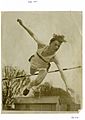
Wells, of Queen Elizabeth's School, becoming the first English schoolboy to clear 6 ft 0in
-
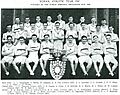
Queen Elizabeth's School athletics team, 1947
-
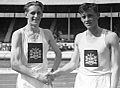
Wells (left) congratulating Ron Pavitt after both jumpers beat the English native high jump record
-
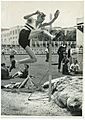
Wells practising at Vancouver, 1954
