
Place cell facts for kids

A place cell is a special type of brain cell found in the hippocampus, a part of your brain. These cells become active when an animal enters a specific spot in its environment. This special spot is called a place field. Scientists believe that place cells work together to create a mental map of where you are, like a built-in GPS for your brain! This mental map is often called a cognitive map.
Place cells work with other brain cells in the hippocampus and nearby areas to help animals understand their location. They have been found in many animals, including rats, bats, monkeys, and even humans.
The way place cells fire can be influenced by things around them, like what they see (landmarks), what they smell, or how their body moves. Sometimes, place cells can suddenly change their firing patterns. This is called remapping. It can happen if the environment changes, like if a new smell appears.
Place cells are also very important for your episodic memory. This is the memory of events and experiences, like remembering your last birthday party. They help store information about where a memory happened. They also seem to help strengthen memories by "replaying" past experiences very quickly.
Sadly, place cells can change with age or diseases like Alzheimer's. These changes might explain why memory problems can happen.
In 2014, the Nobel Prize in Physiology or Medicine was given to John O'Keefe for discovering place cells. Edvard and May-Britt Moser also won for finding grid cells, which are related to place cells.
Contents
Discovering Place Cells
Place cells were first found in 1971 by John O'Keefe and Jonathan Dostrovsky. They were studying rats' brains. They noticed that rats with damage to their hippocampus had trouble with tasks that involved finding their way around. This made them think that this brain area must hold some kind of map of the environment.
To test this idea, they used tiny devices to record the activity of individual cells in the hippocampus. They saw that some cells became active only when a rat was in a "particular part of the testing platform facing in a particular direction." These cells were later named place cells.
In 1976, O'Keefe did more research. He showed that these "place units" (place cells) fired a lot when a rat was in its specific place field. Outside of this field, they were mostly quiet. He also found some "misplace units" that fired only when the rat did something extra, like sniffing a new object. These discoveries strongly supported the idea that the hippocampus creates a cognitive map of the environment.
Scientists have discussed whether place cells rely more on landmarks (like a specific tree), on the edges of an environment (like walls), or on both. It turns out that different place cells can use different cues. Some rely on nearby cues, while others use distant landmarks. What a place cell relies on can also depend on what the animal has experienced before.
There's also a discussion about whether place cells only store spatial information or if they also store other kinds of information. The original idea was that the hippocampus was mainly for spatial maps. However, newer studies suggest that place cells might also respond to non-spatial things, like sounds. This means the hippocampus might have a more general role in understanding different kinds of continuous information, with location being just one example.

How Place Cells and Grid Cells Work Together
Scientists think that place cells might be formed from grid cells. Grid cells are another type of brain cell found in a nearby area called the entorhinal cortex. Grid cells create a hexagonal, grid-like pattern of activity in the brain. Imagine a repeating pattern on a floor. The idea is that the place fields of place cells are created by combining the signals from several grid cells. This relationship might develop through learning. Grid cells may also help place cells by providing information about how an animal moves through space, a process called path integration.
What Place Cells Do
What Are Place Fields?
Place cells become active in a specific area of an environment. This area is called a place field. Think of it like a special "on" switch for that cell when you're in a certain spot. Unlike some other brain cells, neighboring place cells don't necessarily have neighboring place fields. This means the brain's map isn't laid out like a simple grid.
Inside its place field, a place cell fires many signals very quickly. Outside, it's mostly quiet. Place fields are allocentric. This means they are based on the outside world, not just your body's position. For example, a place cell might fire when you are next to the window, no matter which way you are facing. This helps them act like a map of the environment. Usually, a place cell has only one or a few place fields in a small area. But in larger spaces, they can have many irregular place fields. Some place cells also show directionality, meaning they only fire in a certain spot if you are moving in a particular direction.

Remapping: Changing the Map
Remapping is when a place cell's firing pattern changes. This happens when an animal experiences a new environment or the same environment in a new way. This idea was first reported in 1987. It is thought to be important for how the hippocampus helps with memory.
There are two main types of remapping: global and partial. In global remapping, most or all place cells change their place fields. They might gain a new field, lose one, or have their field move. Partial remapping means only a few place cells change, while most stay the same. Changes that can cause remapping include altering the shape or size of a room, changing the color of the walls, adding new smells, or changing how important a location is for a task.
Phase Precession: Timing is Everything
The firing of place cells is linked to brain waves called theta waves. This is called phase precession. When an animal enters a place field, the place cell fires at a specific moment within these theta waves. As the animal moves further into the field, the cell fires earlier and earlier in the wave cycle. Scientists believe this makes the brain's location coding more accurate and helps with learning.
Directionality: Knowing Which Way to Go
Some place cells are directional. This means they only fire in a certain spot if the animal is moving in a particular direction. Other place cells are omnidirectional, firing no matter which way the animal is going. Directionality might be stronger in more complex environments. For example, in a maze with many paths, place cells might be very directional. This directionality seems to develop based on how the animal behaves.
How Senses Help Place Cells
Place cells don't just react to simple sensory inputs. They respond to complex information. For example, removing a large landmark might not affect them much, but a small change in color or shape can. This suggests that place cells combine different sensory cues. Information from our senses is processed in other brain areas before reaching the hippocampus. So, place cells receive a combined picture of the environment.
Sensory information for place cells can be split into two types:
- Metric information tells place cells where to fire. This includes spatial inputs like distances or the edges of a room.
- Contextual information tells place cells whether to fire in a certain environment. This helps them adapt to small changes, like a new object color.
Both types of information are processed together before reaching the place cells. Our vision and sense of smell are key examples of sensory inputs used by place cells.
What We See (Visuospatial Inputs)
Visual cues like the shape of a room or landmarks are important metric inputs. For instance, the walls of a room give information about distance and location. Place cells often rely more on distant cues than on very close ones, though local cues can still be important. Visual inputs also provide contextual information. A change in the color of an object or the walls can affect if a place cell fires. So, what we see is vital for forming and remembering place fields.
What We Smell (Olfactory Inputs)
Even though vision is very important, smells can also affect place fields. Our sense of smell can sometimes make up for a lack of visual information. It can even help create stable place fields, just like visual cues do. Studies in virtual environments with odor gradients have confirmed this. Changing the smell in an environment can also cause place cells to remap.
Our Sense of Balance (Vestibular Inputs)
Signals from our vestibular system, which helps with balance and knowing how our head moves, can also change how place cells fire. After receiving these signals, some place cells might adjust their map to match this input. Problems with the vestibular system can lead to abnormal firing of place cells and difficulties with spatial tasks.
How We Move (Movement Inputs)
Movement is another important spatial cue. Animals use information about their own motion to figure out how far and in what direction they have traveled. This is called path integration. It's especially useful when there aren't many continuous sensory cues. For example, if it's dark, an animal might use touch to find an edge and then calculate its location based on how far it has moved from that edge. Grid cells help a lot with path integration by creating a grid-like representation of a location. This helps place cells fire correctly as an animal moves.
Place Cells and Memory
Place cells play a big role in episodic memory. A key part of episodic memory is remembering the spatial context – where an event happened. Place cells keep stable firing patterns even when some cues from a location are removed. They start firing when they get signals from a place they've been before. This suggests that place cells help recall the brain's map of an environment, providing the spatial context for a memory.
Place cells also show two important qualities for memory: pattern completion and pattern separation.
Pattern Completion: Filling in the Gaps
Pattern completion is your brain's ability to remember a whole memory even if you only get a small hint or a partial cue. Place cells can keep a stable firing field even after important signals are removed from a location. This means they can recall a pattern based on only part of the original information. This pattern completion is also flexible. You can use any part of a memory to recall the whole thing. For example, if you remember where you left an object, you can recall the object. Or, if you see the object, you can remember where you left it.
Pattern Separation: Keeping Memories Separate
Pattern separation is your brain's ability to tell one memory apart from other similar memories. This process starts in the dentate gyrus, another part of the hippocampus. Cells in the dentate gyrus process sensory information and send a first draft of the environment's map to form place fields. Place fields are very specific. They can remap and adjust their firing based on tiny changes in sensory signals. This specificity is crucial for pattern separation, helping your brain distinguish between different memories.
Reactivation, Replay, and Preplay
Place cells often become active even when an animal is not in its place field. This is called reactivation. This reactivation happens much faster than the actual experience. It usually occurs in the same order as the original experience, or sometimes in reverse. This "replay" is thought to help with memory retrieval (recalling memories) and memory consolidation (strengthening memories).
Interestingly, the same sequence of activity can sometimes happen before the actual experience. This is called preplay. Scientists think preplay might help with prediction and learning.
Animals That Help Us Learn
Place cells were first found in rats. Since then, scientists have found place cells or similar cells in many other animals, including rodents, bats, and primates. In 2003, evidence for place cells was also found in humans!

Rodents: Rats and Mice
Rats and mice are often used to study place cells. Rats became popular when scientists developed ways to record many cells at once. Mice are also useful because there are many different genetic types available for study. Scientists can also use special microscopes to look directly into the brains of mice. While rats and mice have similar place cell activity, mice have smaller place cells and more place fields per cell on the same track. Their "replay" of memories is also not as strong as in rats. Studies suggest that in rodents, almost all hippocampal pyramidal cells act as place cells. Place cells have also been found in chinchillas.
Rats even have "social place cells" that encode the position of other rats! This exciting discovery was published in the journal Science at the same time as similar findings in bats.
Bats: Flying in 3D
Place cells were reported in Egyptian fruit bats in 2007. What's really cool is that bat place cells have place fields in 3D space, probably because bats fly in three dimensions! These place cells can rely on either vision or echolocation (using sound to navigate). They can even remap when bats switch between these two senses. Bats also have social place cells, just like rats.
Primates: Closer to Humans
Scientists have found place-related responses in the brains of Japanese macaques and common marmosets. There's still some debate about whether these are true place cells or "spatial view cells." Spatial view cells respond to locations that the monkey is looking at, rather than its body's actual position. However, more recent studies suggest that true place cells might exist in freely moving macaques and marmosets.
When Place Cells Don't Work Right
Alzheimer's Disease
One of the first signs of Alzheimer's disease is often trouble with spatial memory and finding your way around. Studies in mice with Alzheimer's-like conditions show that their place cells can break down. This leads to problems with spatial memory. Also, the place cells in these mice have unstable maps of space and struggle to learn stable maps for new environments. The brain waves that influence place cell firing are also affected.
Aging and Memory
In general, many properties of place cells, like how often they fire, are similar in young and older rats. However, in one part of the hippocampus (CA3), older rats have a higher average firing rate. Young rats show "place field plasticity." This means when they move along a path, their place fields activate one after another. If they repeat the path, the connections between these place fields get stronger. This makes later place fields fire more quickly and even expand, which helps young rats learn and remember spatial information. Unfortunately, this place field expansion and plasticity is reduced in older rats, which might explain why their spatial learning and memory can decrease.
Scientists have found that giving older rats a medicine called memantine can help restore this plasticity. Memantine is known to improve spatial memory. While memantine helps older rats learn new spatial information, it doesn't seem to help them recall that information later.
Older rats also show a lot of instability in their place cells in another part of the hippocampus (CA1). If they are put in the same environment multiple times, their brain's map of that environment might change about 30% of the time. This suggests that their place cells are remapping even in the exact same environment. On the other hand, place cells in the CA3 region of older rats show increased plasticity. The same place fields in CA3 might activate in similar environments, whereas young rats would notice subtle differences and activate different place fields. One reason for these changes might be that older rats rely more on cues from their own movement.
See also
- Spatial view cells, primate hippocampal counterpart for visual field.
- Grid cells
- Head direction cells
- List of distinct cell types in the adult human body
Images for kids
-
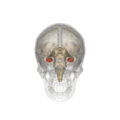
Place cells are found in the hippocampus, a structure in the medial temporal lobe of the brain.
-
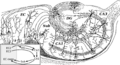
Anatomy of the hippocampal formation, including the entorhinal cortex (EC), the dentate gyrus (DG) and the different hippocampal subfields (CA1 and CA3). Inset shows the wiring between these different areas.
-
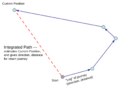
Grid and place cells contribute to path integration, a process which sums the vectors of distance and direction travelled from a start point to estimate current position.

.png)

