
Portuguese Water Dog facts for kids

Portuguese Water Dog
|
|||||||||||||||||||||
| Other names | Cão de água português, Cão de água algarvio | ||||||||||||||||||||
|---|---|---|---|---|---|---|---|---|---|---|---|---|---|---|---|---|---|---|---|---|---|
| Common nicknames | Portie, PWD, Wa | ||||||||||||||||||||
| Origin | Portugal | ||||||||||||||||||||
|
|||||||||||||||||||||
|
|||||||||||||||||||||
| Domestic dog (Canis lupus familiaris) | |||||||||||||||||||||
The Portuguese Water Dog is a special type of dog that comes from the Algarve region of Portugal. These amazing dogs were once very important helpers for fishermen along Portugal's coast. They learned to guide fish into nets, find lost fishing gear, and even carry messages between boats or from a boat to the shore.
Portuguese Water Dogs traveled with fishermen on their fishing trawlers. They journeyed from the Atlantic Ocean near Portugal all the way to the cold waters off Iceland, helping to catch cod fish.
In Portuguese, this breed is called cão de água, which simply means 'dog of water'. People in Portugal also know them as the Algarvian Water Dog or the Portuguese Fishing Dog. There are two main types based on their fur: the wavy-haired kind and the curly-haired kind.
Portuguese Water Dogs are not super common. For example, in 2013, only 36 of them competed in the famous Crufts dog show in Great Britain. Many people like them because they don't shed much hair. This quality has made them more popular lately. Even former US President Barack Obama had two Portuguese Water Dogs named Bo and Sunny. His family chose Sunny partly because of the breed's low-shedding coat.
Contents
Discovering the Portuguese Water Dog

Portuguese Water Dogs are related to Spanish water dogs, suggesting they share a common ancestor. Many believe their closest relative is the Standard Poodle. Like Poodles and other water dog breeds, Portuguese Water Dogs are very smart. They can have curly fur, have webbed toes that help them swim, and don't shed much.
However, Portuguese Water Dogs are built a bit differently. They have strong, sturdy legs and a muscular body. Their fur can be wavy, not just tightly curled like a Poodle's. They are usually a bit longer than they are tall. Their eyes are black or different shades of brown. Their coats can be black, brown, black and white, or brown and white.
Male Portuguese Water Dogs typically stand about 20 to 23 inches (51 to 58 cm) tall. They usually weigh between 40 and 60 pounds (18 and 27 kg). Female dogs are a bit smaller, growing to about 17 to 21 inches (43 to 53 cm) tall. They weigh between 35 and 50 pounds (16 and 23 kg).
Understanding Their Unique Coats
Portuguese Water Dogs have a special single layer of fur that doesn't shed much. This means they are often a good choice for people who have allergies to dog hair.
Most Portuguese Water Dogs are solid black, black and white, brown, or brown with silver tips. It's common to see white patches on their chest, paws, or legs, especially on black or brown dogs. Dogs with more than one color are sometimes called "parti" dogs. In Portugal, the breed rules say that a dog shouldn't have more than 30% white markings. White is the rarest color for these dogs. Black fur with white markings on the chin (sometimes called a "milk chin") and the chest is the most common color.
There are two main types of coats:
- Curly coat: This fur is made of tight, round curls that don't shine much. Sometimes, the hair on their ears can be wavy.
- Wavy coat: This fur falls in gentle waves, not tight curls, and has a slight shine.
Some dogs even have a mix, with curly fur on their body and wavy fur on their tail and ears!
-
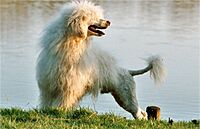
White is one of the less-common colours among PWDs.
-
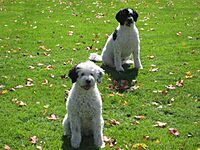
Two parti-colored Portuguese Water Dogs, female curly in front and male wavy at rear
-
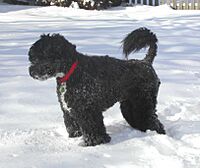
Black and white wavy
-
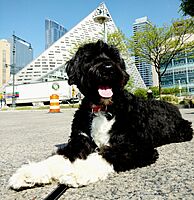
Image of PWD


Keeping Their Coats Tidy
A Portuguese Water Dog's hair grows continuously, just like human hair! If it's not trimmed, it can grow so long that it covers their eyes, making it hard for them to see. Their fur can also get tangled and matted, which can irritate their skin. To keep them healthy and comfortable, these dogs need a trim about every two months. Their coats should also be brushed every other day.
There are two main ways to groom a Portuguese Water Dog: the "retriever cut" and the "lion cut."
The Lion Cut: A Traditional Style
The lion cut is a very old style that came from the fishing dogs in Portugal. With this cut, the dog's back legs, snout, and the base of its tail are shaved short. About one-third of the tail hair is left long, like a flag. The rest of the body's fur is left long. This style helped the dogs when they jumped into cold water from boats. The longer fur kept their important organs warm, while the shaved back legs made it easier for them to swim and move their strong, rudder-like tail.
The Retriever Cut: A Modern Look
The retriever cut is a newer style. In this cut, the dog's fur is trimmed to about one inch (2.5 cm) all over its body. Some owners might prefer the fur on the snout or the base of the tail to be a bit shorter. Again, about one-third of the tail hair is left long. This style became popular because breeders wanted the dogs to look even more attractive to people looking for a pet. During warm summer months, some owners might even clip their dog's fur very short, creating a modified retriever cut.
How Portuguese Water Dogs Communicate
Portuguese Water Dogs have a wide range of sounds they can make! They are usually quiet dogs, but they will bark to let you know if someone is coming near your home. They are very good at telling their owners what they want, both with sounds and actions. Their bark is strong and easy to recognize.
Sometimes, they make a special "ha-ha-ha-ha" sound, which is like an invitation to play or a hint that they want some food. They might also whine sometimes. Because they are so smart and willing to learn, and because they like to make sounds to get attention, they can be excellent assistance dogs for people who are deaf or hard of hearing. They can be trained to bark loudly when a phone rings, then go find their owner to let them know.
The Personality of a Portuguese Water Dog

Portuguese Water Dogs are loving, smart, and can be quite independent. They are easy to train for things like obedience and agility courses. They are usually friendly with new people and enjoy getting pets.
Since they are working dogs, Portuguese Water Dogs are happiest when they are with their owners, ready for a task. If they are trained, they can follow many different commands. They learn very fast, seem to enjoy training, and remember the names of objects for a long time. These qualities, along with their low-shedding coats, make them excellent for various service roles. They can be hearing dogs for the deaf, mobility dogs, or even seizure response dogs. They also make wonderful therapy dogs.
A Portuguese Water Dog likes to stay close to its owners, whether inside or outside. Even though they are very social, they often form a very strong bond with one main family member. Some people think this strong bond developed because these dogs worked closely with their owners on small fishing boats. Modern Portuguese Water Dogs love water and attention. They prefer to be busy with an activity where they can see their human partner. This breed is not happy being left alone for long periods, either indoors or outdoors.
Because they are water dogs, they have a strong instinct to retrieve things. This can also mean they like to tug and chew. A Portuguese Water Dog might jump up to greet you, which owners can teach them not to do. Some might even walk, hop, or "dance" on their back legs when they are excited or greeting someone. They might also stand up at kitchen counters if they smell food, a habit sometimes called "counter surfing."
Due to their intelligence and energy, they need lots of exercise and mental challenges regularly. They are gentle and patient—but they are not lazy dogs. If they get bored, they might become destructive.
The History of the Portuguese Water Dog
Ancient Roots

The Portuguese Water Dog and the Poodle seem to have come from the same ancient family of dogs. Long ago, Poodles had longer coats, similar to one type of Portuguese Water Dog. Some breeders believe that today's Poodle, Kerry Blue Terrier, and Irish Water Spaniel might be related to these early "water dogs."
Modern Comeback
The Portuguese Water Dog breed was almost gone when, in the 1930s, a rich Portuguese shipping owner named Vasco Bensaude decided to help. He started looking for fishermen's dogs to begin a breeding program and bring the breed back. His kennel was called Algarbiorum. His most famous dog was Leão (born in 1931, lived until 1942). Leão was a perfect example of the breed and was bred with many different female dogs. Because of him, about half of all purebred Portuguese Water Dogs today can trace their family tree back to Leão. Bensaude received help from two Portuguese veterinarians, Frederico Pinto Soares and Manuel Fernandes Marques. His important work was continued by Conchita Cintron de Castelo Branco, who received his last 14 dogs and all his records.
António Cabral founded the Alvalade kennels in Portugal. Two of his many famous Portuguese Water Dogs were Ch. Charlie de Alvalade (a brown dog) and C. B. Baluarte de Alvalade. He registered his first Portuguese Water Dog in 1954, after Bensaude had started the effort to bring the breed back in Portugal. Cabral worked with Carla Molinari, Deyanne Miller, Sonja Santos, and others to help establish Portuguese Water Dogs in the United States. A special mark, sometimes called the "Mark of Cabral," is a triangular patch of different colored or textured hair, usually about 2 to 3 inches (5 to 8 cm) from the base of the tail.
Deyanne Miller played a huge role in making the Portuguese Water Dog popular in America. In 1972, the Millers and 14 other people created the Portuguese Water Dog Club of America, Inc. (PWDCA). She worked with dogs from both the Cintron and Cabral family lines to create a strong and healthy group of Portuguese Water Dogs in the US at her Farmion kennels. The actor Raymond Burr was another early breeder of Portuguese Water Dogs in the US.
-

US President Barack Obama and his family with Bo, their Portuguese Water Dog.
-

Bo in the Cabinet Room (shown with Oval Office director Brian Mosteller).
-
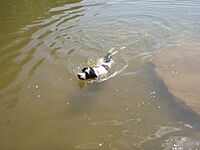
Modern Portuguese Water Dogs are agile swimmers.


Keeping Portuguese Water Dogs Healthy
Like all purebred dogs, Portuguese Water Dogs can sometimes have certain health issues that are passed down through their families. Because there aren't a huge number of these dogs, responsible breeders carefully check family trees and choose dogs for breeding. This helps to lower the chance of passing on genetic problems. When a breed becomes more popular, sometimes people who don't know much about the breed start breeding them, which can lead to more health problems.
Hip Dysplasia
Like poodles, Portuguese Water Dogs can sometimes get hip dysplasia. This is a problem with the hip joints that can be present from birth or develop as they grow. However, the risk of a Portuguese Water Dog getting hip dysplasia can be greatly reduced. Good breeders carefully check the health records of both the mother and father dogs before breeding.
Eye Health: Cataracts and PRA
Cataracts and progressive retinal atrophy (PRA) are two eye conditions that can affect Portuguese Water Dogs. PRA can cause "night blindness" and might eventually lead to complete blindness. This condition is caused by a simple recessive gene. There are special DNA tests, called "Optigen Testing," that can find out if a dog carries the gene for PRA. Dogs that are "Normal" or "A" do not carry the gene. "Carriers" or "B" dogs have one copy of the gene and will not get the disease themselves, but they can pass the gene to half of their puppies. "Affected" or "C" dogs have two copies of the PRA gene and will likely develop the disease later in life. "B" or "C" dogs should only be bred with "A" dogs to make sure none of their puppies get the disease.
Ingrown eyelashes (distichiasis) can happen in some curly-coated breeds, but they are not very common in Portuguese Water Dogs. Ingrown eyelashes can rub against the eye, causing irritation. This condition is usually minor if treated and can be fixed with surgery if needed.
GM1 Storage Disease
GM1 storage disease is a serious genetic disorder that is always fatal. It's caused by a lack of a certain enzyme, which leads to harmful materials building up in the nerve cells. Because all Portuguese Water Dogs are somewhat related, scientists were able to identify dogs that carried the gene for GM1 storage disease. Thanks to careful breeding and testing, this condition has now been almost completely removed from the breed. All breeding dogs should be tested for GM1 storage disease. This nerve disease usually appears when a puppy is about six months old. Affected puppies might show signs like trouble walking, shaking, weakness, and seizures. They might also have changes in their personality. Eye problems can also occur.
Juvenile Dilated Cardiomyopathy

Juvenile dilated cardiomyopathy is a fatal heart condition caused by a autosomal recessive gene. Puppies with this condition often die suddenly or with very little warning, usually between six weeks and seven months old. Signs might include losing appetite, having less energy, vomiting, and difficulty breathing, all within 12 to 48 hours. Some puppies show no signs at all and are simply found deceased.
Today, there is no cure or treatment for this condition. However, there is a way to prevent puppies from getting juvenile dilated cardiomyopathy. Breeders now have a DNA gene-based test that uses a cheek swab or blood sample. This test tells them if a dog carries the gene for the disease. By testing all breeding animals, breeders can avoid breeding two carriers together. A puppy from parents where at least one does not have the gene will not get this fatal disease.
See also
 In Spanish: Cão de água português para niños
