
Probreviceps rungwensis facts for kids
Quick facts for kids Probreviceps rungwensis |
|
|---|---|
| Conservation status | |
Scientific classification  |
|
| Kingdom: | Animalia |
| Phylum: | Chordata |
| Class: | Amphibia |
| Order: | Anura |
| Family: | Brevicipitidae |
| Genus: | Probreviceps |
| Species: |
P. rungwensis
|
| Binomial name | |
| Probreviceps rungwensis Loveridge, 1932
|
|
| Script error: The function "autoWithCaption" does not exist. | |
| Synonyms | |
|
Probreviceps macrodactylus rungwensis Loveridge, 1932 |
|
Script error: No such module "Check for conflicting parameters".
The Probreviceps rungwensis is a special kind of frog that belongs to the Brevicipitidae family. It's only found in Tanzania, a country in Africa. You can find this frog in places like the Mahenge Mountains, Udzungwa Mountains, and the Southern Highlands. It's even named after Mount Rungwe, where it was first discovered!
Scientists first thought this frog was a type of Probreviceps macrodactylus. But now, they know it's its own unique species. Some studies even suggest there might be more than one species hiding under this name!
What Does It Look Like?
These frogs are quite small. Adult males can grow to about 48 millimeters (or 1.9 inches) long. Females are a bit bigger, reaching up to 60 millimeters (about 2.4 inches). This measurement is taken from their snout (nose) to their vent (where waste leaves the body).
The Probreviceps rungwensis has a strong, round body. Its legs are short, which helps it with its burrowing habits. This means it likes to dig and live underground. Its snout is pointy and sticks out past its lower jaw.
You can see its tympanum (which is like its eardrum). It's quite large, sometimes 1.5 times bigger than its eye! However, a fold of skin above it can hide it a little. The frog's back (called the dorsum) is brown and doesn't have any special patterns. Its sides, arms, and legs are dark brown and have small, bumpy warts with white tips.
Where Does It Live?
The Probreviceps rungwensis lives in mountain and sub-mountain forests. These forests are found at high places, from about 1,050 to 2,200 meters (about 3,445 to 7,218 feet) above sea level. It's a semi-fossorial animal, meaning it spends some of its time digging and living in the forest floor.
Life Cycle
Unlike many frogs that lay eggs in water, the Probreviceps rungwensis lays its eggs in burrows. These burrows are dug in the leaf litter on the forest floor. The eggs don't hatch into tadpoles. Instead, they hatch directly into tiny froglets that look like miniature adult frogs!
Why Is It Important to Protect It?
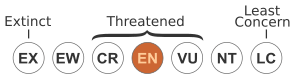
The Probreviceps rungwensis is not a common frog. It's only found in a few places, and its population seems to be spread out. This frog can handle some small changes to its home. However, it's still in danger because of forest loss.
Forests are being cut down for a few reasons. People use the land for small farms and cut trees for wood. Even though this frog lives in some protected areas that are well-managed, it's still important to keep an eye on its numbers and protect its forest home.
