
Island oak facts for kids
Quick facts for kids Island oak |
|
|---|---|
 |
|
| island oak, Santa Rosa Island | |
| Conservation status | |
Scientific classification  |
|
| Kingdom: | Plantae |
| Clade: | Tracheophytes |
| Clade: | Angiosperms |
| Clade: | Eudicots |
| Clade: | Rosids |
| Order: | Fagales |
| Family: | Fagaceae |
| Genus: | Quercus |
| Subgenus: | Quercus subg. Quercus |
| Section: | Quercus sect. Protobalanus |
| Species: |
Q. tomentella
|
| Binomial name | |
| Quercus tomentella Engelm.
|
|
 |
|
| Natural range of Quercus tomentella | |
| Script error: The function "autoWithCaption" does not exist. | |
| Synonyms | |
|
List
Quercus chrysolepis subsp. tomentella (Engelm.) A.E.Murray
Quercus chrysolepis var. tomentella (Engelm.) A.E.Murray Quercus tomentella var. conjungens Trel. Quercus tomentella f. conjungens (Trel.) Trel. |
|
Script error: No such module "Check for conflicting parameters".

The Island Oak (also called Island Live Oak or Channel Island Oak) is a special type of oak tree. Its scientific name is Quercus tomentella. You can find this tree growing naturally on six islands. Five of these are the Channel Islands off the coast of California: Anacapa Island, San Clemente Island, Santa Catalina Island, Santa Cruz Island, and Santa Rosa Island. The sixth island is Guadalupe Island, which is part of Baja California in Mexico.
Contents
What Does the Island Oak Look Like?
The Island Oak is a tree that can grow quite tall, up to 20 metres (66 ft) high. When the tree is fully grown, its trunk is usually grayish to reddish-brown. The bark is scaly and has deep grooves.
Its small branches, called twigs, are reddish. They are covered in soft, woolly hairs. The leaves are tough and feel like leather. They often curve inwards, like a spoon. They are shaped like a long oval or a spear, with pointed or rounded tips.
The edges of the leaves can be smooth or have small teeth. When they first grow, the top side of the leaves is dark green and slightly hairy. Over time, they lose these hairs. The underside of the leaves is gray-green and covered in woolly hairs, which also become less woolly as the leaf gets older. These leaves are usually 7 to 10 centimeters (2.8 to 4.0 inches) long. Some can even be up to 12 centimeters (4.8 inches) long.
The acorns of the Island Oak grow either alone or in pairs. The cup that holds the acorn has thick scales and woolly hairs. It can be up to 3 centimeters (1.2 inches) wide. The acorn nut itself is up to 3.5 centimeters (1.4 inches) long and has a rounded tip.
Island Oak Life and Reproduction
The Island Oak can sometimes hybridize (mix its genes) with another type of oak called the canyon live oak. This means they can create a new tree that has traits from both parents.
This tree is also considered a "relict" species. This means it's a leftover from a time when it was much more common. Even though it only grows on islands now, scientists have found many fossils of the Island Oak on the California mainland. These fossils show that it used to grow there a long, long time ago, during the Tertiary period.
Recently, scientists studied Island Oaks on Santa Catalina Island. They found that the trees there have a lot of different genes, which is good for their health. However, this genetic variety is not spread out evenly among all the trees.
Protecting the Island Oak
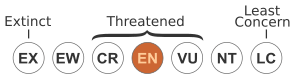
The Island Oak is an endangered species. This means it is at risk of disappearing forever. The International Union for the Conservation of Nature (IUCN) has listed it as endangered.
One of the biggest threats to the Island Oak is overgrazing. This happens when too many animals eat the plants, preventing new ones from growing. This problem is most serious on Guadalupe Island. The trees there are not reproducing, meaning new young trees are not growing.
For at least 150 years, many feral goats (wild goats) have lived on Guadalupe Island. These goats have eaten most of the native plants. They have also caused a lot of soil erosion, which washes away the dirt that plants need to grow. To help the plants recover, people have built fenced areas. These fences keep the goats out and allow the local plants to start growing back.
See also
 In Spanish: Quercus tomentella para niños
