
Radix natalensis facts for kids
Quick facts for kids Radix natalensis |
|
|---|---|
 |
|
| This drawing of the apertural view of a shell of Radix natalensis shows one of the extreme shell forms of this species. | |
| Conservation status | |
Scientific classification  |
|
| Kingdom: | Animalia |
| Phylum: | Mollusca |
| Class: | Gastropoda |
| Subclass: | Heterobranchia |
| Clade: | Euthyneura |
| Superorder: | Hygrophila |
| Family: | Lymnaeidae |
| Genus: | Radix |
| Species: |
R. natalensis
|
| Binomial name | |
| Radix natalensis (Krauss, 1848)
|
|
| Script error: The function "autoWithCaption" does not exist. | |
| Synonyms | |
|
See list |
|

Script error: No such module "Check for conflicting parameters".
Radix natalensis is a type of freshwater snail. It's a small water animal that belongs to a group called gastropods, which are a kind of mollusc. These snails are part of the Lymnaeidae family.
This snail is found in many places across Africa. It's important because it can carry a tiny parasite called Fasciola gigantica, which can affect other animals. Scientists confirmed that this snail belongs to the Radix group in 2010.
Contents
Where Radix natalensis Lives
Radix natalensis is found all over Africa, from the very north to the very south. Here are some of the regions where it lives:
- Northern Africa: You can find it in countries like Algeria, Tunisia, Egypt, and Sudan. There's even evidence that these snails lived in Algeria thousands of years ago! In Egypt, they've been found in water areas around the Nile Delta.
- Western Africa: This includes countries such as Benin, Burkina Faso, Ghana, Mali, Nigeria, and Senegal.
- Eastern Africa: They live in places like Ethiopia, Kenya, Malawi, Mozambique, Tanzania, Uganda, and Zimbabwe.
- Central Africa: You can find them in Angola, Cameroon, Democratic Republic of the Congo, and Gabon.
- Southern Africa: They are present in Botswana, Namibia, South Africa, and Zimbabwe.
- They also live on the island of Madagascar.
The first time this snail was officially described was in "pools in Port Natal", which is now known as Durban, South Africa.
What Radix natalensis Looks Like
The Radix natalensis snail was first described by a German scientist named Christian Ferdinand Friedrich Krauss in 1848.
Its shell has an oval shape and is usually clear or light brown. The opening of the shell, called the aperture, takes up about three-quarters of the shell's total height. The edge of this opening is thin and sharp. The shell's width is usually between 5.75 and 7 millimeters. The height of the shell can range from 4.6 to 19.2 millimeters.
How Radix natalensis Lives
Radix natalensis snails live in water bodies that are always there, like ponds or slow-moving streams. They like clear water that moves slowly, doesn't have too much salt, and has lots of plants.
In one study in Tanzania, scientists found about 34 snails per square meter in their natural home. These snails mostly lived in shallow water, only 0 to 4 centimeters deep, and close to the shoreline. They prefer to live on plant pieces that have fallen to the bottom or on rocks.
Experiments in labs have shown that some larger Radix natalensis snails can stay alive on a wooden surface without water for up to 21 days! Smaller snails can survive being dried out on soil for up to 60 days, especially on "black" soil. Some tiny snails even survived for up to 90 days in soil among sedges (a type of grass) or in "black" soil exposed to the sun, or in soil with stones. This shows how tough they can be!
Parasites and Predators
These snails can be hosts for tiny parasites, meaning the parasites live inside the snails for part of their life cycle. Two important parasites they carry are Fasciola hepatica and Fasciola gigantica.
About 10% to 40% of these snails can be infected with parasites. The highest infection rates happen in the summer. This might be why there are fewer snails during that season.
Other parasites found in Radix natalensis include:
- Trichobilharzia species
- Some cercaria (a type of parasite larva) from Echinostomatidae
- Some xiphidiocercaria (another type of parasite larva) from Plagiorchiidae
- Four different types of trematode larvae found in Zambia
Leeches, like Helobdella nilae and Alboglossiphonia conjugata, are known to eat Radix natalensis snails.
In an experiment in 1982, a different type of snail called Marisa cornuarietis was introduced to a small pond in Tanzania. These new snails completely got rid of Radix natalensis and two other native snail species from the pond.
Scientists have also found that oil from the gum myrrh plant, Commiphora myrrha, can kill Radix natalensis snails. This is called molluscicidal activity.
Images for kids
-
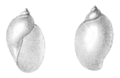
Drawing of apertural and abapertural view of the shell of Radix natalensis from its original description by Christian Ferdinand Friedrich Krauss in 1848.
-
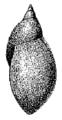
Drawing of lateral view of the shell.


