
Russet antshrike facts for kids
The russet antshrike (scientific name: Thamnistes anabatinus) is a type of passerine bird, which means it's a perching bird. It belongs to the "typical antbirds" family, called Thamnophilidae. You can find this bird in Mexico, most Central American countries, Colombia, Ecuador, Venezuela, and maybe even Peru.
Quick facts for kids Russet antshrike |
|
|---|---|
 |
|
| Conservation status | |
| Scientific classification | |
| Genus: |
Thamnistes
|
| Species: |
anabatinus
|
 |
|
| Range of "western" russet antshrike (see Taxonomy and Distribution sections) | |

Contents
What is the Russet Antshrike?
Discovering the Russet Antshrike
The russet antshrike was first described by two English bird experts, Philip Sclater and Osbert Salvin, in 1860. They also created a new group, or genus, called Thamnistes, just for this bird. Its scientific name, Thamnistes anabatinus, comes from an old Greek word, anabatēs, which means "climber" or "mounter." This name fits because these birds love to climb!
Different Types of Russet Antshrikes
Scientists sometimes have different ideas about how to group animals. For the russet antshrike, some experts recognize six slightly different types, called subspecies. These subspecies are:
- T. a. anabatinus
- T. a. saturatus
- T. a. coronatus
- T. a. intermedius
- T. a. gularis
- T. a. aequatorialis
Other groups of scientists sometimes split these into "western" and "eastern" russet antshrikes, or even consider some as separate species. For this article, we will follow the idea that there are six subspecies.
What Does the Russet Antshrike Look Like?
The russet antshrike is a medium-sized bird, about 13 to 15 cm (5.1 to 5.9 in) long. It weighs around 19 to 24 g (0.67 to 0.85 oz), which is about the weight of a few quarters. It has a strong body and a thick beak with a hooked tip, which helps it find food.
Male and female russet antshrikes look very similar. They both have an olive-yellow stripe above their eye and a dark line through their eye. Their feathers on top are olive-brown, and their tail is a reddish-brown color. Their wings are also a reddish-brown. Their chest and belly are a pale yellowish-olive color.
Male birds have a hidden patch of cinnamon or orange-red feathers between their shoulders. This patch is very hard to see when they are flying or perched. Females do not have this patch. Both male and female birds have reddish-brown eyes, a dark gray or black beak, and blue-gray legs and feet.
Variations Among Subspecies
Some subspecies have slight differences in their appearance:
- T. a. saturatus is a bit darker than the main type.
- T. a. coronatus has a more reddish-brown crown (top of the head) and yellower underparts.
- T. a. intermedius is a little darker than coronatus.
- T. a. gularis has a more yellowish-brown throat.
- T. a. aequatorialis has a very dark olive-brown crown and olive-yellow throat. Its shoulder patch (in males) is orange-red with black spots.
Where Do Russet Antshrikes Live?
Russet antshrikes live in different parts of Central and South America, depending on their subspecies:
- T. a. anabatinus: Found in southern Mexico, northern Guatemala, southern Belize, and northern Honduras.
- T. a. saturatus: Lives in Nicaragua, Costa Rica, and a small part of western Panama.
- T. a. coronatus: Found from central Panama into northwestern Colombia.
- T. a. intermedius: Lives on the western side of the Andes mountains in Colombia and Ecuador.
- T. a. gularis: Found in Venezuela and possibly nearby Colombia.
- T. a. aequatorialis: Lives on the eastern side of the Andes in Colombia and Ecuador, possibly reaching northern Peru.
Their Forest Home
These birds mostly live in evergreen forests, both in lowlands and on mountains. They also live in nearby secondary forests, which are forests that have grown back after being cut down. In some northern Central American areas, they can also be found in forests where trees lose their leaves part of the year.
Russet antshrikes usually stay in the middle and upper parts of the forest, called the subcanopy and canopy. They can be found from sea level up to about 1,500 m (4,900 ft) high in the mountains, depending on the region.
How Do Russet Antshrikes Behave?
Staying in One Place
The russet antshrike does not migrate. It stays in the same area all year long.
What Do They Eat?
Russet antshrikes mainly eat arthropods, which are creatures like insects and spiders. They have also been seen eating fruit. They usually look for food alone or in pairs. They almost always join a mixed-species feeding flock, which is a group of different bird species that feed together. This can help them find more food and stay safe.
They mostly search for food in the middle and upper parts of the forest. They fly from tree to tree and then hop quickly along tree trunks, branches, and vines. They pick prey from leaves, stems, vines, and moss. Sometimes, they even follow army ant swarms, going closer to the ground to catch insects that are trying to escape the ants.
Reproduction and Nests
Scientists are still learning about when and how russet antshrikes breed. It seems to happen at different times of the year depending on where they live, usually between March and July.
Only one nest has been described in detail, found in Costa Rica. It was a deep, pouch-shaped nest made of dead leaves, held together by roots and fungi. It hung from a fork in thin branches and was partly hidden by living leaves, about 15 m (50 ft) above the ground. Both the male and female birds helped build the nest, sat on the eggs to keep them warm, and fed the baby birds. The eggs hatched after about 15 to 18 days. Another nest in Costa Rica was found to have two eggs.
Their Calls and Songs
The russet antshrike is not a very loud bird. All subspecies have a "slow song" that sounds like a short series of notes that drop in pitch, often described as "tsip-i-tssip" or "tseep-it-seet." One subspecies, T. a. aequatorialis, also has a "rapid song" that is loud and piercing, like "teeeu, tseu!-tseu!-tseu!-tseu!"
Their calls are usually one, two, or three notes. People have described them as a high, thin "tssip-i-tssip" or "tseep-it-seet," a sweet "tsweetsip," or a very thin "wee-tsip."
How Are Russet Antshrikes Doing?
The IUCN (International Union for Conservation of Nature) assesses the "western" and "eastern" russet antshrikes separately. Both are listed as "Least Concern," which means they are not currently in danger of disappearing. They live in large areas.
While their exact numbers are not known, their populations are thought to be decreasing. However, no immediate major threats have been identified for them. Overall, the russet antshrike is considered uncommon to fairly common. It is rarer in Mexico and "uncommon and local" in northern Central America. In Costa Rica, it can be rare or fairly common depending on the area. In Colombia, it's "fairly common but hard to see," and in most of Ecuador, it's common.
One subspecies, T. a. gularis, is very rare and has only been seen a few times since 1956. However, the other five subspecies live in at least one protected area, which helps keep them safe.
Images for kids
-
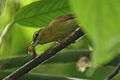
A russet antshrike perched on a branch.
-
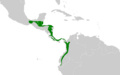
Map showing the range of the "western" russet antshrike.
